On this page
The giant stone figures of Rapa Nui (Easter Island) travelled up to 18 kilometres from the quarry where most were carved, with no wheels, cranes or large animals, as National Geographic puts it. A strong case now suggests the moai walked, and the physics behind it is school-level centre of mass.
How were the Easter Island statues moved?
The best-supported explanation is that teams rocked each upright statue from side to side with ropes, so it shuffled forward one edge at a time. Archaeologists Carl Lipo and Terry Hunt made the case in the Journal of Archaeological Science in 2013 and returned to it with 3D modelling and a reply to critics in a 2025 paper in the same journal.
The 2025 study analysed 962 moai, focusing on 62 statues found along the ancient roads, according to the paper’s abstract. In its walking experiment, 18 people moved a 4.35-tonne replica 100 metres in 40 minutes, says the Binghamton University release; Live Science notes this walk was first filmed for television in 2012. “Once you get it moving, it isn’t hard at all – people are pulling with one arm,” Lipo said in the release. The roads fit too: about 4.5 metres wide with a concave cross-section, per the abstract.
Why does a leaning statue walk?
The centre of mass is the point where a body’s whole weight can be treated as acting, and an object stays up only while the vertical line through that point falls inside its base. It is the same reason dahi handi pyramids need a wide base.
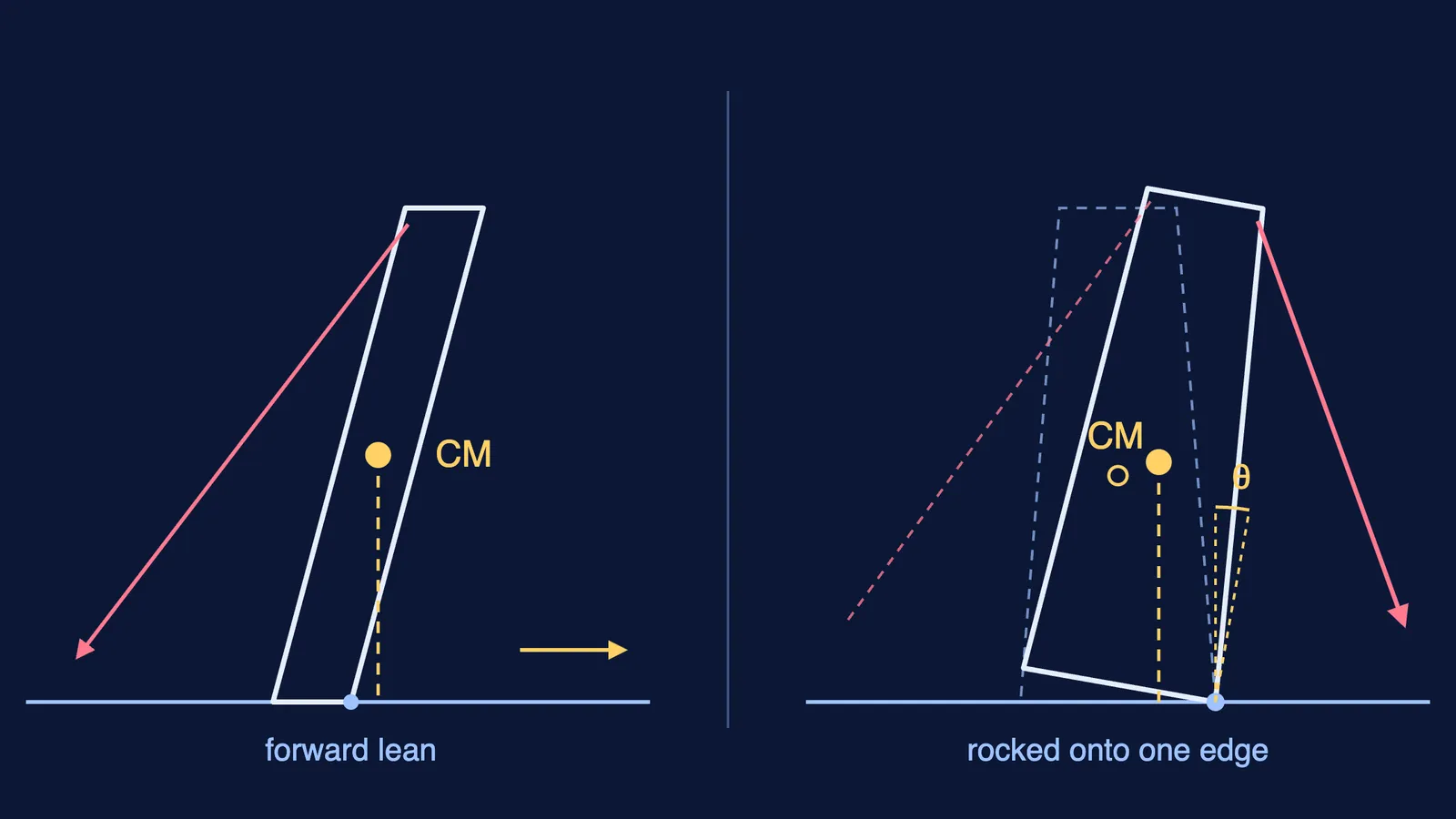
Road moai lean forward by about 6 to 15 degrees, enough that they would topple if they stood alone, Live Science reported from the 2025 paper. Their D-shaped bases act as a pivot point for each step, and tugging on three ropes makes the statue rock and step forward. In centre-of-mass terms:
Alone, the lean would tip the statue forward, so the crew must hold it back.
A pull from one side tips the statue onto one edge of its base. The lifted side swings forward around that pivot.
A pull from the other side rocks it onto its opposite edge, and that side swings forward, in a zig-zag.
The team’s modelling found that 15 to 60 people were needed to start a statue moving and 5 to 25 to keep it going, with steps averaging 89 centimetres (Live Science). Once rocking, the statue swings like a pendulum, so later steps take less effort than the first.
Couldn’t they have used logs and sledges?
People tried. In 1986 engineer Pavel Pavel, working with Thor Heyerdahl and 17 helpers, twisted an upright nine-ton moai forward but damaged its base and had to stop, National Geographic records. A year later archaeologist Charles Love and a team of 25 moved a nine-ton model on a wooden sledge over log rollers, 45 metres in two minutes. Sledges can work. Lipo and Hunt argue that walking fits the shape of the road statues and their roads.
Not everyone agrees, and Live Science calls the debate far from over. Lipo and Hunt write that their critics “have yet to offer plausible alternatives that account for the full range of evidence.” Many Rapa Nui people put it more simply. “The statues walked,” tour guide Suri Tuki told National Geographic in 2012.
How far can you tip a statue before it falls?
Take a made-up statue seen from the front. Its base is 1.6 m wide, so each edge is 0.8 m from the middle, and its centre of mass is 1.8 m above the ground. Give it the replica’s mass of 4,350 kg (paper’s abstract) and take g = 9.8 m/s².
Tipping limit: it falls once the centre of mass passes over the pivot edge, at the angle where tan θ = 0.8 / 1.8. So θ is about 24°.
A 10° rock: the centre of mass is √(0.8² + 1.8²) ≈ 1.97 m from the pivot, 24° off vertical. After a 10° tip it sits 1.97 × cos 14° ≈ 1.91 m up, a rise of about 0.11 m.
Energy per rock: mgh = 4,350 × 9.8 × 0.11 ≈ 4.7 kJ. Much of it returns on the swing back.
Distance: at the 89 cm average step reported by Live Science, 100 m takes about 112 steps.
Try it on a desk: tie two strings near the top of a tall, narrow box and pull left, right, left. It falls the moment the plumb line through its centre of mass leaves the base. Our post on finding the centre of gravity with a plumb line shows how to locate that point.
If the tipping angle is hard to picture, the Fermi Simulation Lab has interactive simulations for ideas that are easier to see than to read, and the Fermi Concept Library gives centre of mass its own lesson and its place in the map of physics.
Next time you see a moai, look at its lean and its base: the walk is carved into the stone.