On this page
Debabrata Basu was born in Dacca on 5 July 1924, joined the Indian Statistical Institute in Kolkata in 1950 as a research scholar under C.R. Rao, and taught at Florida State University from 1975 to 1990, according to his Wikipedia biography. He died in Kolkata on 24 March 2001. He is remembered for a short theorem about independence and for small stories that embarrass big methods.
What does Basu's theorem say?
Basu's theorem states that any boundedly complete sufficient statistic is independent of any ancillary statistic (Basu's theorem, Wikipedia). The paper, "On statistics independent of a complete sufficient statistic", appeared in Sankhyā in 1955, volume 15, pages 377 to 380, and is reprinted in the Selected Works of Debabrata Basu.
Three words carry the result:
Sufficient: a statistic T that keeps all the information the sample holds about the unknown parameter θ.
Complete: the only function of T whose average is zero for every θ is zero itself (boundedly complete is a slightly weaker version).
Ancillary: a statistic V whose distribution does not depend on θ at all.
The intuition: T soaks up everything the data says about θ, V says nothing about θ, and completeness stops them sharing anything else.
Why are the sample mean and variance of normal data independent?
This is the classic use, set out on the Basu's theorem page. Take a sample from a normal distribution with unknown mean μ, holding σ fixed. The sample mean x̄ is complete and sufficient for μ. The sample variance s² is ancillary for μ, because adding the same amount to every observation shifts the data without changing its spread. Basu's theorem then says x̄ and s² are independent, and since this holds for every σ, it holds in general.
How do you use Basu's theorem in a worked example?
Suppose X1, X2, ..., Xn come from an exponential distribution with mean θ. What is the average of X1 divided by the total S = X1 + ... + Xn?
S is complete and sufficient for θ (a standard exponential-family fact).
R = X1/S does not change if you rescale every observation, and θ only sets the scale, so R's distribution does not depend on θ. R is ancillary.
By Basu's theorem, R and S are independent, so the average of X1 = R × S is the average of R times the average of S.
That reads θ = (average of R) × nθ, so R averages 1/n.
Check by symmetry: each Xi/S has the same average and together they add to 1, so each averages 1/n. The Basu route still works for messier ratios where symmetry gives you nothing.
If expectation and independence still feel shaky, the Fermi Concept Library has a lesson for every concept in mathematics. If you get stuck halfway through a problem like this one, the Fermi Problem Library has a step-by-step solver that explains the reasoning rather than printing an answer.
What is Basu's circus elephant example?
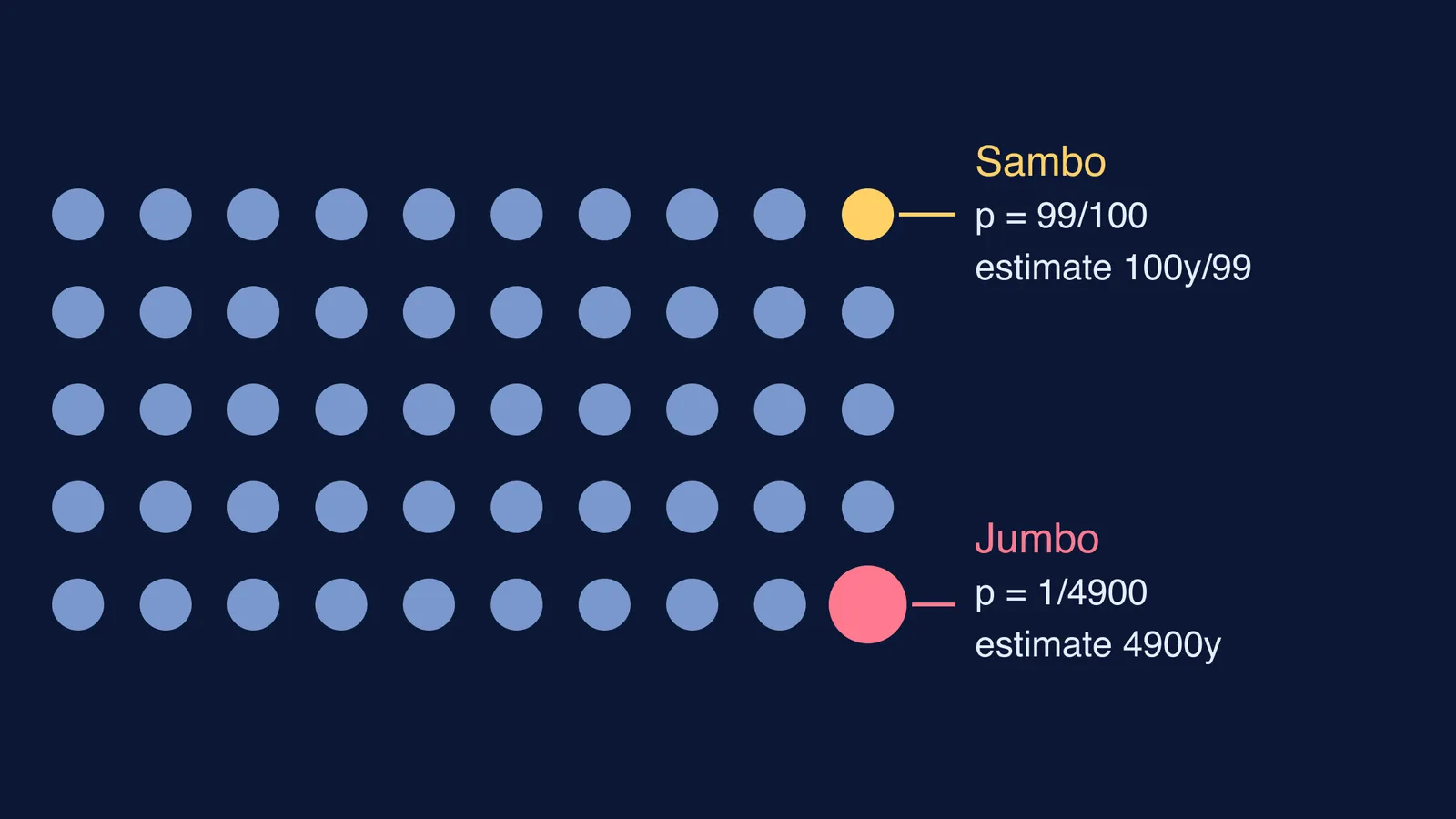
In a 1971 essay on the logical foundations of survey sampling, Basu told this story (the example as Basu wrote it). A circus owner needs a rough total weight for his 50 elephants and wants to weigh just one. Records from 3 years earlier show that Sambo, a middle-sized elephant, was the average elephant in the herd, so the owner plans to weigh Sambo and multiply by 50.
The statistician objects that this plan is not unbiased. They compromise: Sambo gets a selection probability of 99/100 and the other 49 elephants share the rest, 1/4900 each. Sambo is picked. The Horvitz-Thompson estimator divides the observed weight by its selection probability, so the herd estimate is 100y/99, barely one elephant. Had the big elephant Jumbo been picked, the estimate would have been 4900y. Basu ends: "That is how the statistician lost his circus job (and perhaps became a teacher of statistics!)."
The estimator is unbiased: averaged over every possible draw, it hits the true total. Yet on any single draw here it is far off. A guarantee averaged over samples you did not draw does not rescue the answer from the sample you did draw. Basu's examples displayed difficulties in both frequentist and likelihood-based statistics, and mattered especially for survey sampling, as his biography notes.
What can a student learn from Basu?
Read the conditions. Basu's theorem needs completeness; check every condition before you quote a result.
Split hard averages. Find the independent pieces, then multiply their averages.
Run an elephant test. Imagine the most lopsided sample a method could see. If it gives an absurd answer there, find out why before trusting it.
Basu worked at the institute behind India's National Sample Survey, built by P.C. Mahalanobis. For the frequentist school his examples challenged, read Jerzy Neyman and the history of confidence intervals. Basu himself turned Bayesian; see Thomas Bayes's 1763 essay on the doctrine of chances. In 2024, Sankhyā ran an editorial remembering Basu's legacy in statistics.