

On this page
In 1950, a newly independent India faced a massive problem: it needed to plan its economy but lacked reliable data. Conducting a complete census every year was too slow and expensive for a developing nation. The solution came from Prasanta Chandra Mahalanobis, a physicist turned statistician, who argued that a carefully designed sample could accurately reveal the condition of the whole country.
Why did India need the National Sample Survey?
To draft its ambitious Five-Year Plans, the Indian government desperately needed numbers on crop yields, household consumption, and small-scale industries. In October 1950, Mahalanobis founded the National Sample Survey (NSS) (MoSPI).
He had already established the Indian Statistical Institute (ISI) in 1931, growing it from a small statistical laboratory in the Physics Department of Presidency College in Kolkata. The ISI became the technical hub for designing these massive surveys. Before this, data collection in India was often localized, fragmented, or purely anecdotal. Mahalanobis institutionalized a rigorous, mathematical approach to gathering national data.
The NSS was tasked with gathering the empirical evidence that would shape national policy. His vision was to replace guesswork with concrete numbers. By establishing a permanent mechanism for data collection, he provided the young nation with the tools required to understand its own vast and diverse population.
How do sample surveys work?
Instead of counting every single person—which is prone to delays and logistical nightmares—a sample survey picks a representative group. In its first round, running from October 1950 to March 1951, the NSS covered just 1,833 villages out of India's roughly 560,000 (MoSPI). By randomly selecting these villages and ensuring they represented the geographic and economic diversity of the nation, the survey could accurately estimate the conditions of the entire rural population.
The first round of the survey was a monumental logistical achievement. It required training hundreds of field investigators to travel across a country with limited transport and communication infrastructure. They gathered detailed schedules on land utilization, crop yields, and household budgets. Despite these hurdles, the survey was completed efficiently, proving that large-scale sampling could work even in a vast, developing nation.
This approach proved a vital statistical principle: a "good sample" (scientifically designed) is more valuable than "big data" (unstructured or biased census data). It was a mathematically elegant way to balance the precision of data against the enormous cost and effort of collection.
Mahalanobis believed that statistics must serve a social purpose. He used the NSS data to build models for economic growth.
What made Mahalanobis's surveys accurate?
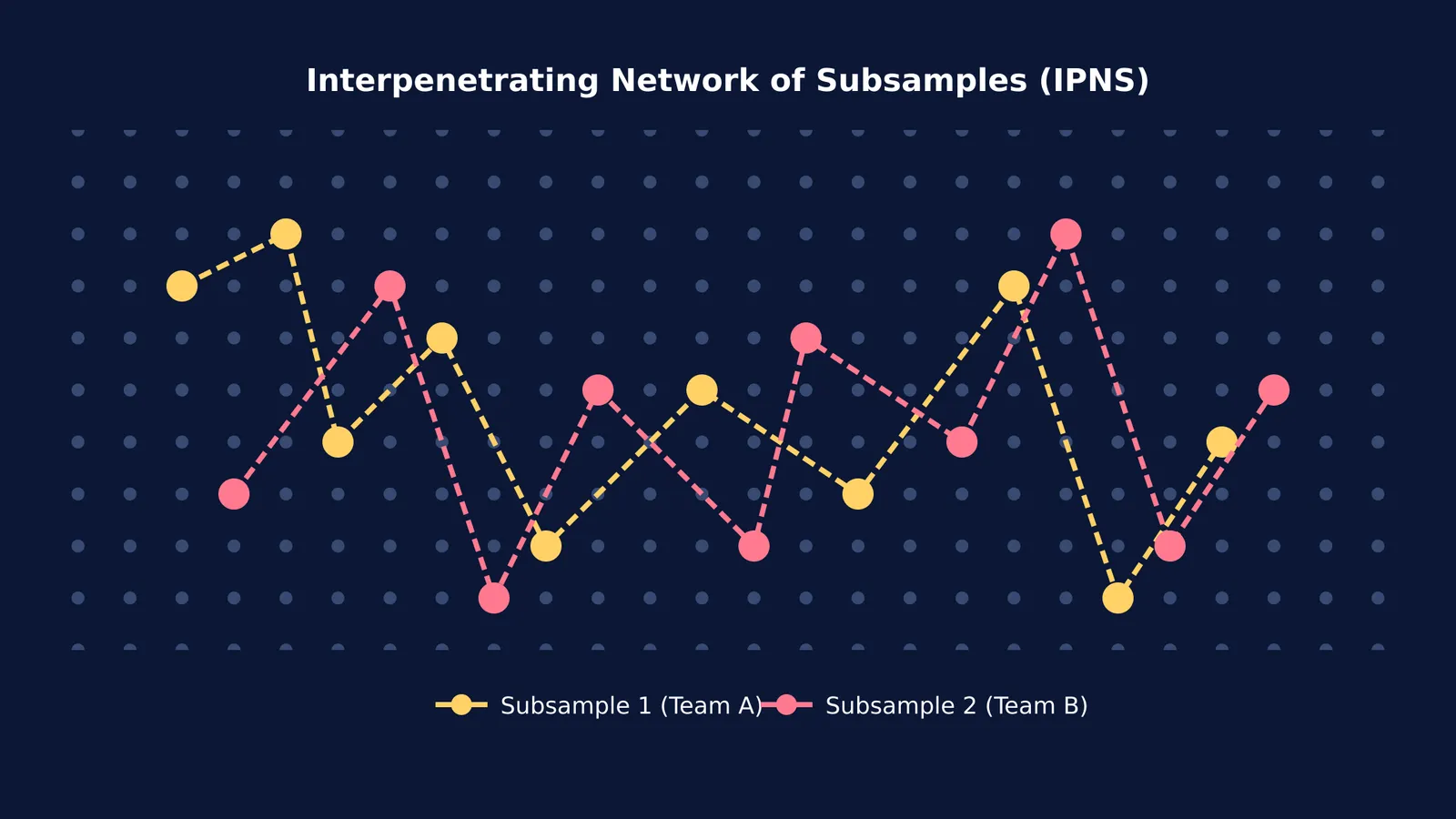
When you rely on a small sample, human errors and investigator bias can skew the results. To solve this, Mahalanobis introduced a brilliant technique in 1936 called the Interpenetrating Network of Subsamples (IPNS).
Instead of one large team conducting the entire survey, two or more independent teams surveyed different, independent subsamples drawn from the same population using the same sampling design. By cross-examining their results, statisticians could easily detect and control non-sampling errors. If one investigator's data deviated sharply from the rest, the error could be isolated and corrected without discarding the entire survey.
This built-in quality control allowed Mahalanobis to challenge the "principle of authority" in government data, insisting that data should be cross-examined scientifically rather than accepted on faith. IPNS is now considered a conceptual forerunner to modern computer-intensive resampling methods like the bootstrap and jackknife, cementing his reputation as a pioneer of survey methodology.
Understanding probability and sampling can be tricky. Fermi's AI tutor works out what you know and builds a plan for the session, holding a line of reasoning to help you understand how small samples represent large populations.
What is the legacy of the NSS?
Today, the system Mahalanobis designed has evolved into the National Sample Survey Organisation (NSSO), now merged into the National Statistical Office. It remains one of the largest continuous survey operations in the world, regularly publishing reports on employment, consumer expenditure, and health.
His methods were so effective that the United Nations and other global bodies advocated for their use in developing nations worldwide. Mahalanobis showed that mathematics could be a profoundly practical tool for human welfare, building a lasting culture of evidence-based policy in India.
For more on how mathematics describes the real world, read about D'Arcy Thompson and the mathematics of growth and form, or learn how adding to or scaling data changes the mean and variance.


