On this page
Darleane Hoffman spent her career on elements that are hard to make and quick to vanish. She was born on 8 November 1926 in Terril, Iowa, and earned a PhD in physical (nuclear) chemistry from Iowa State in 1951, according to the American Nuclear Society's obituary. She worked at Los Alamos from 1953 to 1984 and became the first woman to lead its Chemistry and Nuclear Chemistry Division. She then moved to UC Berkeley and Lawrence Berkeley Laboratory, says UC Berkeley Chemistry, and she died in 2025 at the age of 98.
What did Darleane Hoffman find in nature?
Until 1971, UC Berkeley Chemistry notes, it was widely believed that elements beyond uranium (atomic number 92) did not occur in nature. That year Hoffman, F. O. Lawrence, J. L. Mewherter and F. M. Rourke published "Detection of Plutonium-244 in Nature" in Nature (volume 234, pages 132-134). Los Alamos's own plutonium timeline records that she found naturally occurring plutonium-244 in a mineral deposit from the Precambrian era, showing that plutonium can be found in nature.
Why plutonium-244? It is plutonium's longest-lived isotope, with a half-life of about 81 million years, according to a 2016 review in Scientific Reports. If any was in the dust that formed the Solar System, a tiny amount could still be around today.
Was the plutonium-244 result confirmed?
Not so far. In 2012, a team led by Johannes Lachner used accelerator mass spectrometry, a highly sensitive method, on a sample of bastnäsite, the rare-earth mineral Hoffman's team had studied. They observed no plutonium-244 events. They set an upper limit of 370 atoms per gram for their sample, significantly lower than the value reported in 1971, according to the abstract on the HZDR repository. The same 2016 review says any primordial plutonium-244 in Earth's crust has decayed to undetectable levels.
That does not make the 1971 paper careless. It shows science working: a bold measurement is published, people with better instruments test it, and the claim is narrowed or overturned.
How did Hoffman help confirm seaborgium, element 106?
Element 106 was first reported in 1974 by Albert Ghiorso and co-workers (Physical Review Letters, 1974). The rules of the time said a name should wait for independent confirmation. Making such heavy atoms is so hard that this took almost 20 years, Lawrence Berkeley Laboratory explains in its 1993 announcement.
In 1993, in an experiment designed by Ken Gregorich at the laboratory's 88-Inch Cyclotron, with Hoffman as faculty senior scientist, the team fired oxygen-18 ions at a californium-249 target. Each atom they made had 106 protons and 157 neutrons, so mass number 263, and a half-life of 0.9 seconds. The team looked for an alpha decay from element 106 followed by a second alpha decay from its daughter, rutherfordium-259. They recorded nine such correlated pairs in about 80 hours of running, says the same LBL announcement. The result was published as "First confirmation of the discovery of element 106" in 1994.
The element was then named seaborgium after Glenn Seaborg, the first element named for a living person, as Berkeley Lab's Research Review noted. Hoffman went on to receive the National Medal of Science in 1997, according to the Science History Institute.
For the race that came later, up to element 118, read how Yuri Oganessian synthesised element 118.
How much plutonium-244 could survive since Earth formed?
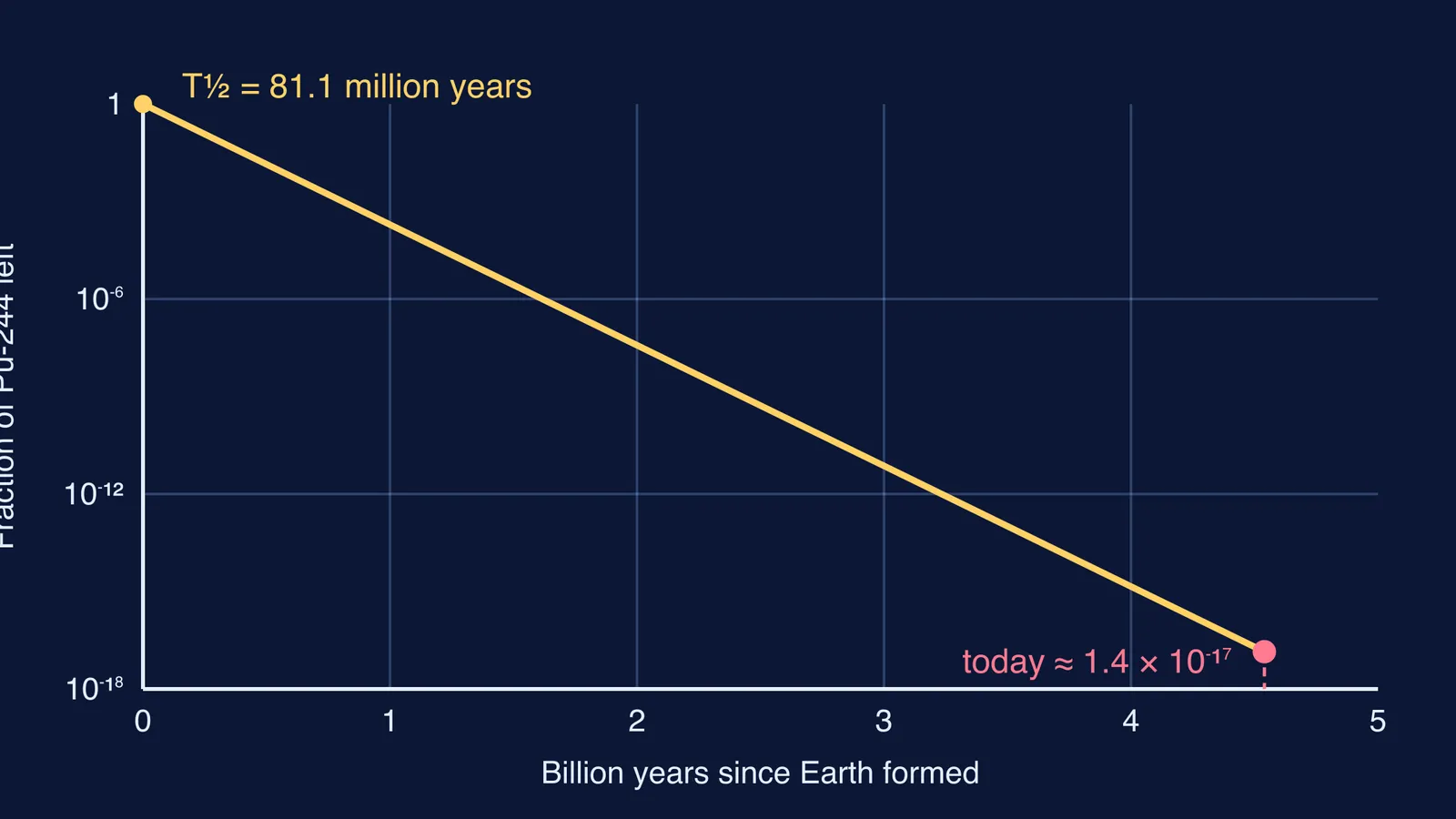
This four-line half-life problem shows why any trace would be tiny.
Age of Earth: 4.54 billion years, from the US Geological Survey.
Half-life of plutonium-244: 81.1 million years, from the Lachner et al. abstract.
Number of half-lives: n = 4540 ÷ 81.1 ≈ 56.
Fraction left: (1/2)^56 ≈ 1.4 × 10^-17.
So out of every 100 million billion atoms present at the start, about one would be left. That is why the hunt needs instruments able to count single atoms.
Two checks that catch common mistakes:
Convert both times to the same unit before you divide (4540 million years, not 4.54).
Half-life is not mean life (τ = T½ ÷ ln 2), as our post on mean life vs half-life explains.
If the difference between plutonium-239 and plutonium-244 feels blurry, revise isotopes, isobars and isotones first. And if you slip on problems like this one, the Fermi Problem Library has worked problems with a step-by-step solver that explains the reasoning rather than printing an answer.
What can a student take from Hoffman's work?
Use her two results as a checklist whenever you read "scientists discover":
What was actually measured, and with what instrument?
How many events or atoms were seen? (Nine pairs is small, but each one was a specific, predicted signature.)
Has an independent team repeated it, ideally with a different method?
If a repeat found nothing, how low was its limit compared with the first claim?