

On this page
The periodic table's seventh row was finally completed with the synthesis of element 118. Creating atoms this heavy requires forcing two lighter nuclei together at tremendous speeds, a process that relies on precise physics and highly specialised equipment.
Who is Yuri Oganessian?
Yuri Oganessian is a Russian-Armenian nuclear physicist who spent his career at the Joint Institute for Nuclear Research (JINR) in Dubna, Russia. He led the laboratory teams that synthesised many of the superheavy elements at the end of the periodic table, transforming our understanding of atomic nuclei.
Oganessian pioneered the "hot fusion" technique for creating these elements. Instead of using traditional targets, his method involves firing a beam of calcium-48—a rare, neutron-rich isotope—at heavy actinide targets to force the nuclei to combine into a single, massive atom.
How was oganesson (element 118) synthesised?
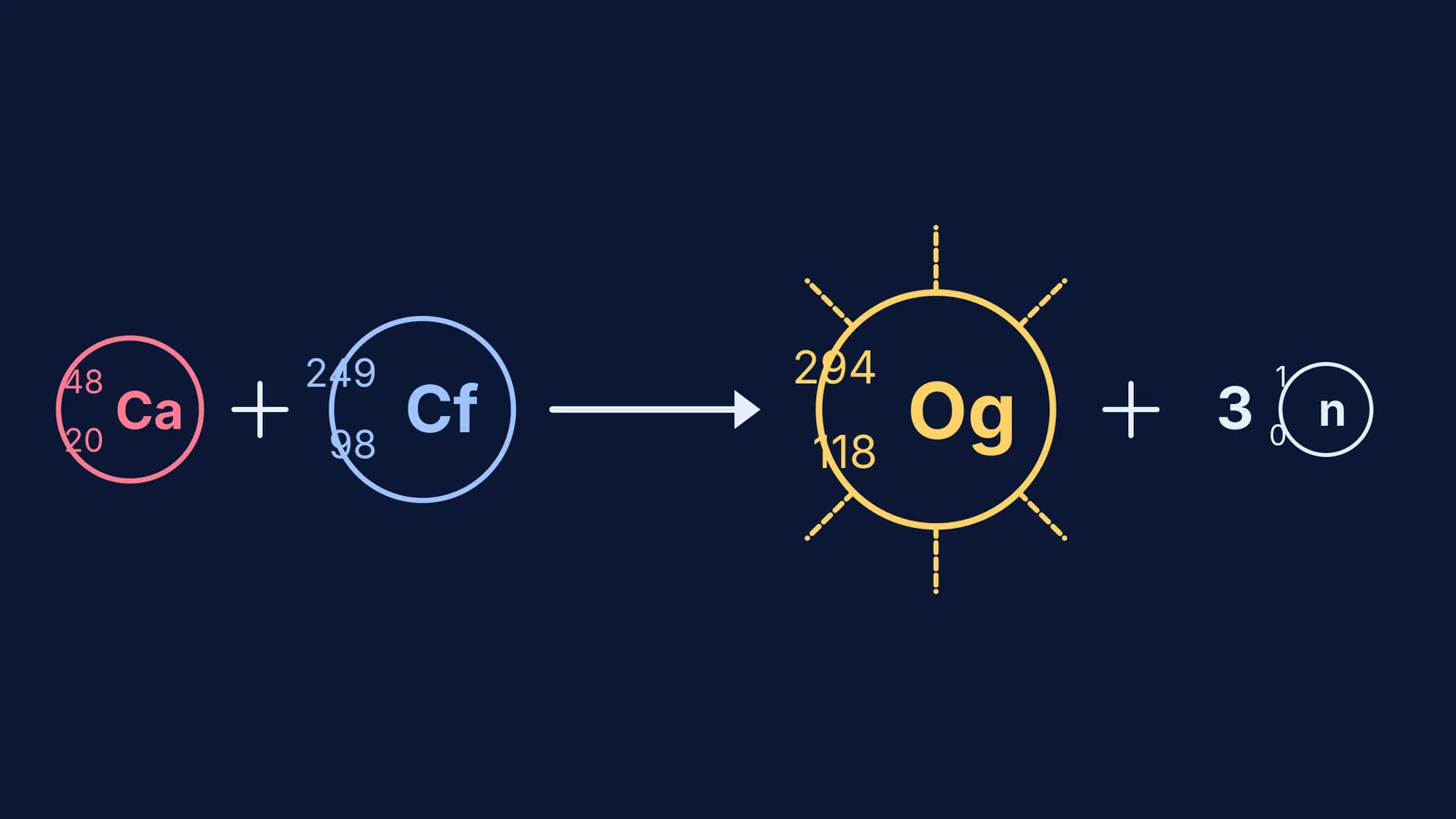
Working with the Lawrence Livermore National Laboratory (LLNL) in the United States, the JINR team conducted these experiments with immense patience and precision. Because the chance of two nuclei fusing is astronomically low, the team had to fire 1.6 × 10¹⁹ calcium ions at the target just to detect three atoms of the new element. They confirmed their results in a 2006 paper in Physical Review C after successfully bombarding a target of californium-249 with calcium-48 ions.
When balancing the mass numbers and atomic numbers in nuclear reactions, it is easy to get stuck. If this happens, Fermi's AI tutor can work out what you already know and build a plan for the session, teaching you the rules of nuclear physics step by step.
The fusion reaction that creates element 118 balances like this:
Target: Californium-249 (atomic number 98, mass 249)
Projectile: Calcium-48 (atomic number 20, mass 48)
Total atomic number: 98 + 20 = 118 (oganesson)
Total mass before reaction: 249 + 48 = 297
Neutron emission: The compound nucleus immediately ejects 3 neutrons (mass 1 each) to become slightly more stable.
Final mass: 297 − 3 = 294.
The result is oganesson-294 (²⁹⁴Og). The new nucleus is highly unstable, with a half-life of 0.89 milliseconds. It decays almost instantly by emitting an alpha particle, a process that involves the recoil of the daughter nucleus in alpha decay to conserve momentum.
Picturing how these superheavy, short-lived nuclei form and split apart can be difficult from textbook descriptions alone. The Fermi Simulation Lab has interactive simulations for the ideas that are easier to see than to read, helping you visualise nuclear decay in real time.
What is the Island of Stability?
Yuri Oganessian's work is driven by a concept in nuclear physics known as the "Island of Stability". As elements get heavier, the repulsive force between their positively charged protons increases, making the nuclei highly unstable. This is why superheavy elements like oganesson decay almost instantly.
However, nuclear shell models predict that certain "magic numbers" of protons and neutrons create exceptionally stable arrangements. If physicists can pack exactly the right number of neutrons into a superheavy nucleus, they might reach this theoretical island. In this region, elements could have half-lives lasting minutes, days, or even years, allowing chemists to study their properties in standard laboratories. Such stability would let scientists explore new chemistry and potentially find practical applications for these extraordinary elements. The synthesis of element 118 provided crucial experimental data that helps researchers map the boundaries of this island, pushing the limits of what we know about atomic structure.
Is oganesson a noble gas?
In 2016, the International Union of Pure and Applied Chemistry (IUPAC) formally named element 118 oganesson to recognise Oganessian's contributions to transactinoid research.
The name ends in "-on" rather than "-ium" to follow the IUPAC naming rules for Group 18. Elements in this column—neon, argon, krypton, xenon and radon—are the noble gases, known for being chemically inert. Normally, we predict an atom's chemical behaviour from the electron configuration of ions and neutral atoms in its column. However, theoretical physics suggests oganesson's inner electrons move so quickly that relativistic effects alter its structure dramatically. Instead of being a non-reactive gas, models predict oganesson might act more like a solid metallic semiconductor at room temperature, a profound departure from the rest of its group.


