On this page
C. S. Seshadri worked in one of the most abstract corners of mathematics, then built a place in Chennai where students learn mathematics next to people doing research in it.
Who was C. S. Seshadri?
According to the MacTutor biography of C. S. Seshadri, he was born on 29 February 1932 in Kanchipuram and died in Chennai on 17 July 2020. He graduated from Loyola College, Madras, in 1953 and went to the Tata Institute of Fundamental Research (TIFR) in Mumbai, where K. Chandrasekharan was his thesis advisor. He finished his thesis in 1957 and received his PhD from Bombay University in 1958. From 1957 to 1960 he worked in Paris, where Claude Chevalley was his greatest influence.
He became a TIFR professor in 1965 and moved to the Institute of Mathematical Sciences, Chennai, in 1984. His honours include the Shanti Swarup Bhatnagar Prize (1972), Fellowship of the Royal Society (1988) and the Padma Bhushan (2009).
What did Seshadri prove in algebraic geometry?
Algebraic geometry studies shapes described by polynomial equations. Seshadri's best-known result is the Narasimhan–Seshadri theorem, proved with M. S. Narasimhan and published as Stable and Unitary Vector Bundles on a Compact Riemann Surface in the Annals of Mathematics in November 1965. The Crossref record for the paper lists 538 later works that cite it.
The paper itself, as quoted by MacTutor, says that for a compact Riemann surface X of genus at least 2, "the stable vector bundles are precisely the holomorphic vector bundles on X which arise from certain irreducible unitary representations." Put simply, two very different descriptions, one from geometry and one from the algebra of symmetries, turn out to pick out exactly the same objects.
CMI's tribute to Seshadri also credits him with the modern theory of standard monomials, developed with his students C. Musili and V. Lakshmibai, and with work on geometric invariant theory, moduli and parabolic bundles. The Seshadri constant, introduced by Jean-Pierre Demailly, takes its name from Seshadri's criterion for when a line bundle is ample.
Why did Seshadri found the Chennai Mathematical Institute?
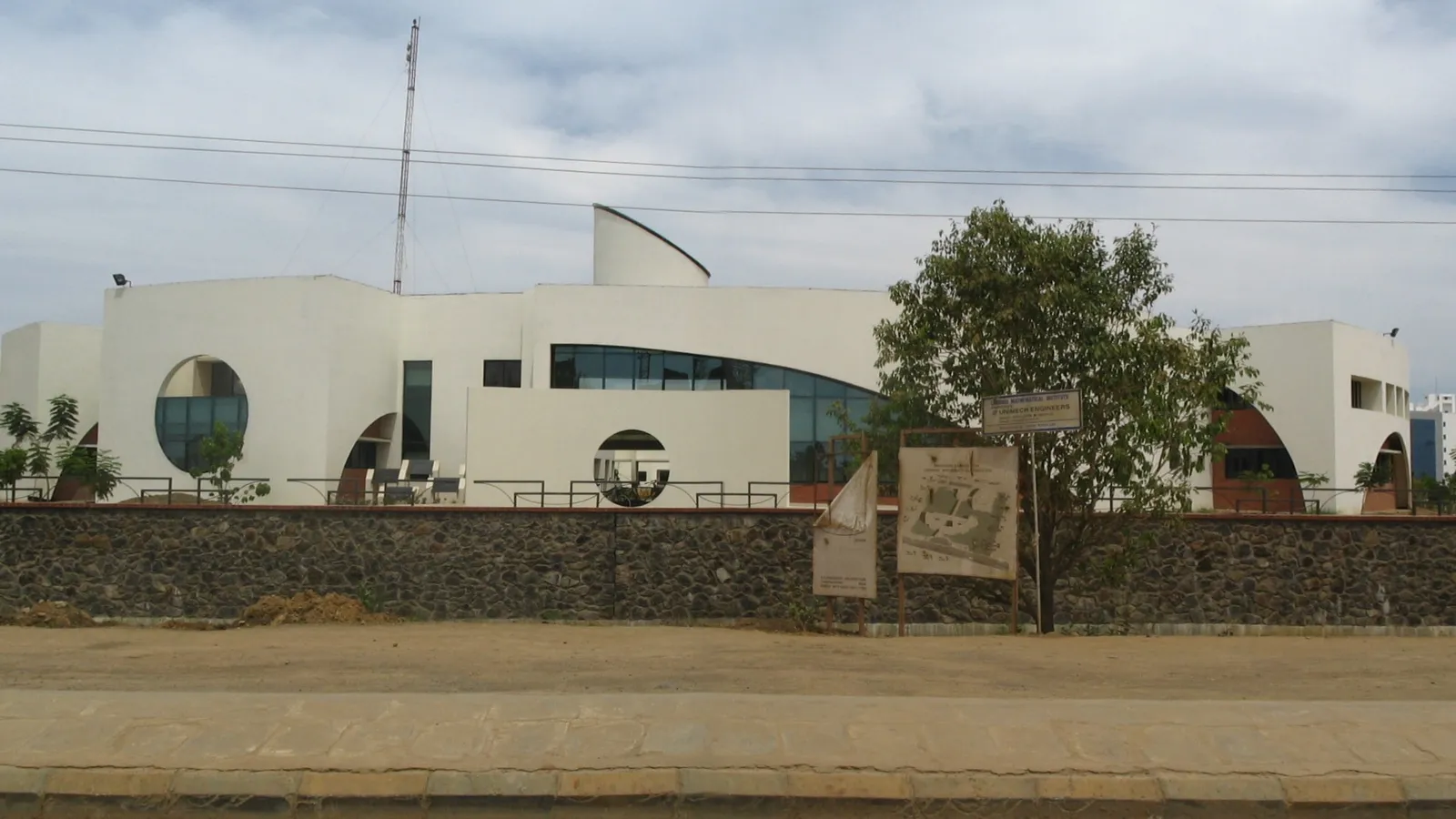
The Chennai Mathematical Institute says it "was founded in 1989 as a part of the SPIC Science Foundation, funded by the SPIC group in Chennai," and has been autonomous since 1996. MacTutor records that it was renamed the Chennai Mathematical Institute in January 1999 and that Seshadri was its founder-director until 2011, then director-emeritus.
CMI's tribute page says the institute grew out of "Seshadri's vision that higher learning can only occur in an atmosphere of active research amidst the presence of masters in the subject."
Today CMI runs BSc programmes in Mathematics and Computer Science and in Mathematics and Physics, MSc programmes in Mathematics, Computer Science and Data Science, and a PhD programme, according to its about page.
How can you read a theorem like Narasimhan–Seshadri at 16?
You will not follow the proof yet, but you can practise the habit mathematicians use on any unfamiliar statement. Here it is, worked on the 1965 paper's title.
List every technical word: stable, unitary, vector bundle, compact, Riemann surface.
Mark which ones have a cousin you know. Vectors come from school physics and maths; the closed interval from 0 to 1 gives the flavour of compact.
Find the smallest picture for each new word. A Riemann surface looks like a patch of the complex plane when you zoom in; a sphere is one. A vector bundle attaches a vector space to every point, like a tangent plane resting on each point of a ball.
Rewrite the claim as these equal those: two lists of objects are the same list.
Ask what that buys you: when two descriptions match, you can attack a question in whichever language is easier.
If step 3 stalls because an older idea is shaky, such as complex numbers or vectors, the Fermi Concept Library has every concept in mathematics with its own lesson and its place in the map, so you can patch that gap before returning to the hard idea.
Is a research-style maths degree right for you?
CMI's admissions page says there is one common entrance examination for all its BS (Hons.) programmes and that you choose your course after admission, with a separate route for strong olympiad performers. Rules change, so check the current page.
Before you decide, run this quick check:
You enjoy problems that take days, not minutes.
You want to know why a formula is true, not only how to use it.
You have tried a few olympiad-style problems untimed and liked the struggle.
You have read about other paths too, such as these careers for students who are good at maths.
When an olympiad problem stumps you, the Fermi Problem Library has worked problems with a step-by-step solver that explains the reasoning rather than printing an answer.
Next, read about Ramanujan and his 1914 pi series or Mahalanobis and the Indian Statistical Institute.