

On this page
When students show an aptitude for mathematics in school, the default advice is often to pursue engineering. While engineering remains an excellent and challenging path, modern economies increasingly reward quantitative skills across a much broader range of industries.
Understanding what else is out there helps students map their strengths to the right university courses and, eventually, to highly paid careers that match their working style.
Why is there a wage premium for quantitative skills?
Being good at maths signals to employers that you can process abstract information, solve logical puzzles, and make data-driven decisions. This analytical foundation commands a significant wage premium in the job market. Data from the OECD's Programme for the International Assessment of Adult Competencies reveals that a one standard deviation increase in numeracy skills is associated with an average 20% wage premium across 32 OECD countries.
This premium exists because the global shift toward big data requires professionals who can interpret numbers accurately. Even if a role does not require calculus, a strong quantitative background serves as a foundation for learning new technical tools on the job. When deciding between paths, it helps to start by exploring options like talking about STEM careers beyond engineering and medicine.
What careers can you do if you are good at maths?
Comparing the main maths-heavy careers reveals that each one applies numbers in distinctly different ways:
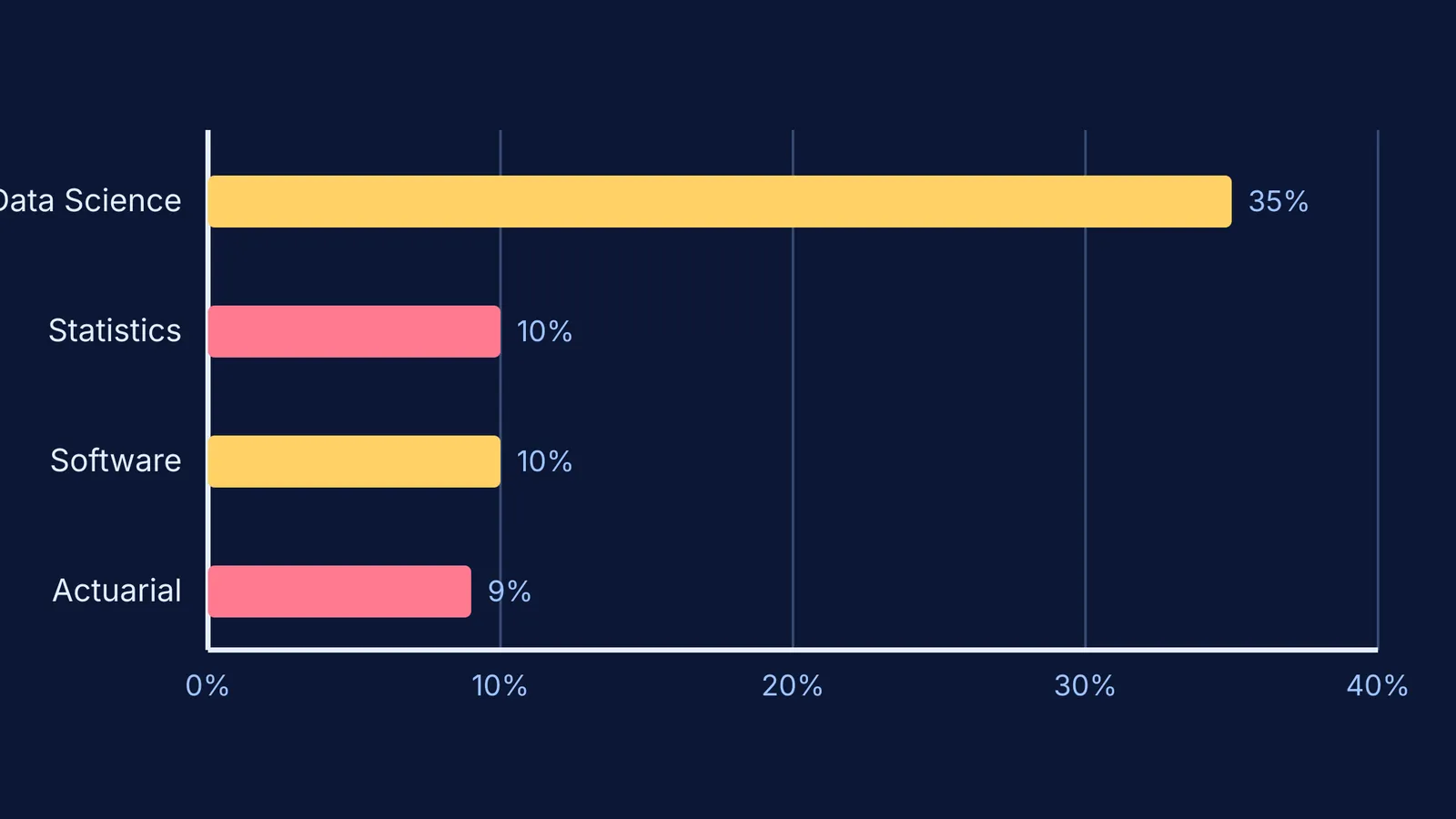
1. Data Science and Computing. Data scientists use algorithms and statistical models to extract insights from vast amounts of raw data. This role blends mathematics, particularly linear algebra and probability, with programming. The U.S. Bureau of Labor Statistics projects a 35% growth for data scientists over the decade through 2035, classing it as growing much faster than average.
2. Actuarial Science. Actuaries use mathematics, statistics, and financial theory to measure and manage risk, primarily for insurance companies and pension funds. It is a highly specialized and lucrative path with a steep qualification process. In India, there are fewer than one fellow actuary per million people, representing a severe supply shortfall as the insurance sector expands.
3. Quantitative Finance and Statistics. Statisticians and quants apply mathematical models to predict market movements, price financial derivatives, or run clinical trials in pharmaceuticals. While similar to data science, this path is often more heavily grounded in pure probability theory than software engineering. It requires intense focus on variance and statistical significance.
4. Engineering. Engineers apply mathematical principles to design and build physical structures, circuits, or chemical processes. From mechanical and civil to aerospace engineering, mathematics is the primary tool used to ensure safety, efficiency, and functionality. It is the most direct translation of high school physics and calculus into the physical world.
5. Academic and Applied Research. For students who love mathematics for its own sake, such as discovering new theorems or exploring topology, a career as a research mathematician allows them to push the boundaries of human knowledge. Research roles are found in universities, national laboratories, and cryptography departments.
How do you choose between the mathematical paths?
If you have a talent for numbers but are unsure where to aim, use the abstract-to-applied test.
If you love proving theorems: You may thrive in research or pure mathematics.
If you love solving logic puzzles with code: Consider data science or software development.
If you enjoy probability and risk: Look into actuarial science or quantitative finance.
If you want to build tangible things: Engineering is likely the best fit for your skills.
As you navigate these choices, mastering the underlying logic is non-negotiable. The Fermi Problem Library has worked problems with a step-by-step solver that explains the reasoning rather than printing an answer. This helps students verify their logic before moving on to higher-level concepts. If an underlying theoretical concept feels hard to picture, the Fermi Concept Library explains every concept in physics, chemistry, biology, mathematics and computing.
What should students and parents do next?
The best way to prepare for any of these careers is to build a robust foundation in high school mathematics. Keep your options open by taking advanced mathematics and physics courses, and consider picking up a programming language like Python to see if you enjoy algorithmic thinking.
You can also research which skills matter more as AI spreads to ensure your mathematical abilities are paired with the communication and problem-solving skills employers want most. Focus on deeply understanding how to apply formulas to new scenarios rather than simply memorising them. By combining strong quantitative skills with the right career direction, you can position yourself for long-term success.


