

On this page
Calculating the digits of pi (π) used to take mathematicians a lifetime. In the 19th century, calculation by hand was agonizingly slow, and mistakes were common. But in 1914, Srinivasa Ramanujan published a paper called "Modular Equations and Approximations to π" that changed computation forever.
He presented 17 new infinite series for 1/π based on his deep intuition of modular forms and elliptic functions. At the time, they were seen as brilliant but almost magically strange formulas that were difficult to prove rigorously. Today, they are the mathematical engines inside the world's most powerful computers, used to calculate pi to trillions of digits.
How fast does Ramanujan's 1914 series for pi converge?
The most famous formula from Ramanujan's 1914 paper is based on the constant 9801:
1/π = (2√2 / 9801) × ∑ [(4n)! (1103 + 26390n)] / [(n!)⁴ 396⁴ⁿ]
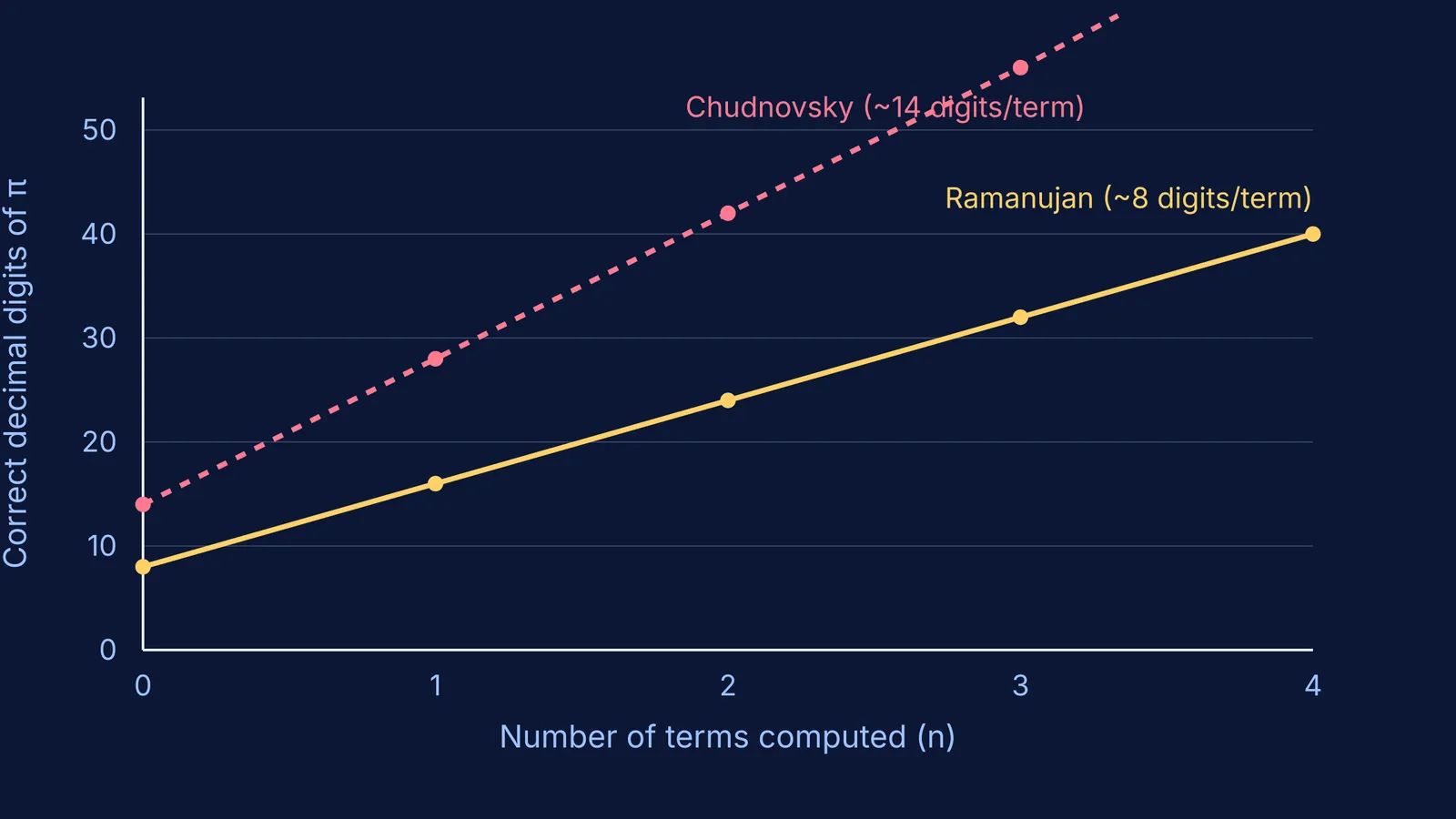
What makes this Ramanujan-Sato series special is its astonishing convergence rate. Older methods for calculating pi, like the Gregory-Leibniz series (1 - 1/3 + 1/5 - 1/7...), need millions of terms to get just a few correct decimal places. Ramanujan's formula takes a massive leap forward: it adds about eight correct decimal digits of pi with every single term you compute.
You can see this speed in action just by calculating the very first term, where n = 0. The massive factorials drop out to leave 1, and 396⁰ is also 1, which cleans up the expression to leave:
1/π ≈ (2√2 / 9801) × 1103
This simplifies to π ≈ 3.1415927. In a single step, the formula matches the true value of pi to six decimal places. The next term (n = 1) pushes the accuracy to 14 decimal places, and the numbers grow exponentially larger from there.
How did a 1914 formula become a supercomputer algorithm?
For decades, Ramanujan's series were admired for their elegance but were too complex to calculate far by hand. The real breakthrough came when computers became powerful enough to handle large integer arithmetic. In 1985, computer scientist Bill Gosper programmed this exact 1914 formula into a machine to calculate 17.5 million digits of pi, setting a world record at the time.
In 1988, mathematicians David and Gregory Chudnovsky tweaked Ramanujan's approach to create the Chudnovsky algorithm. Their version is even faster, yielding about 14 decimal digits of accuracy per term. When you read about modern supercomputers breaking the pi record — such as Google reaching 100 trillion digits in 2022, or servers hitting 314 trillion digits more recently — they are running heavily optimised versions of the algorithm Ramanujan pioneered.
How can you learn sequences and series?
Ramanujan's work shows how spotting the right pattern can turn an impossible calculation into straightforward arithmetic. When you study sequences and series for exams like JEE Main, you won't need to invent new formulas for pi, but you will need to find elegant patterns in arithmetic and geometric progressions.
If you are stuck on a series problem and cannot see the pattern, Fermi's AI tutor can work out what you already know and build a plan for the session, so you sit down to a clear next step. You can also explore the Fermi Problem Library to find worked problems with a step-by-step solver that explains the reasoning rather than printing an answer. For more on progressions, see our guides on summing arithmetico-geometric series or using the method of differences for series.


