On this page
In the early hours of 26 April 1986, reactor 4 at the Chernobyl power plant in Ukraine was destroyed during a safety test. The World Nuclear Association's account calls it the product of a flawed Soviet reactor design coupled with serious mistakes by the operators. The physics behind it is a feedback loop with the wrong sign.
What caused the Chernobyl disaster?
The IAEA's International Nuclear Safety Advisory Group, in its report INSAG-7, judged that the factors leading to the accident lay in the safety features of the design, the actions of the operators, and the general safety and regulatory framework. Compared with its 1986 report, INSAG-1, it put more weight on the design flaws, while still calling the operators' actions unsatisfactory in many respects.
The reactor was an RBMK-1000: a graphite-moderated, water-cooled design rated at 3200 MW of heat, controlled by 211 control rods, according to the World Nuclear Association. Its fuel was uranium dioxide enriched to about 2% uranium-235.
New to moderators? Start with how a nuclear reactor uses control rods and a moderator.
What is a positive void coefficient?
The void coefficient of reactivity is how much a reactor's reactivity changes when the fraction of steam bubbles (voids) in its coolant changes, as defined in INSAG-7. In the RBMK, graphite slows the neutrons, and the cooling water's absorption of neutrons is a significant factor in how the reactor behaves. Turn water into steam and fewer neutrons are absorbed, so more cause fission, the World Nuclear Association's RBMK page explains.
By INSAG-7's figures, losing all coolant would change reactivity by -2β with fresh fuel but by +(4-5)β in normal refuelling operation (β is the delayed neutron fraction). At the time of the accident, both the void and power coefficients were positive.
What happened during the safety test?
The test checked whether a slowing turbine could power the cooling pumps after a loss of station power, until the diesel generators started. The World Nuclear Association's sequence of events gives the timeline:
The reactor should have been held at about 700-1000 MW of heat, but at 00:28 on 26 April power fell to about 30 MW.
Operators withdrew many control rods to raise power. By 01:03 the reactor held at about 200 MW, and the test went ahead there.
At 01:22:30 the operating reactivity margin was equal to eight control rods; the procedures required at least 15.
At 01:23:04 the test began and four cooling pumps started to slow down.
At 01:23:40 the shutdown (scram) button was pressed. Within seconds power passed 530 MW and kept rising, fuel ruptured, and two explosions followed.
Why did pressing the shutdown button make it worse?
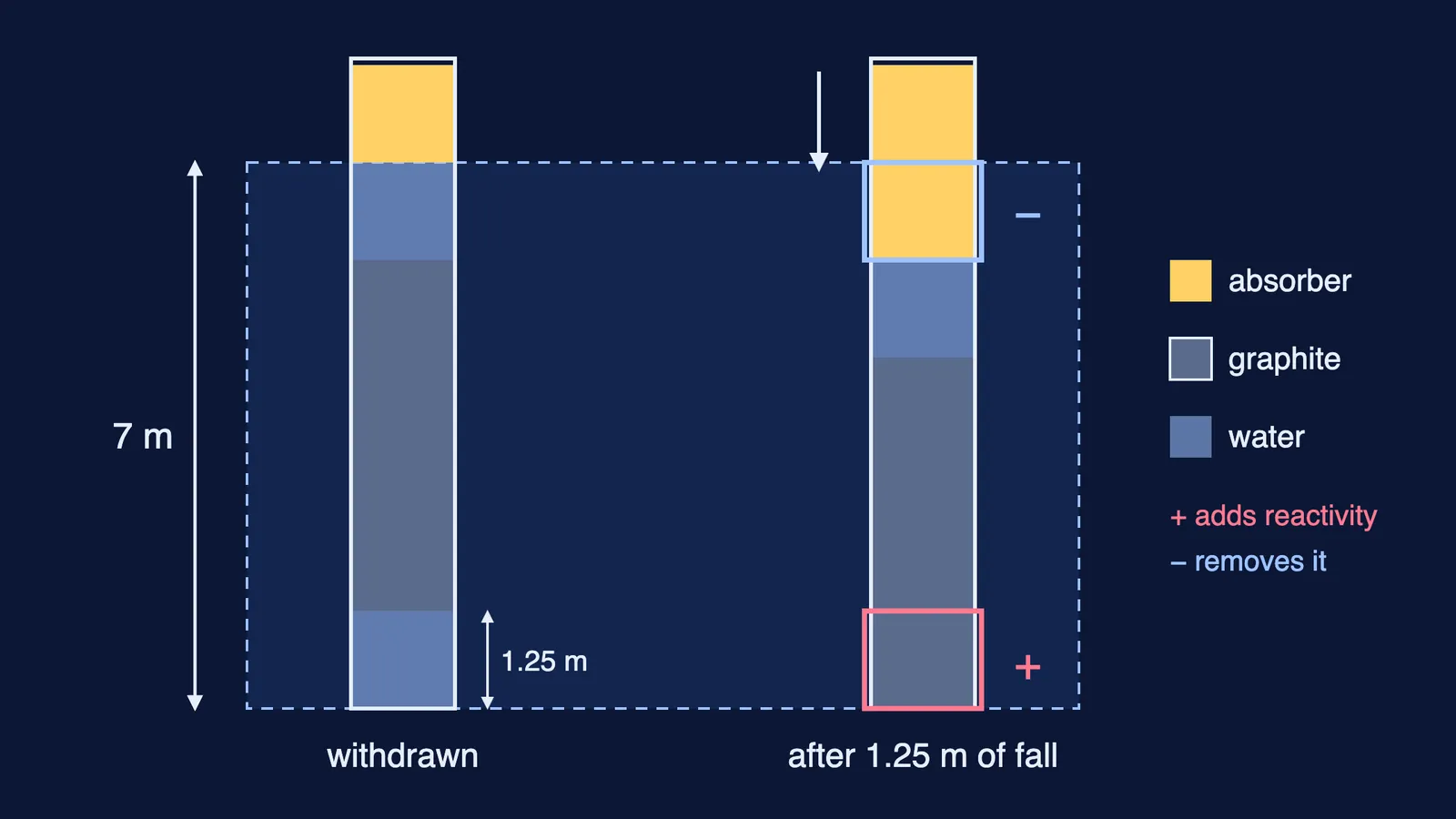
Most RBMK control rods carried a graphite "displacer" below the absorber. With the rod fully out, the displacer sat in the middle of the core with 1.25 m of water above and below it, INSAG-7 states. As the rod fell, graphite pushed out the water at the bottom of the channel, which added reactivity to the lower core before the absorber got there. This was the "positive scram" effect.
The rods were slow too: full insertion took 18 seconds, INSAG-7 notes. It adds that what started the surge is not known for certain, but the reactivity added by the falling rods was probably a decisive contributory factor. The power rose to around 100 times the reactor's rated capacity, says the World Nuclear Association.
How bad was the radioactive fallout?
About 14 EBq (14 × 10^18 becquerel) of radioactivity was released, more than half of it as noble gases, according to the World Nuclear Association. Iodine-131 (half-life 8 days) and caesium-137 (half-life 30 years) were particularly significant for the dose to the public. New to the unit? See what a becquerel and a curie measure.
The same source reports that two workers died in the explosions and 28 more died of acute radiation syndrome within weeks. By 14 May, some 116,000 people within 30 km had been evacuated. It quotes UNSCEAR, the UN radiation committee, finding no evidence of a major public health impact from radiation 20 years on, apart from some 5000 thyroid cancers (15 of them fatal). A significant but uncertain share of those, in people who were children in 1986, is likely due to radioactive iodine.
How can you check any feedback loop for the same flaw?
Ask three questions of any system, from a reactor to an exam problem:
When the output rises, what else changes? At Chernobyl: more steam.
Does that change push the output up or down? In the RBMK: up, so the loop feeds itself. Where the same water both moderates and cools, steam slows fewer neutrons and power falls, as the World Nuclear Association notes.
Can the brake act faster than the loop? An 18-second scram against a surge lasting seconds: no.
The Fermi Simulation Lab has interactive simulations for ideas that are easier to see than to read, and the Fermi Concept Library covers the nuclear physics underneath, from fission to half-life.