On this page
Close to the speed of sound, the air flowing over a wing becomes hard to predict. Engineers wanted to know: can you shape a wing so that no shock waves form at all? Mathematician Cathleen Synge Morawetz answered with a proof. Such a shape can exist on paper, she showed, but you cannot rely on it in the sky.
What is transonic flow?
The Mach number is the ratio of an aircraft's speed to the speed of sound, according to NASA Glenn Research Center. Transonic flight means a Mach number close to 1, when air over parts of the aircraft moves faster than sound.
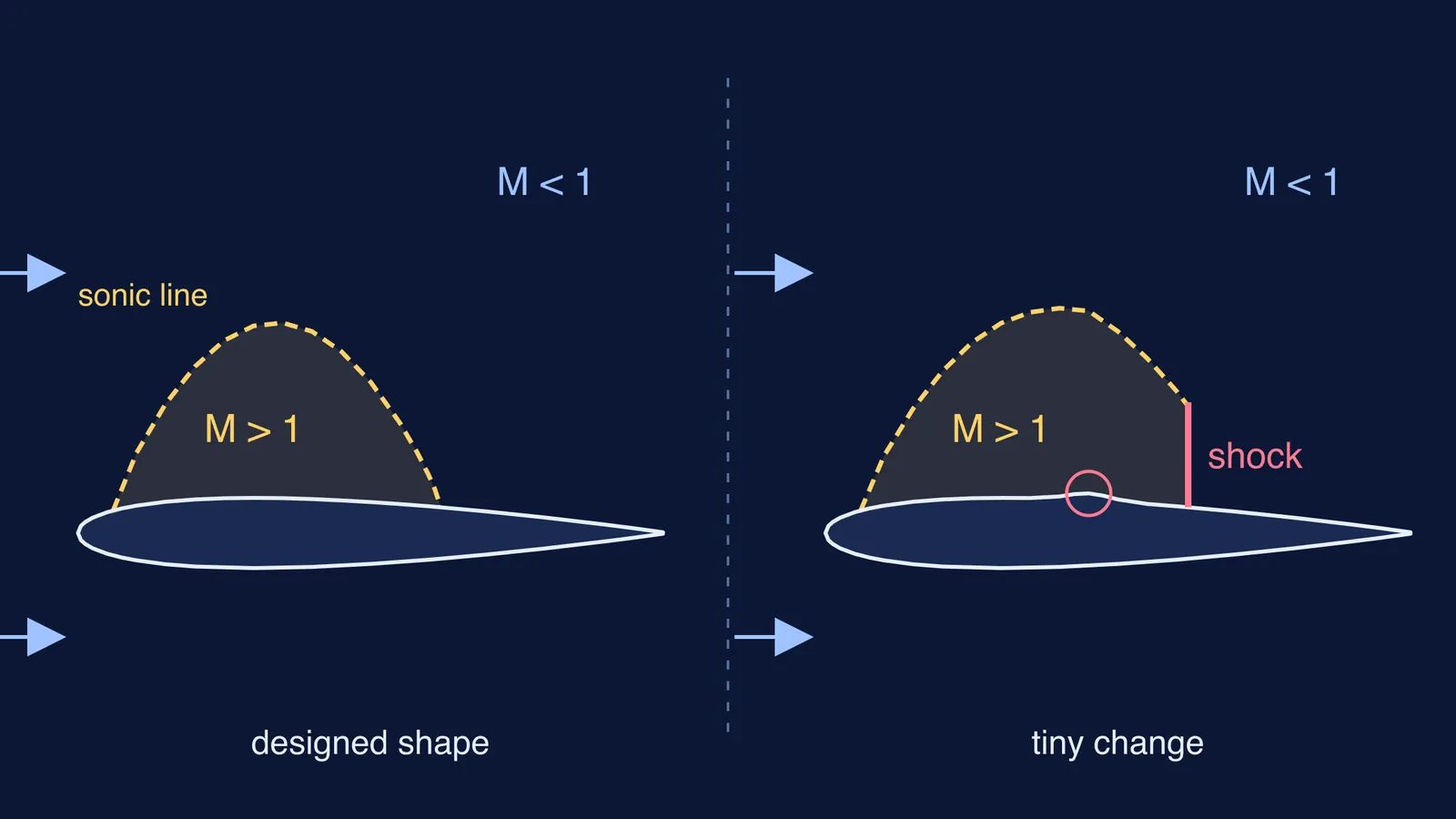
A transonic flow is one that contains both subsonic and supersonic regions, as Gui-Qiang Chen explains in a 2023 survey of Morawetz's work in the Bulletin of the American Mathematical Society. Far from the wing the air is slower than sound; over the curved surface a pocket of supersonic air forms.
That pocket makes the maths hard. The equation for steady flow is elliptic where the air is subsonic and hyperbolic where it is supersonic (Chen, arXiv version). In an elliptic region a change anywhere is felt everywhere, like a poke in a stretched rubber sheet; in a hyperbolic region signals travel along fixed lines, like waves. Such a mixed-type equation is much harder to analyse than either kind alone.
When the supersonic pocket ends abruptly, it ends in a shock wave: a thin jump in pressure. Jet aircraft near the sound barrier ran into shock waves and power-sapping drag, as WPI notes in its profile of NASA engineer Richard Whitcomb.
What did Cathleen Morawetz prove about shockless airfoils?
Her paper "On the non-existence of continuous transonic flows past profiles I" appeared in Communications on Pure and Applied Mathematics in February 1956, the first of a series. She had finished her PhD, on imploding shock waves, under Kurt Friedrichs in 1951 (Simons Foundation).
The result, in Chen's words: shock-free transonic flows are unstable with respect to arbitrarily small perturbations in the shape of the profile (Chen, 2023). The Simons Foundation biography puts it in plain terms: a wing could be designed for certain speeds with no shock, but if anything changed, even a fly landing on the wing or the angle of the wing shifting, the shock would return.
Her NYU colleague Jonathan Goodman summed it up in the New York Times obituary: "The search for shock-free airfoils is sort of futile."
How did her proof change aircraft design?
Chen writes that Morawetz's results led engineers to re-calibrate wing design to minimise shock strength over a useful range of transonic speeds, and that 1960s work on supercritical airfoils, including Whitcomb's, underscored that impact (Chen, 2023). The supercritical wing delays the onset of drag at high speeds (WPI). In 1971 Garabedian and Korn showed that, in the simpler potential-flow model, small perturbations of a continuous flow produce only weak shocks (Chen, 2023).
Morawetz went on to direct NYU's Courant Institute from 1984 to 1988, was President of the American Mathematical Society from 1995 to 1997, and received the National Medal of Science in 1998 (NYU Mathematics). She died on 8 August 2017, aged 94.
How can you tell existence from stability in your own problems?
Morawetz's lesson for a student is a question to ask of any perfect solution: does it survive a nudge? Try it on a pencil balanced on its point.
Does a solution exist? Yes. A pencil exactly upright, with no tilt, stays upright. That is a true equilibrium, like the designed shock-free wing.
What happens after a tiny change? Model the pencil as a mass on a light stick of length L. For a small tilt angle, angular acceleration = (g/L) times the angle, so the tilt grows exponentially at a rate of the square root of g/L.
Put numbers in. With L = 0.15 m and g = 9.8 m/s squared, the rate is the square root of 65.3, about 8.1 per second. A tilt of 0.001 radians reaches about 1 radian when e raised to (8.1 times t) equals 1000, so t = ln 1000 / 8.1, about 0.85 seconds (a rough figure, since the small-angle formula fails near 1 radian).
Draw the conclusion. The upright pencil exists but is unstable, so no design should rely on it. Aircraft designers learned the same thing: keep shocks weak instead of hoping for none.
Use the same checks in any equilibrium problem: find the equilibrium, nudge it, and see whether it returns. If a quantity growing away from equilibrium is hard to picture, the Fermi Simulation Lab has interactive simulations for ideas that are easier to see than to read. To revise stable and unstable equilibrium first, look the topic up in the Fermi Concept Library, where each concept has its own lesson.
For more on air at high speed, read how Gustaf de Laval shaped a nozzle that makes exhaust supersonic, how Olga Taussky-Todd used matrices to stop aircraft flutter, and when Bernoulli's equation stops working.