

On this page
In 1888 the Swedish engineer Gustaf de Laval needed steam to hit his turbine blades as fast as possible, and a plain tapering nozzle could only push it so fast. His fix was a tube that narrows to a pinch and then widens again. According to the de Laval nozzle entry on Wikipedia, most modern rocket engines that burn fuel into hot gas use the same shape.
Who was Gustaf de Laval?
Gustaf de Laval was born on 9 May 1845 in Orsa, Sweden, and died in Stockholm on 2 February 1913, according to his Wikipedia biography. In 1883 he co-founded the company that became Alfa Laval, and his impulse steam turbines could spin at up to 30,000 rpm.
His American turbine patent, US 522,066, was granted on 26 June 1894 and lists a Belgian priority date of 29 September 1888. It describes a nozzle that is "diverging or gradually enlarged in cross section from this narrowest point to its discharge opening".
What does a convergent-divergent nozzle do?
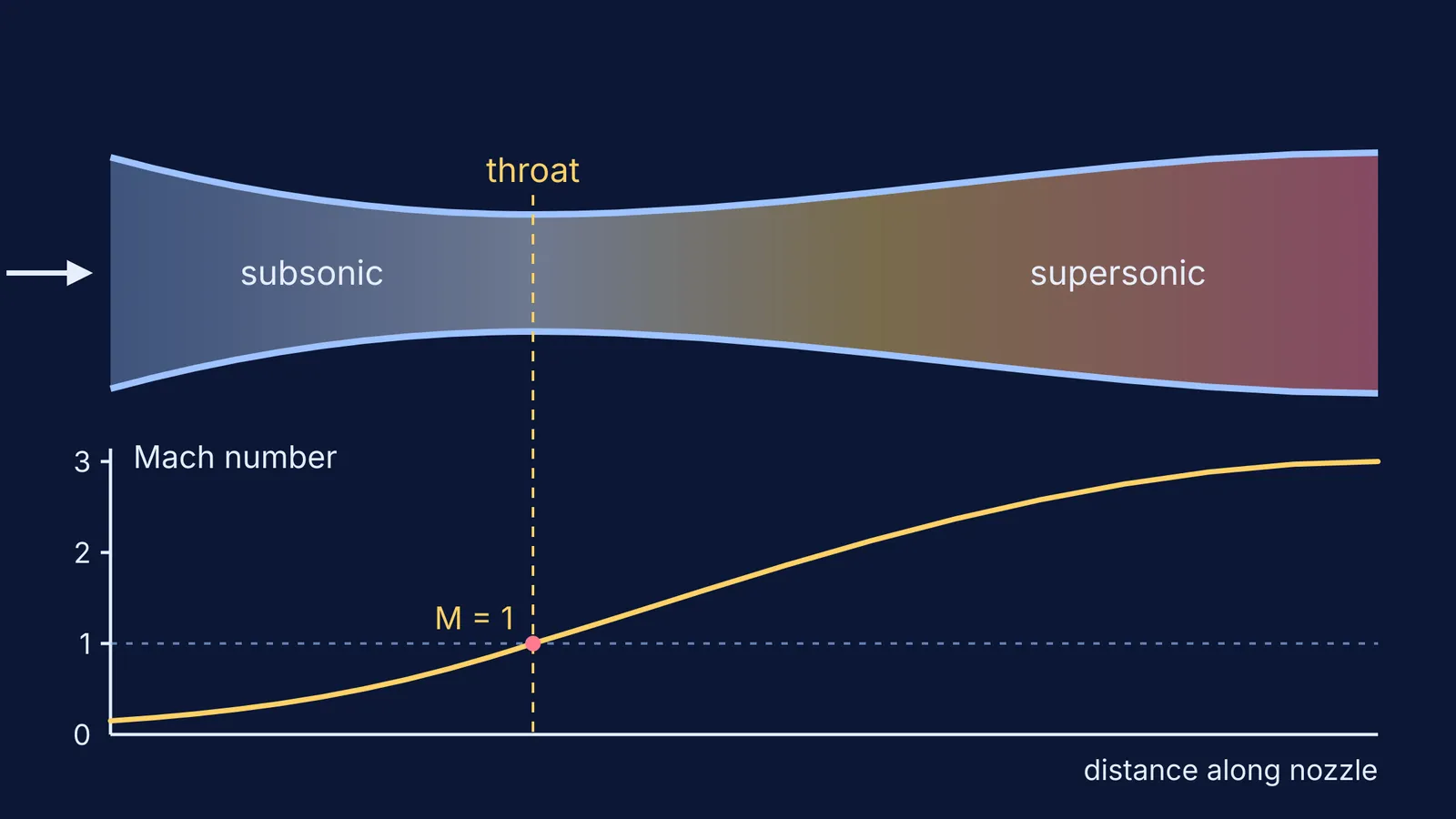
A de Laval nozzle is a tube that narrows to a throat and then widens, so that a gas can be pushed past the speed of sound (Wikipedia). Three things happen:
In the narrowing part the gas is slower than sound and speeds up as the area shrinks.
At the throat the flow reaches the speed of sound, Mach 1. NASA calls this choked flow: the throat size sets how much gas passes each second (NASA Glenn).
In the widening part the supersonic gas keeps speeding up as the area grows.
De Laval's patent puts it in numbers. At the throat the pressure "is equal to 57.7 per cent. of the initial pressure", the most a plain contracted nozzle can achieve. His diverging section turns that leftover pressure into speed; earlier nozzles, he wrote, left "more than one half" unused.
Why does a gas speed up when the nozzle widens?
For water in a pipe, the equation of continuity for flow in pipes and nozzles says a narrower pipe means faster flow. That works because water's density barely changes. A fast-moving gas does change its density, and NASA Glenn gives the relation that decides what happens:
(1 − M²) × dV/V = −dA/A
Here V is the flow speed, A is the area, and M is the Mach number: the flow speed divided by the speed of sound in the gas (NASA Glenn), named after Ernst Mach and his work on shock waves.
If M < 1, the bracket is positive: a smaller area gives a higher speed.
If M > 1, the bracket is negative: a larger area gives a higher speed.
At M = 1 the left side is zero, so dA must be zero: sonic speed happens only at the narrowest point.
In supersonic flow the gas thins out faster than it speeds up, so the same mass per second needs more room, and the nozzle flares.
If flows like this are hard to picture, the Fermi Simulation Lab has interactive simulations for ideas that are easier to see than to read.
Worked example: how big must the exit be for Mach 2?
NASA's isentropic flow page gives the area ratio A/A* (area over throat area) and pressure ratio p/p₀ (pressure over chamber pressure) in terms of M and γ, the ratio of specific heats. For air, γ = 1.4 (NASA Glenn), and the formulas simplify to A/A* = (1/M) × [(1 + 0.2M²)/1.2]³ and p/p₀ = (1 + 0.2M²)^(−3.5).
At the throat, M = 1, so p/p₀ = 1.2^(−3.5) ≈ 0.528. The throat pressure is about 53% of the chamber pressure.
At an exit Mach number of 2: 1 + 0.2 × 4 = 1.8, then 1.8/1.2 = 1.5, and 1.5³ = 3.375. Divide by M = 2 to get A/A* ≈ 1.69.
So a throat of 10 cm² needs an exit of about 16.9 cm².
Exit pressure: 1.8^(−3.5) ≈ 0.128, about 13% of the chamber pressure.
Watch for the trap: the same area ratio of 1.69 also fits a subsonic flow, at about M = 0.37. Which one you get depends on the pressure outside: the nozzle only chokes and goes supersonic if the pressure and flow are large enough (Wikipedia). The throat figure also depends on γ, which helps explain why de Laval's 57.7% for steam differs from 52.8% for air.
If you get stuck setting up problems like this, the Fermi Problem Library has worked problems with a step-by-step solver that explains the reasoning rather than printing an answer.
How did a turbine nozzle end up on rockets?
In 1915 Robert Goddard tested commercial rockets at Clark University and found that only about 2% of the available energy went into the jet's speed, according to a NASA Goddard Space Flight Center history page. With de Laval nozzles he measured jet speeds between 7,000 and 8,000 ft/s and efficiencies of up to 63%. Read more in our post on Robert Goddard's 1926 liquid-fuel rocket.
Next time you watch a launch, look at the bell under the engine: narrow where the gas hits Mach 1, wide where it leaves faster than sound.


