

On this page
Every rocket question in Class 11 physics rests on one idea: a rocket pushes gas backwards, and the gas pushes the rocket forwards. Robert Goddard, an American physicist, spent his working life turning that idea into hardware. His most famous flight lasted less than three seconds. This post sets out what he actually did, using NASA records and his own patents, works through the numbers, and ends with what you can borrow from his way of working.
What happened on 16 March 1926?
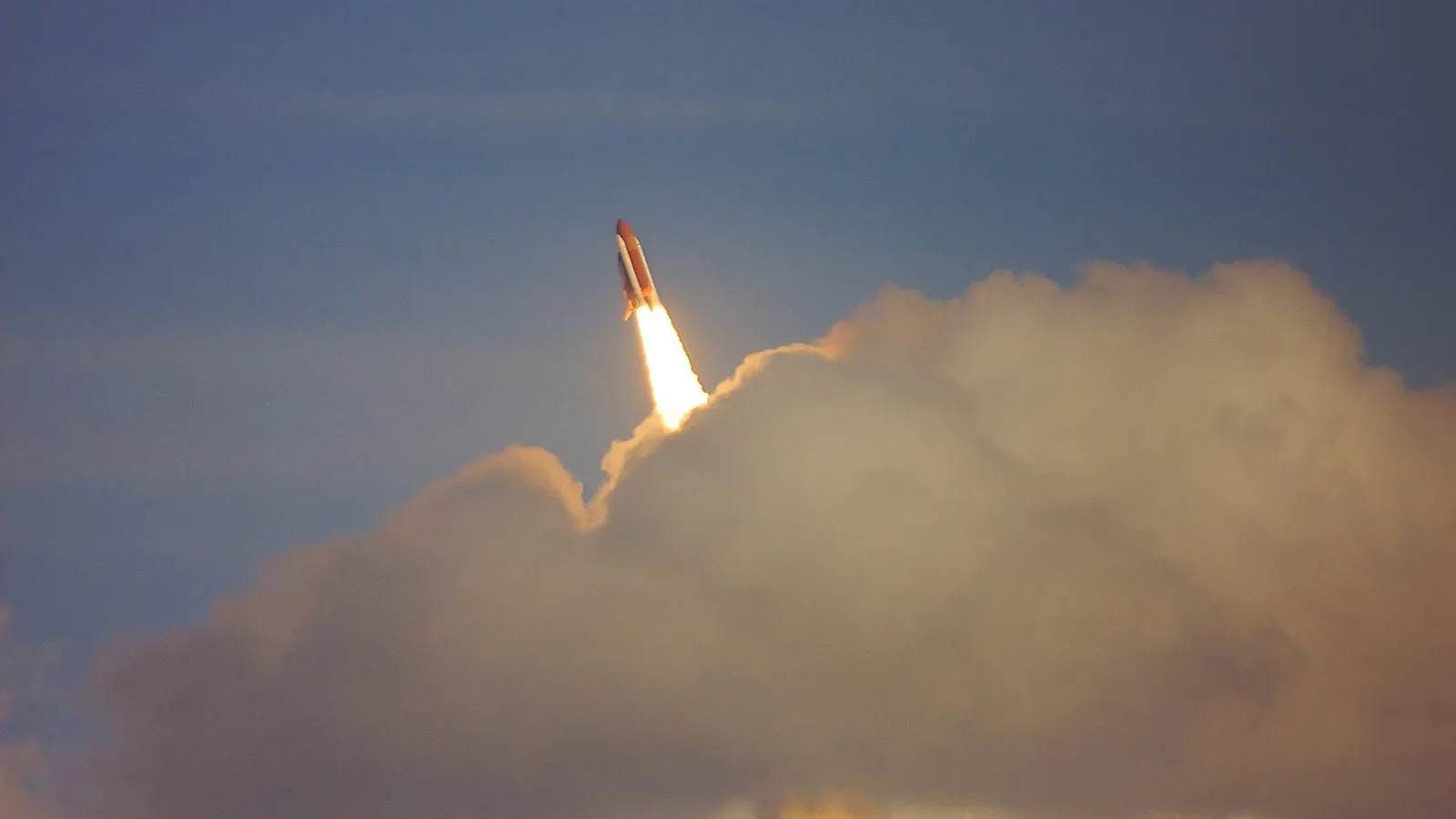
According to NASA's image archive, Goddard's "liquid oxygen-gasoline rocket was fired on March 16, 1926, at Auburn, Mass." NASA adds that "It flew for only 2.5 seconds, climbed 41 feet, and landed 184 feet away in a cabbage patch." That sounds tiny next to a modern launch, but it was the first flight of a rocket that burned liquid propellants rather than a solid charge such as gunpowder.
Those numbers are worth converting, because exam questions are set in SI units.
Height: 41 ft × 0.3048 m/ft = 12.5 m.
Ground distance: 184 ft × 0.3048 m/ft = 56.1 m.
Average horizontal speed: 56.1 m ÷ 2.5 s = 22.4 m/s.
A common slip is to call 22.4 m/s the rocket's speed. It is only the average horizontal speed over the whole flight. The rocket also moved up and then down, and its speed changed all the time, so its top speed was higher.
Why did Goddard want liquid fuel?
A solid rocket burns until its charge is used up. A liquid rocket can store fuel and oxidiser in separate tanks and feed them to a combustion chamber. Goddard had written this down twelve years before the flight. His US patent 1,103,503, "Rocket apparatus", filed on 15 May 1914 and granted on 14 July 1914, describes two tanks, one filled with "gasolene" and the other with liquefied nitrous oxide. Because the second substance stays liquid only when cold, he wrote that its tank should be filled just before launch and enclosed in a second, insulated tank. The same patent describes a primary rocket that carries and fires a secondary rocket, an early form of the multi-stage idea. A NASA Goddard Space Flight Center record sums up that he "received patents for a multi-stage rocket and liquid propellants in 1914."
What did his 1919 paper argue?
In 1919 the Smithsonian Institution published Goddard's paper A Method of Reaching Extreme Altitudes. The Smithsonian Libraries copy shows the structure clearly: Part I, Theory; Part II, Experiments; Part III, Calculations based on the theory and the experimental results. NASA's summary says the paper "detailed methods for raising weather-recording instruments higher than what could be achieved by balloons and explained the mathematical theories of rocket propulsion." It also discussed a rocket reaching the Moon, "a position for which the press ridiculed Goddard."
How does a rocket push itself upwards?
The rocket throws hot gas downwards. By Newton's third law the gas pushes the rocket upwards with an equal and opposite force, called thrust. The NCERT Class 11 chapter Laws of Motion has a direct exercise (4.9): a rocket with lift-off mass 20,000 kg is blasted upwards with an initial acceleration of 5.0 m/s². Find the initial thrust.
Two forces act on the rocket at lift-off: thrust F upwards and weight mg downwards.
Newton's second law upwards: F − mg = ma.
So F = m(g + a) = 20,000 × (9.8 + 5.0) = 20,000 × 14.8 = 2.96 × 10⁵ N.
The usual mistake is to write F = ma = 1.0 × 10⁵ N and forget that the thrust must first hold up the rocket's weight. Draw the free-body diagram before you write any equation. When the mass changes as fuel burns, you need the variable-mass method in our post on rocket thrust and conveyor belt problems.
If you keep losing marks on set-ups like this, the Fermi Problem Library has a step-by-step solver that explains the reasoning, so you can compare your free-body diagram with a full solution.
What came after the cabbage patch?
The 1926 rocket was a beginning, not an end. NASA's archive notes that "From 1930 to 1941, Dr. Goddard made substantial progress in the development of progressively larger rockets, which attained altitudes of 2400 meters," and that he refined guidance and control, welding, insulation and pumps. NASA's Goddard Space Flight Center is named after him, and the same NASA record says his work "largely anticipated in technical detail the later German V-2 missiles," including gyroscopic control and power-driven fuel pumps.
For an Indian student, the line from Goddard runs on to the launch vehicles you read about today. Our post on A. P. J. Abdul Kalam's work in rocketry picks up that story in India.
What can a student take from Goddard's way of working?
Write the idea down early. His 1914 patents described liquid propellants and staging long before he could fly them.
Test small and record everything. A 2.5-second flight with measured height and distance is real data. A grand plan with no test is not.
Join theory to experiment. His 1919 paper put theory, experiments and calculations side by side, and each part checked the others.
Expect early results to look unimpressive. A 12.5 m climb was still the first of its kind.
Try this today: draw the free-body diagram for NCERT exercise 4.9, solve it without notes, then change the acceleration to 10 m/s² and see how the thrust changes.


