On this page
When we learn about matrices in school, they can feel like endless grids of arithmetic with no clear connection to the real world. But during World War II, those grids were quite literally a matter of life and death.
In 1943, mathematician Olga Taussky-Todd joined the Aerodynamics Division of the UK's National Physical Laboratory (NPL) (MacTutor). Born in what is now Czechia, she fled the political climate in Germany and moved to the UK in 1935. At the NPL, her job was to help solve a terrifying engineering problem: aircraft flutter. Her work not only made planes safer to fly but also helped turn matrix theory into a major, independent field of mathematics.
What is aircraft flutter?
Flutter is a dangerous self-excited vibration. When an aircraft flies at high speeds, the aerodynamic forces of the wind push against the natural structural elasticity of the wing. If the plane reaches its critical "flutter speed", these vibrations begin to feed on themselves. Instead of damping out, the vibrations grow more and more violent, eventually becoming strong enough to tear the wing apart in mid-air.
To design a safe aircraft, engineers modelled the complex motion of the wing using large systems of differential equations. Determining whether a particular aircraft design would flutter came down to finding the eigenvalues of a complex matrix (Wikipedia).
The rule was simple in theory: if the real parts of all the eigenvalues were negative, the aircraft was structurally stable. If any of the eigenvalues had a positive real part, the vibrations would grow over time, and the plane would flutter.
How do you bound an eigenvalue?
At the time, computing the exact eigenvalues of such a complex matrix was incredibly difficult. The calculations had to be done by hand, and a single arithmetic mistake could lead to a catastrophic aircraft failure. Taussky-Todd realised that the engineers did not actually need the exact numerical values of the eigenvalues; they only needed to prove that their real parts were negative.
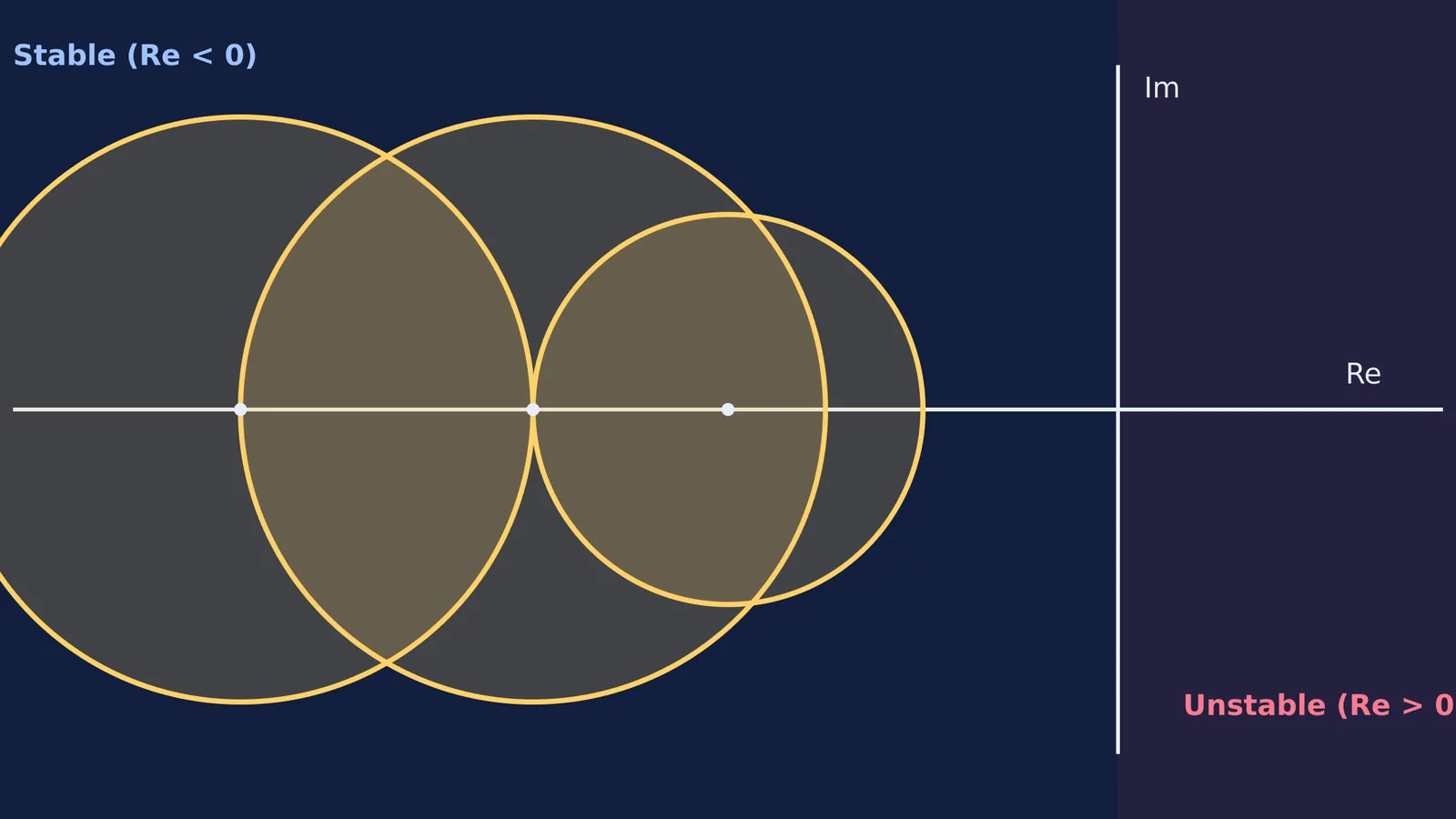
She revived a 1931 theorem by the Soviet mathematician Semyon Gershgorin, which provided a quick way to trap eigenvalues inside specific discs in the complex plane, now known as Gershgorin circles (Wikipedia).
To find these discs for any square matrix, you simply look at each row. The centre of the disc is the diagonal element, and the radius is the sum of the absolute values of all the other elements in that row. The theorem states that every eigenvalue of the matrix must lie inside at least one of these discs.
When you first meet matrices in Class 12, the heavy arithmetic can easily hide the beautiful physics behind them. If you keep getting lost in the rows and columns, the Fermi Problem Library has worked problems with a step-by-step solver that explains the reasoning rather than printing an answer.
What is diagonal dominance?
If the absolute value of every diagonal element in a matrix is strictly greater than the sum of the absolute values of the rest of its row, the matrix is strictly diagonally dominant.
Taussky-Todd used this powerful property to check aircraft stability quickly. If the diagonal elements are all negative real numbers, and the matrix is strictly diagonally dominant, all the Gershgorin discs lie entirely in the negative half of the complex plane. Without calculating a single exact eigenvalue, she could mathematically guarantee that the aircraft was safe to fly.
A torchbearer for matrix theory
After the war ended, Taussky-Todd moved to the United States. In 1949, she published her most famous paper, "A Recurring Theorem on Determinants", in *The American Mathematical Monthly*, summarising the long history of the diagonal dominance theorem (Wikipedia). She pointed out that the theorem had been independently discovered and forgotten by many mathematicians over the decades.
Before her pioneering work, matrices were often treated as just a computational trick for other fields like statistics or differential equations. She proudly called herself a "torchbearer" for the subject, pushing for it to be studied rigorously in its own right. In 1957, she broke a major barrier by becoming the first woman to hold a formal teaching position in mathematics at the California Institute of Technology (Caltech).
Today, matrix theory is the foundation of computer graphics, quantum mechanics, and artificial intelligence. To see how these tools are used in the school curriculum, read about How to Solve Matrix Word Problems on Cost and Sales in Class 12 and the Cayley-Hamilton theorem: finding A⁻¹ and A⁵⁰ step by step.