

On this page
The Cayley-Hamilton theorem turns two slow jobs, finding A⁻¹ and finding A⁵⁰, into a few lines of arithmetic. Here are the steps, a 2×2 and a 3×3 example worked in full, and the checks that catch the usual slips.
What does the Cayley-Hamilton theorem say?
For a square matrix A, the characteristic polynomial is p(λ) = det(λI − A), and the Cayley-Hamilton theorem says p(A) = O, with the constant term multiplied by the identity matrix I (Wolfram MathWorld).
Arthur Cayley published the idea in his 1858 memoir on the theory of matrices (Royal Society, DOI 10.1098/rstl.1858.0002). According to the MacTutor history of matrices, Cayley proved the 2×2 case and said he had checked 3×3, Hamilton proved the 4×4 case, and Frobenius proved the general result in 1878. More in our profile of Arthur Cayley and the matrix algebra you use in Class 12.
How do you write the characteristic equation of a 2×2 or 3×3 matrix?
Read the coefficients straight off the matrix:
2×2: λ² − (tr A)λ + det A = 0, where tr A is the sum of the diagonal entries.
3×3: λ³ − (tr A)λ² + Sλ − det A = 0, where S is the sum of the three diagonal 2×2 minors (delete row 1 and column 1, then row 2 and column 2, then row 3 and column 3).
Then replace λ by A and the constant term by that number times I.
How do you use Cayley-Hamilton to find the inverse of a matrix?
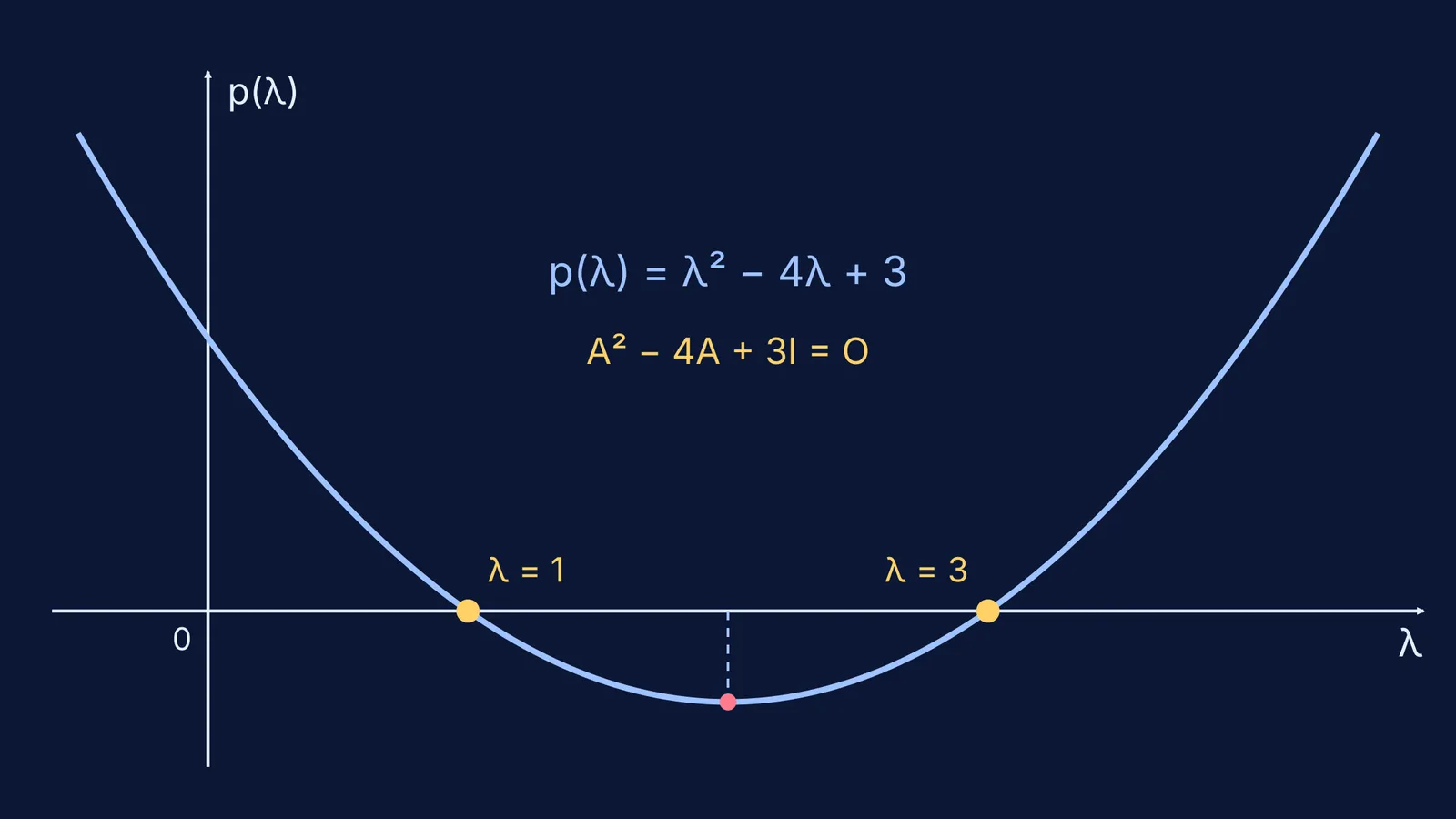
Take A = [[2, 1], [1, 2]], written row by row. Here tr A = 4 and det A = 3, so the characteristic equation is λ² − 4λ + 3 = 0 and the theorem gives A² − 4A + 3I = O.
Check det A ≠ 0. It is 3, so A⁻¹ exists.
Move the constant term across: A² − 4A = −3I.
Factor A out: A(A − 4I) = −3I.
Divide by −3: A(4I − A)/3 = I, so A⁻¹ = (4I − A)/3 = (1/3)[[2, −1], [−1, 2]].
Check: A times [[2, −1], [−1, 2]] gives [[3, 0], [0, 3]], which is 3I. Correct.
The method is the same for a 3×3 matrix. Take A = [[1, 1, 0], [0, 1, 1], [1, 0, 1]]. Here tr A = 3, each of the three diagonal minors is 1 so S = 3, and det A = 2. The characteristic equation is λ³ − 3λ² + 3λ − 2 = 0, so A³ − 3A² + 3A − 2I = O.
Move 2I across and factor: A(A² − 3A + 3I) = 2I, so A⁻¹ = (A² − 3A + 3I)/2. You need only one matrix product, A² = [[1, 2, 1], [1, 1, 2], [2, 1, 1]]. That gives A⁻¹ = (1/2)[[1, −1, 1], [1, 1, −1], [−1, 1, 1]]. Multiply it by A and you get I, as you should.
The adjoint route needs nine cofactors instead; see adjoint and inverse of a matrix: the properties JEE tests.
How do you find A⁵⁰ without multiplying 50 times?
Divide λ⁵⁰ by the characteristic polynomial. The remainder has degree less than 2, so λ⁵⁰ = q(λ)(λ² − 4λ + 3) + aλ + b for some polynomial q. Put A in place of λ: the first term vanishes because A² − 4A + 3I = O, leaving A⁵⁰ = aA + bI.
To find a and b, substitute the roots λ = 1 and λ = 3, where the bracket is zero:
λ = 1 gives a + b = 1.
λ = 3 gives 3a + b = 3⁵⁰.
So a = (3⁵⁰ − 1)/2 and b = (3 − 3⁵⁰)/2, and A⁵⁰ = (1/2)[[3⁵⁰ + 1, 3⁵⁰ − 1], [3⁵⁰ − 1, 3⁵⁰ + 1]].
Test it on a small power: with 2 in place of 50 it gives [[5, 4], [4, 5]], which is exactly A². If the roots are equal, differentiate the identity with respect to λ and substitute the root again to get the second equation.
When the powers follow an obvious pattern, spotting the pattern for Aⁿ can be quicker; Cayley-Hamilton works even when none shows.
Where do students slip, and how should you practise?
Most mistakes are sign errors in the characteristic equation (for a 3×3 matrix the det A term carries a minus sign, for a 2×2 a plus) and a dropped I. Check every answer by multiplying back. The Fermi Problem Library has worked problems with a step-by-step solver that explains the reasoning rather than printing an answer, so you can see which line went wrong. If minors or determinants still feel shaky, the Fermi Concept Library gives each concept in mathematics its own lesson.
Tonight, pick any 2×2 matrix, write its characteristic equation, and find its inverse both ways.


