

On this page
In the 2024-25 CBSE Class 12 mathematics syllabus, the Algebra unit—covering matrices and determinants—carries 10 marks out of the 80-mark theory paper. Matrices and determinants show up throughout the year, from spotting matrix powers to using determinants to find the area of a triangle. However, one of the most reliable long-answer questions you will face involves setting up a matrix equation from a real-world scenario.
What do matrix word problems on cost and sales test?
Word problems testing matrix algebra usually present you with a scenario involving multiple items, prices and total costs. The examiner wants to see if you can translate English sentences into a system of linear equations, separate those equations into distinct matrices, and solve them systematically using the inverse matrix method.
Before the matrix method was formally taught, you might have solved linear systems using substitution, elimination or rules defined by mathematicians like Gabriel Cramer. The matrix method is powerful because it easily scales to three or more variables without creating a tangled mess of substitutions.
The standard matrix equation takes the form AX = B. Here, A is the coefficient matrix (usually the quantities of items), X is the column matrix of unknowns (usually the prices), and B is the column matrix of constants (the final totals).
How do you set up the matrices?
Let us look at a standard Class 12 scenario. Imagine three people shopping for stationery:
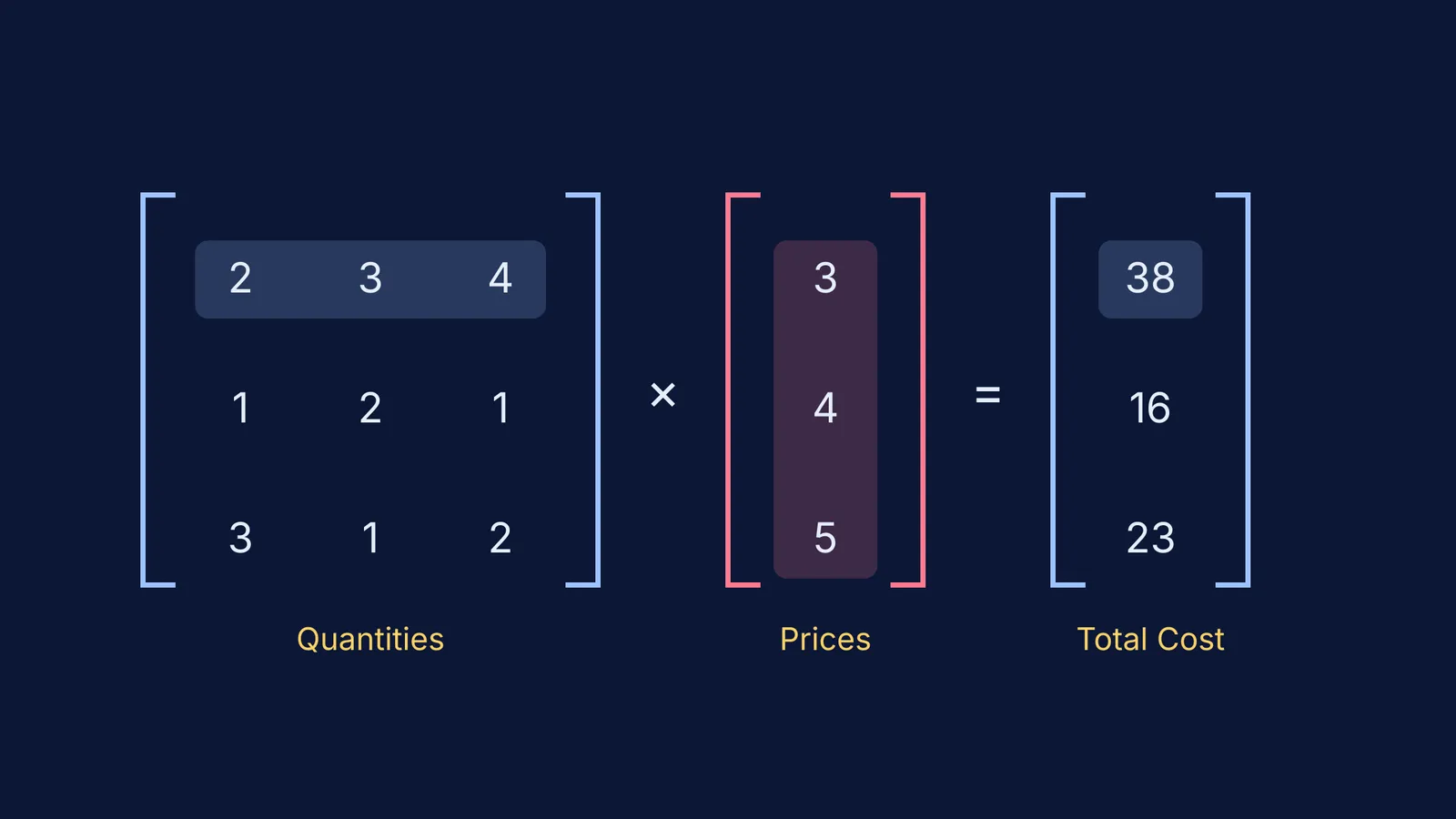
Person A buys 2 pens, 3 pencils and 4 erasers for Rs 38. Person B buys 1 pen, 2 pencils and 1 eraser for Rs 16. Person C buys 3 pens, 1 pencil and 2 erasers for Rs 23.
First, clearly define your variables. Let the cost of one pen be x, one pencil be y, and one eraser be z.
The item quantities form a 3×3 square matrix, which we will call A: [ 2 3 4 ] [ 1 2 1 ] [ 3 1 2 ]
The unknown unit prices form a 3×1 column matrix, which we will call X: [ x ] [ y ] [ z ]
The total costs paid by each person form another 3×1 column matrix, which we will call B: [ 38 ] [ 16 ] [ 23 ]
If you multiply A and X, the result equals B. This gives us the governing matrix equation AX = B.
How do you solve the matrix equation using A⁻¹?
Since AX = B, multiplying both sides by the inverse of A gives X = A⁻¹B. Finding A⁻¹ is the core of the problem. It requires finding the determinant and then the adjoint matrix.
Step 1: Find the determinant, |A|. Expanding along the first row: |A| = 2(4 − 1) − 3(2 − 3) + 4(1 − 6) |A| = 2(3) − 3(−1) + 4(−5) |A| = 6 + 3 − 20 = −11
Step 2: Find the cofactor matrix. Calculate the cofactor for every single element in matrix A, remembering the alternating plus and minus signs for the positions. The resulting cofactor matrix is: [ 3 1 −5 ] [ −2 −8 7 ] [ −5 2 1 ]
Step 3: Write the adjoint matrix, adj(A). The adjoint is simply the transpose of the cofactor matrix. You swap the rows and columns. adj(A) = [ 3 −2 −5 ] [ 1 −8 2 ] [ −5 7 1 ]
Step 4: Multiply A⁻¹ by B. The inverse is A⁻¹ = (1 / |A|) × adj(A). Therefore, the solution is X = (1 / −11) × adj(A) × B.
Multiply the 3×3 adjoint matrix by the 3×1 B matrix: Row 1: 3(38) − 2(16) − 5(23) = 114 − 32 − 115 = −33 Row 2: 1(38) − 8(16) + 2(23) = 38 − 128 + 46 = −44 Row 3: −5(38) + 7(16) + 1(23) = −190 + 112 + 23 = −55
Finally, divide each row's result by the determinant (−11): x = −33 / −11 = 3 y = −44 / −11 = 4 z = −55 / −11 = 5
The cost is Rs 3 for a pen, Rs 4 for a pencil and Rs 5 for an eraser.
How can you verify your matrix solution?
After calculating x, y, and z, the smartest thing you can do in an exam is plug the numbers back into one of the original equations.
For example, check Person C's purchase. They bought 3 pens, 1 pencil, and 2 erasers, which should cost Rs 23. Let us test our answers: 3(3) + 1(4) + 2(5) = 9 + 4 + 10 = 23.
The numbers match perfectly. Taking two minutes to run this check guarantees your marks are safe.
These problems require careful arithmetic, as a single sign error when finding a cofactor ruins the final answer. The Fermi Problem Library has worked problems with a step-by-step solver that explains the reasoning rather than printing an answer, which is ideal for isolating simple arithmetic mistakes and mastering the matrix method.


