On this page
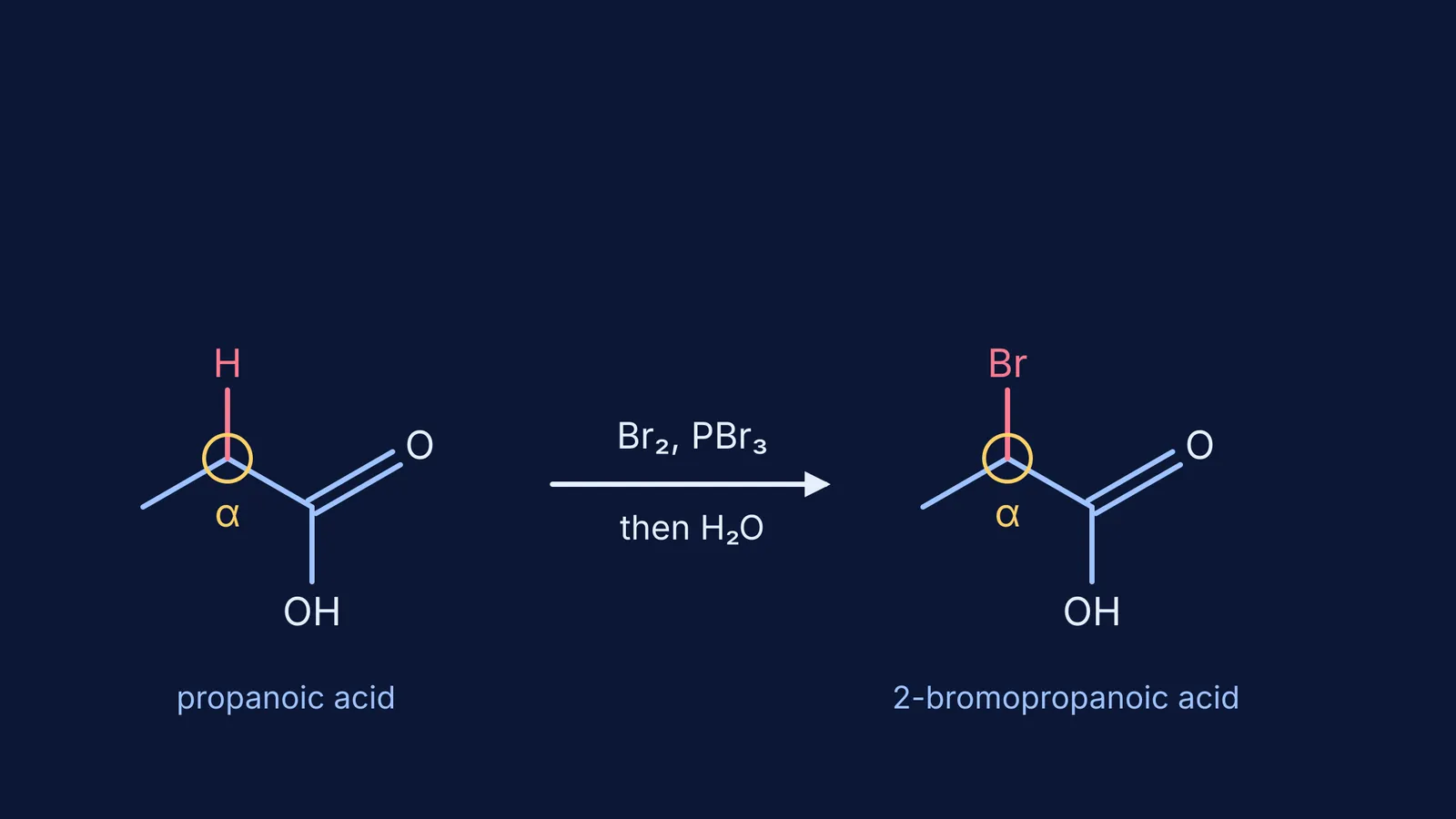
Every carboxylic acid that has a hydrogen on its alpha carbon (the carbon right next to the –COOH group) can have that hydrogen swapped for bromine in one pot. Chemists call this the Hell-Volhard-Zelinsky reaction, or HVZ, and it uses a mixture of bromine and phosphorus tribromide, as the LibreTexts organic chemistry chapter on alpha bromination/22:_Carbonyl_Alpha-Substitution_Reactions/22.04:_Alpha_Bromination_of_Carboxylic_Acids) describes it. The long name is a small history lesson: three chemists, one paper in 1881 and two in 1887.
Who discovered the Hell-Volhard-Zelinsky reaction?
Carl Magnus von Hell came first. He was born in Stuttgart in 1849, studied under Hermann von Fehling in Stuttgart and Emil Erlenmeyer in Munich, and became professor of chemistry at the Technical University of Stuttgart after Fehling died in 1883, according to his Wikipedia biography. In 1881 he published "Ueber eine neue Bromirungsmethode organischer Säuren" (On a new bromination method for organic acids) in Berichte der deutschen chemischen Gesellschaft, volume 14, pages 891-893 (Crossref record).
Jacob Volhard was the senior figure. Born in Darmstadt in 1834, he trained with Justus von Liebig and August Wilhelm von Hofmann and taught at the University of Halle from 1882 to 1908 (Wikipedia biography). You may already know his name from the Volhard method of titration, and his doctoral students included Hermann Staudinger. His 1887 paper "Ueber Darstellung α-bromirter Säuren" (On the preparation of α-brominated acids) ran to pages 141-163 of volume 242 of Liebigs Annalen (Crossref record).
Nikolay Zelinsky was the youngest. Born in Tiraspol in 1861, he studied in Odessa, Leipzig and Göttingen, became a professor at Moscow University in 1893, and in 1915 invented an activated-charcoal gas mask (Wikipedia biography). His 1887 contribution was a single page in Berichte volume 20, page 2026, on a convenient way to make the ester of α-bromopropionic acid (Crossref record).
Why can't you just add bromine to a carboxylic acid?
Ketones pick up bromine at the alpha carbon through their enol form, but a carboxylic acid barely forms an enol. Its O–H proton is removed before an alpha hydrogen, so ordinary alpha bromination stalls (LibreTexts/22:_Carbonyl_Alpha-Substitution_Reactions/22.04:_Alpha_Bromination_of_Carboxylic_Acids)). The same resonance that stops acids from behaving like ordinary carbonyls is explained in our post on why carboxylic acids don't give carbonyl group reactions.
HVZ gets around this with a detour through the acid bromide, which has no acidic O–H and enolises much more readily. The steps, as set out in the LibreTexts chapter above and its named-reaction page on HVZ/Reactions/Named_Reactions/Hell-Volhard-Zelinsky_reaction):
PBr3 replaces the –OH of the acid with Br, giving an acyl bromide.
The acyl bromide tautomerises to its enol, with HBr as the catalyst.
The enol's C=C attacks Br2, putting bromine on the alpha carbon.
Water (or the starting acid) turns the α-bromo acyl bromide back into an α-bromo carboxylic acid.
Worked example: what does propanoic acid give?
Take CH3CH2COOH. The alpha carbon is the CH2. After the four steps, one of its hydrogens is replaced, giving CH3CHBrCOOH, 2-bromopropanoic acid. The –CH3 carbon is untouched because it never becomes part of the enol.
The alpha carbon now carries four different groups, so it is a stereocentre, and because bromine adds to a flat enol the product is racemic (LibreTexts/22:_Carbonyl_Alpha-Substitution_Reactions/22.04:_Alpha_Bromination_of_Carboxylic_Acids)).
The same LibreTexts chapter notes that α-bromo acids can be turned into α-hydroxy acids with aqueous base, and that excess ammonia replaces the bromine with –NH2, a possible route to amino acids. From 2-bromopropanoic acid, that means lactic acid with hydroxide and alanine with ammonia. For a multi-step version, see making acrylic acid from propanoic acid by the HVZ route.
How do you spot an HVZ question in an exam?
Run these four checks whenever you see Br2 with P or PBr3 next to an acid:
Find the carbon attached to –COOH. That is the only carbon HVZ touches.
Count its hydrogens. No alpha hydrogen means no HVZ: benzoic acid and 2,2-dimethylpropanoic acid both fail this check.
Check the amount of bromine. The usual procedure adds one molar equivalent of Br2 to brominate the alpha position once (Wikipedia on HVZ halogenation).
Read the next reagent. NH3 or aqueous OH– after HVZ usually means a substitution at the new C–Br bond; quenching with an alcohol instead of water gives the α-bromo ester.
If the enol step is the part that feels shaky, the Fermi Concept Library covers every concept in chemistry, each with its own lesson and its place in the map. To practise multi-step conversions, the Fermi Problem Library has worked problems with a step-by-step solver that explains the reasoning rather than printing an answer.
For a revision page focused on the mechanism and exam-style variants, read our Hell-Volhard-Zelinsky reaction guide to alpha-halogenation of acids.