

On this page
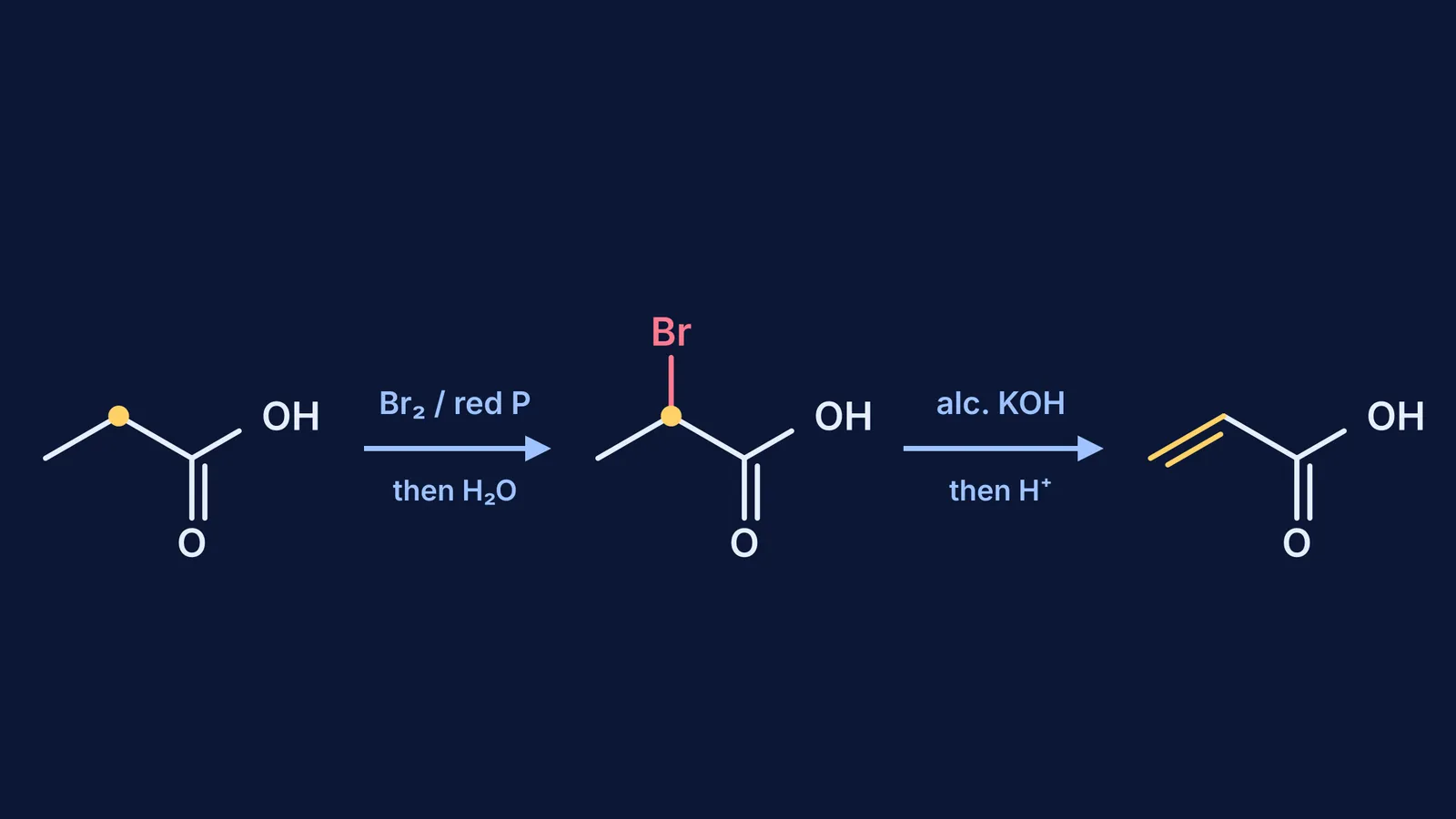
This is a classic two-step conversion in Class 12 organic chemistry and JEE practice. You put a bromine on the carbon next to COOH, then pull HBr back out to make a C=C double bond. Propanoic acid (CH₃CH₂COOH) and acrylic acid (CH₂=CHCOOH) both have three carbons; overall you only remove two hydrogens.
Acrylic acid's IUPAC name is prop-2-enoic acid, formula C3H4O2, molar mass 72.06 g/mol, according to PubChem.
How do you convert propanoic acid to acrylic acid?
The whole route fits in three lines:
HVZ step: CH₃CH₂COOH treated with Br₂ and red phosphorus, then H₂O, gives CH₃CH(Br)COOH (2-bromopropanoic acid).
Elimination step: heat 2-bromopropanoic acid with excess alcoholic KOH to get CH₂=CHCOO⁻K⁺ (potassium acrylate) plus KBr and water.
Work-up: acidify with dilute acid to get CH₂=CHCOOH.
The first step is straight from the syllabus. NCERT's Class 12 chemistry textbook, Unit 8, says: "Carboxylic acids having an α-hydrogen are halogenated at the α-position on treatment with chlorine or bromine in the presence of small amount of red phosphorus to give α-halocarboxylic acids." It names this the Hell-Volhard-Zelinsky reaction. Propanoic acid has two α-hydrogens on its CH₂, so it qualifies.
What does red phosphorus actually do in the HVZ reaction?
Phosphorus is what gets bromine onto the α-carbon. The Organic Chemistry Portal's HVZ page sets out the sequence:
Phosphorus reacts with bromine to make PBr₃, which turns the acid into an acyl bromide, CH₃CH₂COBr.
The acyl bromide readily forms its enol, and the enol is quickly brominated at the α-carbon.
The monobrominated product is much less nucleophilic, so the reaction stops after one bromine.
The α-bromo acyl bromide swaps bromide with unreacted acid through an anhydride, so the cycle keeps going. That is why only a small amount of phosphorus is needed.
The final water step turns the leftover acyl bromide back into a carboxylic acid. For why the α-hydrogen is the one that moves, our explainer on why alpha hydrogens next to a carbonyl are acidic covers the enol idea in more depth.
Why does alcoholic KOH give an alkene and not an alcohol?
NCERT's Unit 6 on haloalkanes puts it plainly: when a haloalkane with a β-hydrogen is heated with alcoholic KOH, hydrogen leaves the β-carbon and halogen leaves the α-carbon, forming an alkene. The same unit warns that substitution and elimination compete, and which one wins depends on the halide, the base and the conditions. Hot alcoholic KOH pushes the reaction towards elimination. Our guide to choosing between substitution and elimination walks through that decision.
Here is a labelling trap. In 2-bromopropanoic acid, the carbon carrying Br is "alpha" in both senses: it sits next to COOH, and it is the α-carbon of the C–Br bond in NCERT's elimination language. Its neighbours are the CH₃ and the COOH carbon. Only the CH₃ has hydrogens, so only one alkene can form, and Saytzeff's rule does not come into it.
There is a second trap: KOH is a base, and your molecule is an acid. NCERT's Unit 8 gives ethanol a pKa of about 16 and acetic acid 4.76, so carboxylic acids are far stronger acids than alcohols and KOH removes the COOH proton first. The first KOH simply makes the carboxylate salt. Use excess KOH, and acidify at the end to get the free acid back.
How should you write this conversion in an exam?
A full-marks answer is short. Write it like this:
CH₃CH₂COOH, with Br₂ and red P, then H₂O, gives CH₃CH(Br)COOH (HVZ reaction).
CH₃CH(Br)COOH, heated with excess alcoholic KOH, gives CH₂=CHCOOK, with loss of HBr.
CH₂=CHCOOK, with dilute HCl, gives CH₂=CHCOOH (acrylic acid, prop-2-enoic acid).
Before you move on, tick these off:
Reagent says "red P" (not just P) and "then H₂O".
KOH is labelled alcoholic, with heat. Aqueous KOH points examiners towards substitution.
Intermediate is named: 2-bromopropanoic acid.
Final acidification is shown, because KOH leaves you with a salt.
If a step trips you up, the Fermi Problem Library has worked problems with a step-by-step solver that explains the reasoning rather than printing an answer, so you can see where your route went off course.
Is this how acrylic acid is made in industry?
No. PubChem's manufacturing notes, citing ICIS Chemical Business, say industrial production is by gas-phase catalytic oxidation of propylene, mostly through acrolein. The HVZ route is a teaching route that trains you to move a functional group along a chain. For other ways to build the COOH group itself, see our comparison of methods for preparing carboxylic acids.
If words like enol, α-carbon or β-elimination still feel shaky, the Fermi Concept Library gives each concept in chemistry its own lesson and its place in the map. Try the same two steps on butanoic acid next: you should get but-2-enoic acid.


