

On this page
When solving systems of linear equations, you have two main algebraic tools: substitution and elimination. Because both methods will eventually lead to the same answer, students often wonder which one to rely on. The truth is that sticking to just one method guarantees you will eventually run into messy algebra. The "better" method depends entirely on the numbers you start with.
Substitution vs elimination method: which is better?
The answer is neither. As a rule of thumb, you should choose your tool based on the shape of the equations. According to the OpenStax Algebra and Trigonometry textbook, substitution is best when a variable has a coefficient of 1 or −1, while elimination is better when both equations are in standard form without unit coefficients (Source).
If you force substitution on a system built for elimination, you will create complicated fractions. If you force elimination on a system already solved for y, you are doing unnecessary work. You can explore how these different starting conditions change the solution path in the Fermi Concept Library, where every concept in mathematics has its own lesson and its place in the map.
When does a coefficient of 1 make substitution quick?
The substitution method asks you to isolate one variable and plug its expression into the other equation. This is fast and painless if one of your variables is already standing alone, meaning it has a coefficient of 1 or −1.
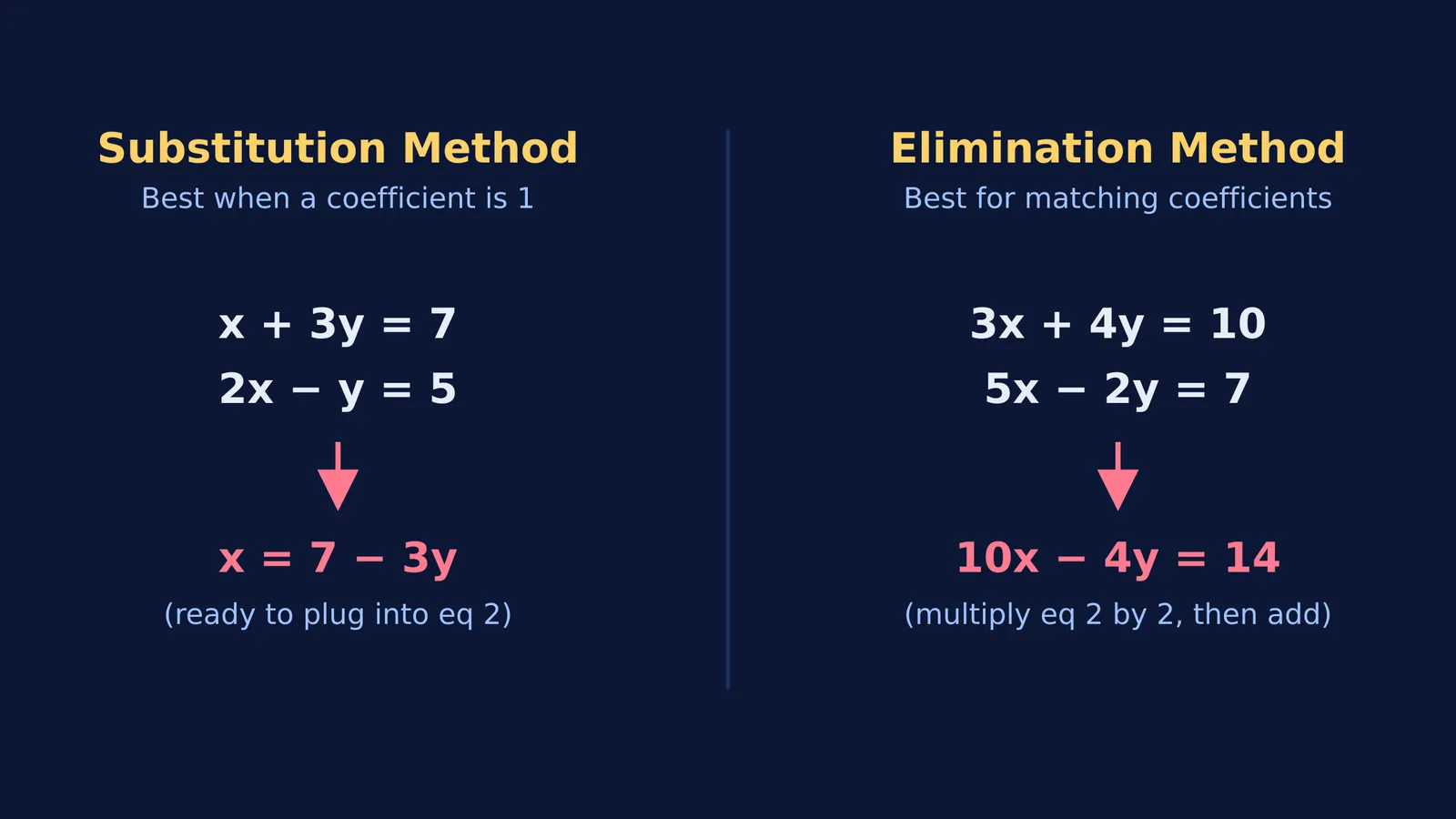
Consider this system:
x + 3y = 7
2x − y = 5
In the first equation, the x has a coefficient of 1. You can rewrite it as x = 7 − 3y in a single step, without dividing anything. You then substitute (7 − 3y) for x in the second equation. The algebra remains clean and entirely in integers.
When does matching coefficients make elimination quick?
The elimination method (often called the addition method) involves adding the two equations together so that one variable disappears. This is the better choice when your equations are in standard form (Ax + By = C) and no variable has a coefficient of 1.
Consider this system:
3x + 4y = 10
5x − 2y = 7
If you try to isolate x or y here, you will end up dividing by 3, 4, 5, or 2, instantly creating messy fractions. Instead, look at the y coefficients: +4 and −2. If you multiply the entire second equation by 2, it becomes 10x − 4y = 14. When you add this new equation to the first one, the +4y and −4y cancel each other out perfectly.
This method is the backbone of many advanced topics, including matrix operations, which you can see at work when determining the consistency of linear equations by the matrix method.
How to check your solution for linear equations?
A common mistake students make is finding their ordered pair (x, y) and moving straight to the next question. Because solving a system involves so many sign changes and multiplications, a single dropped negative can throw off the entire result.
Always check your answer by substituting your final x and y values back into both of the original equations. If your solution is correct, both equations will form a true statement, such as 8 = 8. If one of them yields 5 = 7, you know an error occurred.
If you frequently find yourself tracing back through arithmetic errors, the Fermi Problem Library has worked problems with a step-by-step solver that explains the reasoning rather than just printing an answer. This helps you spot exactly where a sign was dropped or a fraction was mishandled, improving your accuracy when studying linear equations in Class 10: substitution, elimination, graphs.


