

On this page
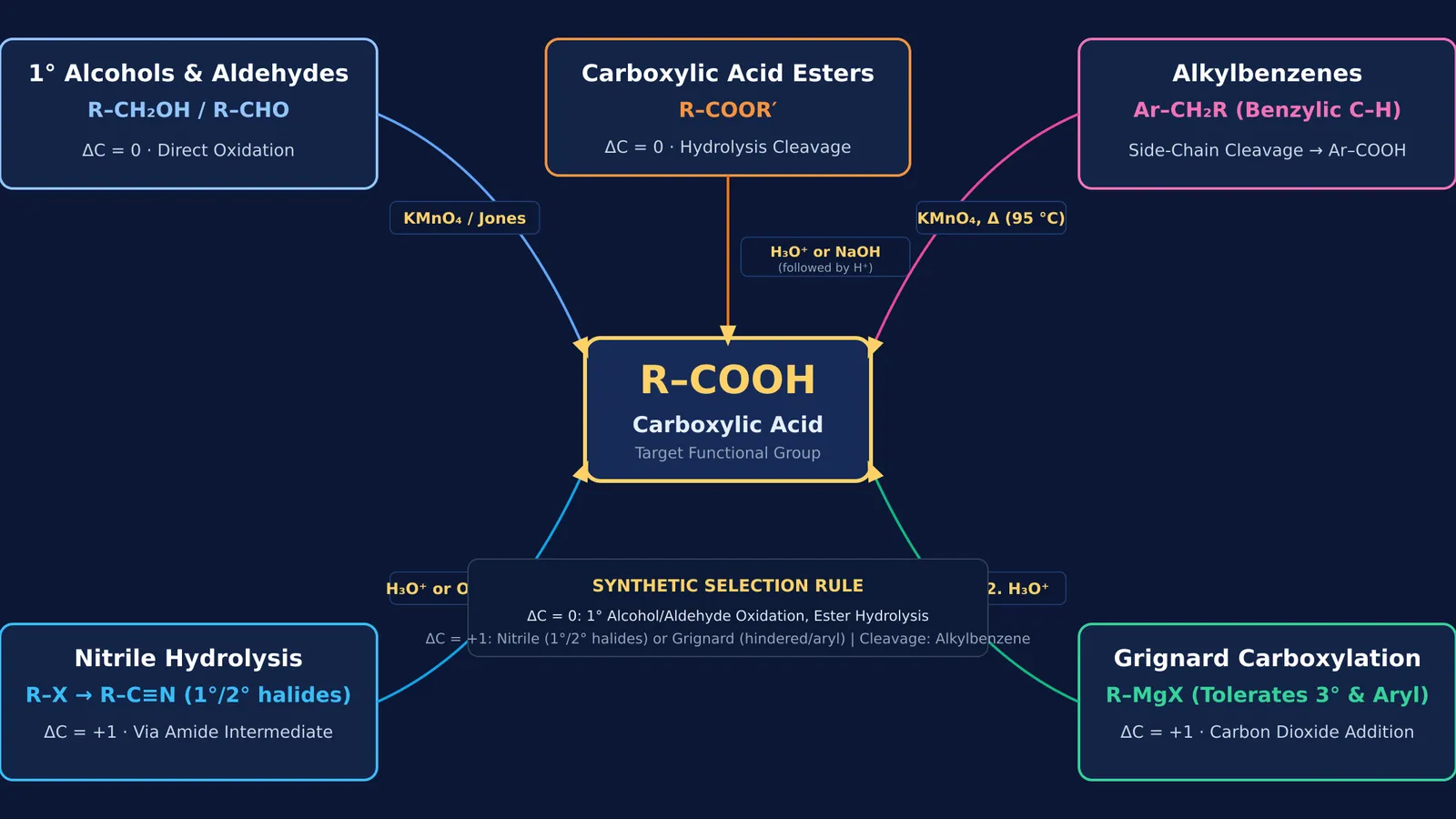
Selecting the right preparation method for a carboxylic acid is a core skill in organic synthesis. The IUPAC Gold Book defines carboxylic acids as oxoacids having the structure RC(=O)OH. While several functional groups convert into this carboxyl arrangement, the choice of pathway depends on whether your synthesis must preserve, increase, or truncate the starting carbon skeleton.
When should you oxidize alcohols or aldehydes?
Direct oxidation is the standard choice when your precursor already has the target carbon skeleton (ΔC = 0).
Primary alcohols undergo vigorous oxidation to carboxylic acids using reagents such as alkaline potassium permanganate (KMnO₄) or chromium trioxide in aqueous sulfuric acid (Jones reagent). As detailed in OpenStax Organic Chemistry Section 20.5, primary alcohols such as 4-methyl-1-pentanol convert cleanly into their corresponding carboxylic acids.
When starting from an aldehyde, oxidation requires far milder conditions. Aldehydes oxidize readily with gentle reagents such as ammoniacal silver nitrate in Tollens' and Fehling's tests, leaving other oxidation-sensitive functional groups unaffected.
Why does side-chain oxidation convert alkylbenzenes to benzoic acid?
Aromatic carboxylic acids can be prepared through side-chain oxidation. Heating an alkylbenzene with alkaline KMnO₄ or chromic acid degrades the aliphatic side chain to a single carboxyl group attached directly to the aromatic ring.
The key prerequisite is at least one benzylic hydrogen on the carbon bonded to the ring. Whether the side chain is a methyl group (toluene) or a longer propyl group, vigorous oxidation at 95 °C yields benzoic acid, with excess carbons cleaved as carbon dioxide, as noted in OpenStax Organic Chemistry.
Substrates lacking a benzylic C–H bond, such as tert-butylbenzene, resist oxidation entirely.
How do nitrile hydrolysis and Grignard carboxylation add one carbon?
When your starting material has one fewer carbon atom than the target acid (ΔC = +1), you must construct a new carbon-carbon bond. Two main methods accomplish this elongation:
In the nitrile route, an alkyl halide first reacts with cyanide through ambident nucleophile substitution. Subsequent heating with aqueous acid or alkali hydrolyzes the nitrile. As shown in Enzyme Catalysis in Organic Synthesis, nitrile hydrolysis passes through an amide intermediate before yielding the carboxylic acid. Because the initial cyanide displacement proceeds by an SN2 mechanism, this route is limited to primary and unhindered secondary halides; tertiary halides undergo E2 elimination instead.
For sterically hindered substrates, organometallic carboxylation is the preferred route. Treating an alkyl, aryl, or vinyl halide with magnesium in dry ether forms a Grignard reagent (R–MgX). The nucleophilic reagent attacks carbon dioxide (dry ice) to form a magnesium carboxylate salt, which yields the carboxylic acid upon acidic workup. A classic procedure in Organic Syntheses illustrates this with the synthesis of dl-methylethylacetic acid from sec-butylmagnesium chloride. This method tolerates tertiary and aryl halides, provided the molecule contains no acidic protons (-OH, -NH₂) or carbonyl electrophiles.
How does ester hydrolysis complete the synthesis toolkit?
Carboxylic acids can also be recovered from ester derivatives. As outlined in Hydrolysis in Drug and Prodrug Metabolism, cleavage proceeds through two distinct mechanisms:
Acid-catalyzed hydrolysis: Heating an ester with dilute aqueous acid establishes an equilibrium between the ester, carboxylic acid, and alcohol. This process represents the microscopic reverse of the Fischer esterification mechanism and requires excess water to push conversion toward the acid.
Base-promoted saponification: Reaction with aqueous sodium hydroxide converts the ester into a resonance-stabilized carboxylate salt. Subsequent acidification with dilute mineral acid isolates the free carboxylic acid in high yield.
Which preparation method fits your starting material?
To select the right synthetic pathway during exam problem solving, follow this four-step decision framework:
Count the carbons: If the carbon skeleton is unchanged (ΔC = 0), choose oxidation of primary alcohols or aldehydes. If you need one additional carbon (ΔC = +1), choose nitrile hydrolysis or Grignard carboxylation.
Evaluate steric hindrance: Use cyanide substitution for unhindered primary halides. Choose Grignard carboxylation for tertiary or aryl halides where SN2 displacement fails.
Screen functional groups: Avoid Grignard reagents if the molecule contains protic groups (-OH, -NH₂) or reactive carbonyls.
Check benzylic positions: When converting an alkylbenzene to benzoic acid, verify that the benzylic carbon bears at least one hydrogen atom.
Wrong-method mistakes often appear in multi-step conversion questions. The Fermi Problem Library has worked problems with a step-by-step solver that explains the reasoning rather than printing an answer. For reviewing how these reactions connect across organic chemistry, the Fermi Concept Library covers every concept in chemistry, each with its own lesson and its place in the map.


