On this page
Boshi Sen began by measuring how plants respond to stimuli and ended up trying to get more food out of Himalayan fields. His kitchen laboratory grew into a national institute that still breeds crops for the hills.
Who was Boshi Sen?
Basiswar "Boshi" Sen (1887–1971) was an Indian agricultural scientist born in Bishnupur, in Bengal's Bankura district, according to his Wikipedia biography. Sister Nivedita introduced him to Jagadish Chandra Bose, and he worked with Bose for several years, once travelling with him to London.
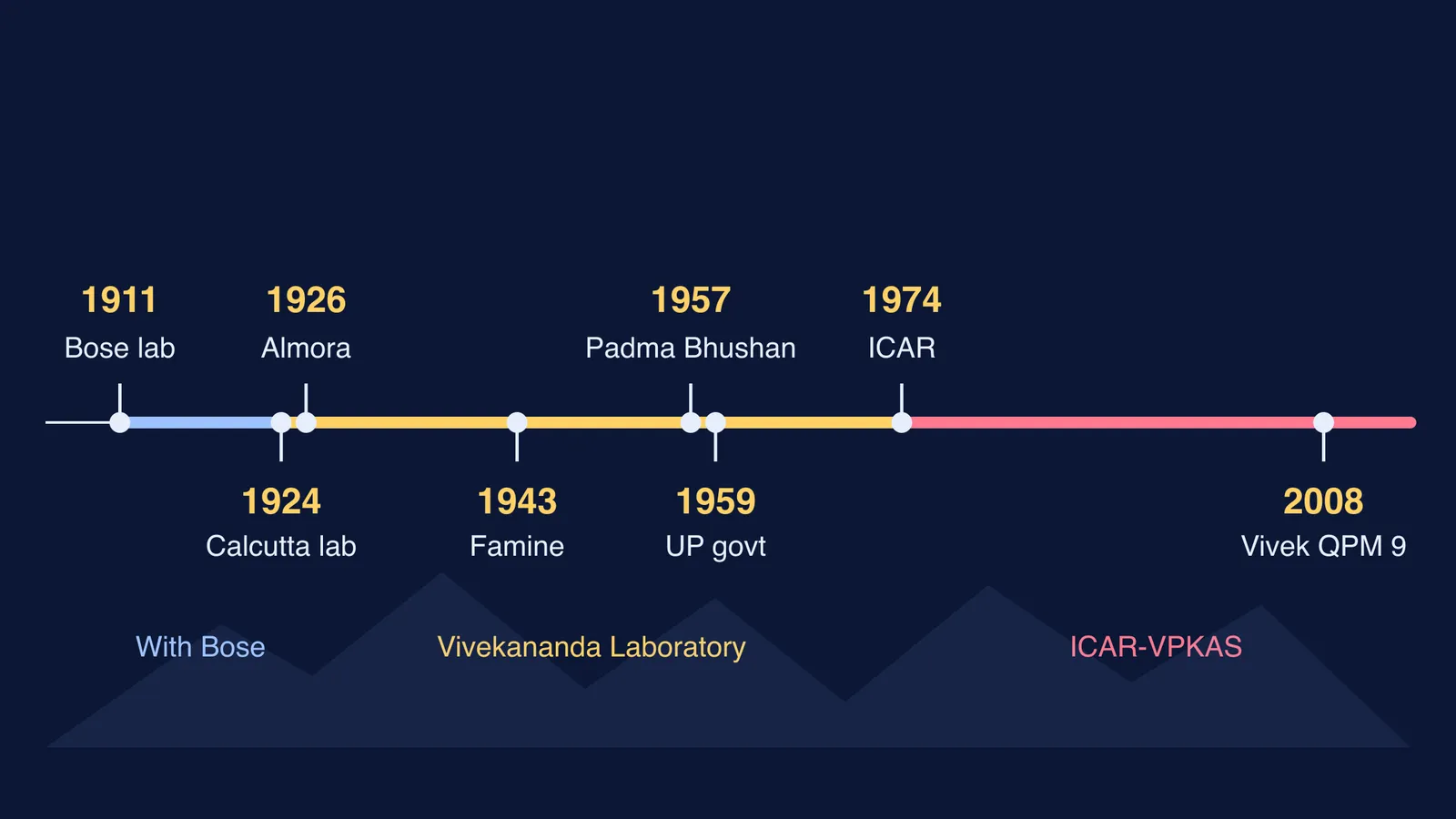
An account of Sen's life by Vinayak Lohani says he joined Bose's Presidency College laboratory in 1911 on a stipend of twenty rupees and stayed for twelve years. Later, at the Bose Institute, he worked on topics such as how carbon dioxide affects the pulsations of the telegraph plant, Desmodium gyrans. Our explainer on J.C. Bose's millimetre waves and plant signals covers what that lab was measuring.
What did the Vivekananda Laboratory do?
Sen started his own kitchen laboratory on 4 July 1924, the anniversary of Swami Vivekananda's death, and named it the Vivekananda Laboratory (Lohani). A 2007 Tribune review of a book about Sen and his wife, the American writer Gertrude Emerson Sen, says he "moved out to the cool climes of the Almora hills in 1926".
After the Bengal Famine of 1943, his Wikipedia biography says, Sen moved from plant-cell research to applied work on food grains: plant introduction, plant breeding, and producing hybrid seed of maize, jowar, bajra and onion. He received the Padma Bhushan in 1957 (list of recipients). In 1959 the laboratory was transferred to the Uttar Pradesh government, which allotted 215 acres for research, and in 1974 it was absorbed by the Indian Council of Agricultural Research (ICAR).
Today it is ICAR's Vivekananda Parvatiya Krishi Anusandhan Sansthan (VPKAS) in Almora, which marked its 98th Foundation Day in 2021 with a tribute to Sen.
Why do hill crops need different breeding?
Three conditions in the hills shape what a useful variety looks like.
Water. An ICRIER study of Uttarakhand's hill districts notes that the Green Revolution of the 1960s helped areas that already had irrigation, "but this was not possible in the hills because of a lack of these resources". ICAR's 2009–10 annual report says only 10% of the area in hilly regions is irrigated, and several of the Almora varieties it lists are meant for rainfed areas.
Cold. The same ICAR report describes hill fodder trees being severely affected by "low temperature and frost during winters".
Small farms. The ICRIER study found that, on average, about two-thirds of land holdings in the hill districts were marginal, averaging less than 0.66 hectare, and it lists low use of quality seed among the reasons yields lagged. The authors write that the scope for "modern input-intensive agriculture is severely constrained in the hill regions" and point to "quality seeds suitable for hill agriculture" as one opportunity.
What has the Almora lab bred for the Himalayas?
The ICAR 2009–10 report lists Almora releases that read like answers to those constraints:
Vivek Maize Hybrid 33: extra-early, 85–90 days in the hills, with tolerance to turcicum and maydis leaf blight, two fungal diseases of maize.
VL Bean 2: a bush bean for Uttarakhand's mid-hills that matures in 46–50 days and gave 21.29% more yield than VL Bauni Bean 1.
Nutrition is a target too. A 2012 paper in Plant Breeding by scientists at the Almora institute and partners describes using marker-assisted backcrossing to move the opaque-2 gene into both parent lines of Vivek Maize Hybrid 9. The result, Vivek QPM 9, released in 2008, had 41% more tryptophan and 30% more lysine than the original hybrid with yield on par. The authors say this short-duration hybrid was adopted in several Himalayan hill states. In 2021 the institute released VL QPM Hybrid 59, the finger millet VL Mandua 382 and VL Cherry Tomato 1 (ICAR).
How do you read a crop variety like a breeder?
Every entry in a variety list answers four questions, and together they show what the breeder was solving for.
Where? The adaptation region or agro-ecology it is meant for.
How long? Days to maturity, set against the local growing season.
Against what? The diseases or stresses it tolerates.
Compared with what? The check variety its yield was measured against.
Worked example, VL Bean 2 from the ICAR 2009–10 variety list:
Where: Uttarakhand mid-hills, so do not assume it suits the plains.
How long: 46–50 days, which you would check against the local season.
Against what: the report names no disease tolerance, so do not claim one.
Compared with what: 21.29% more yield than VL Bauni Bean 1.
The same ideas appear in NCERT's plant breeding chapter, set out step by step in our guide to plant breeding steps and disease-resistant varieties.
If terms like inbred line or backcross still feel slippery, the Fermi Concept Library gives each biology concept its own lesson and its place in the map.
For the plains side of the same story, read how M. S. Swaminathan shaped the science of India's Green Revolution.