On this page
Jagadish Chandra Bose worked with radio waves only a few millimetres long in Calcutta in the 1890s. Later he turned to plants and measured their electrical responses. This post sticks to what primary and peer-reviewed sources record, and turns his radio work into a calculation you can do in two minutes.
Who was J. C. Bose?
Bose was born on 30 November 1858 in Bengal, according to Meghnad Saha's obituary of him for the Royal Society. The radio astronomer D. T. Emerson's IEEE paper on Bose's work, published in 1997, fills in the rest. Bose went to England in 1880 to study medicine, moved to Christ's College, Cambridge, to study natural science, and in 1884 received a Cambridge B.A. and a London B.Sc. He then taught physics at Presidency College, Calcutta, where he was known for classroom demonstrations. Among his students was S. N. Bose, later of Bose-Einstein statistics.
What did Bose do with radio waves?
Emerson's paper describes the work in detail:
In 1894 Bose turned a small room next to a bathroom at Presidency College into a laboratory and studied refraction, diffraction and polarisation of electromagnetic waves.
In 1895 he gave a public demonstration in Calcutta, using the waves to ring a bell at a distance and to explode some gunpowder.
In 1897, invited by Lord Rayleigh, he reported his experiments at the Royal Institution in London. His wavelengths ranged from 2.5 cm down to 5 mm.
His apparatus included waveguides, horn antennas, dielectric lenses and polarisers. One polariser was a railway timetable with sheets of tinfoil between the pages.
He built receivers from a variety of junctions, including galena crystals, plotted their current-voltage curves, and noticed they did not obey Ohm's law.
He patented a detector. US Patent 755,840, "Detector for electrical disturbances", was filed on 30 September 1901 and granted on 29 March 1904 (Google Patents record). Emerson notes that in 1954 Pearson and Brattain credited Bose with priority for using a semiconducting crystal as a radio detector.
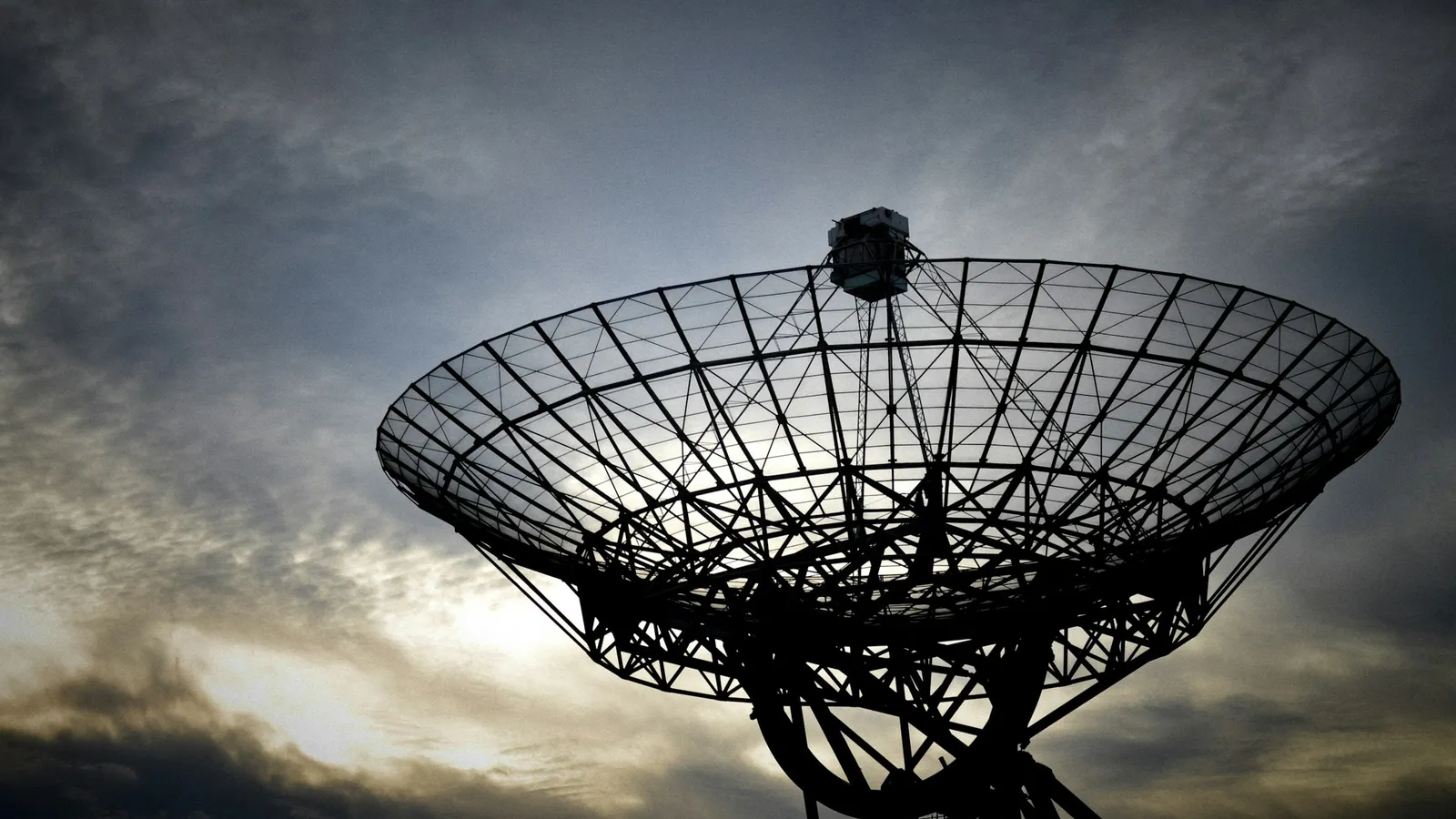
One of Bose's devices found a use a century later. He studied two prisms separated by a small air gap: when the prisms are far apart, total internal reflection sends the wave back; when they touch, it passes through; a small gap lets part of it through. Emerson describes adjustable prism attenuators based on this idea in a 1.3 mm receiver built for the NRAO 12 Meter Telescope in the 1990s.
Worked example: how high were Bose's frequencies?
Use c = f × λ, with c = 3.0 × 10^8 m/s.
For λ = 5 mm = 5 × 10^-3 m: f = (3.0 × 10^8) / (5 × 10^-3) = 6 × 10^10 Hz = 60 GHz.
For λ = 2.5 cm = 2.5 × 10^-2 m: f = 1.2 × 10^10 Hz = 12 GHz.
Hertz, by comparison, used a wavelength of 66 cm (also from Emerson). That gives about 4.5 × 10^8 Hz, or 450 MHz.
So Bose's shortest waves were more than 100 times higher in frequency than Hertz's. That is the millimetre-wave band Emerson's paper is about. You can feel the scale by sketching the waves on the same axis, as in our waves and simulations guide.
What did Bose find in plants?
Around the end of the 19th century, Emerson writes, Bose's interests turned from electromagnetic waves to how plants respond to stimuli. In 1902 he published Response in the Living and Non-Living, which collected his papers comparing electrical responses in metals, animal tissue and plants. The list includes "On Electric Response of Ordinary Plants under Mechanical Stimulus", in the Journal of the Linnean Society, 1902.
A 2019 review in the Indian Journal of Medical Research by Tandon says his findings on plant electrical signalling were met with "disbelief and contradiction" at the time and that little follow-up work happened for decades. It credits recent research with renewed interest "confirming most of Bose's observations", and places him at the origin of what is now called plant neurobiology. That last phrase is a label for a research field, not a claim that plants think the way animals do.
Bose retired from Presidency College in 1915. Two years later the Bose Institute was founded in Calcutta; he was elected a Fellow of the Royal Society in 1920 and died in 1937 (Emerson).
What students can take from Bose
Build the apparatus you need. He designed his own transmitters, receivers and polarisers, and some survive at the Bose Institute.
Measure before you claim. He plotted current-voltage curves and reported that his junctions did not obey Ohm's law, rather than assuming they would.
Ideas cross subjects. Total internal reflection from your ray optics chapter became a microwave component.
If waves are hard to picture from equations alone, the Fermi Simulation Lab has interactive simulations for ideas that are easier to see than to read. Try changing the wavelength and watching the frequency change, then redo the worked example above by hand.