On this page
August von Wassermann was a German bacteriologist, born in Bamberg in 1866, who joined Robert Koch's institute in Berlin in 1890, according to his entry in the Deutsche Biographie. In 1906, with Albert Neisser and Carl Bruck, he published "Eine serodiagnostische Reaktion bei Syphilis" (a serodiagnostic reaction in syphilis) in the Deutsche medizinische Wochenschrift, as the historyofmedicine.com bibliography records. Peter Robertson's 2007 review in Microbiology Australia calls it the first diagnostic serological test.
Fritz Schaudinn and Erich Hoffmann had identified the germ behind syphilis only in 1905, according to Schaudinn's Wikipedia biography. Hideyo Noguchi later tracked the same bacterium into the brain. Wassermann credited his test to Jules Bordet and Octave Gengou's work on complement fixation and to Paul Ehrlich's ideas about how antibodies form, as his Wikipedia biography notes. You can read more about Paul Ehrlich's work on antibodies and the magic bullet.
How did the Wassermann test work?
The test never looked for the germ itself. It looked for antibodies in the patient's blood.
Complement is a set of proteins in blood serum that can burst cells once antibodies have marked them; Jules Bordet's work on complement explains where the idea came from. The key fact Wassermann used is that an antigen-antibody pair binds complement and uses it up. That is what "fixation" means.
The complement fixation test runs in five steps:
Heat the patient's serum to destroy its own complement.
Add the antigen. For the Wassermann test, this was a liver extract, "initially from fetuses", according to the CDC's 2024 laboratory recommendations.
Add a known amount of complement and let the mixture stand.
Add the indicator: sheep red blood cells already coated with antibody against sheep cells.
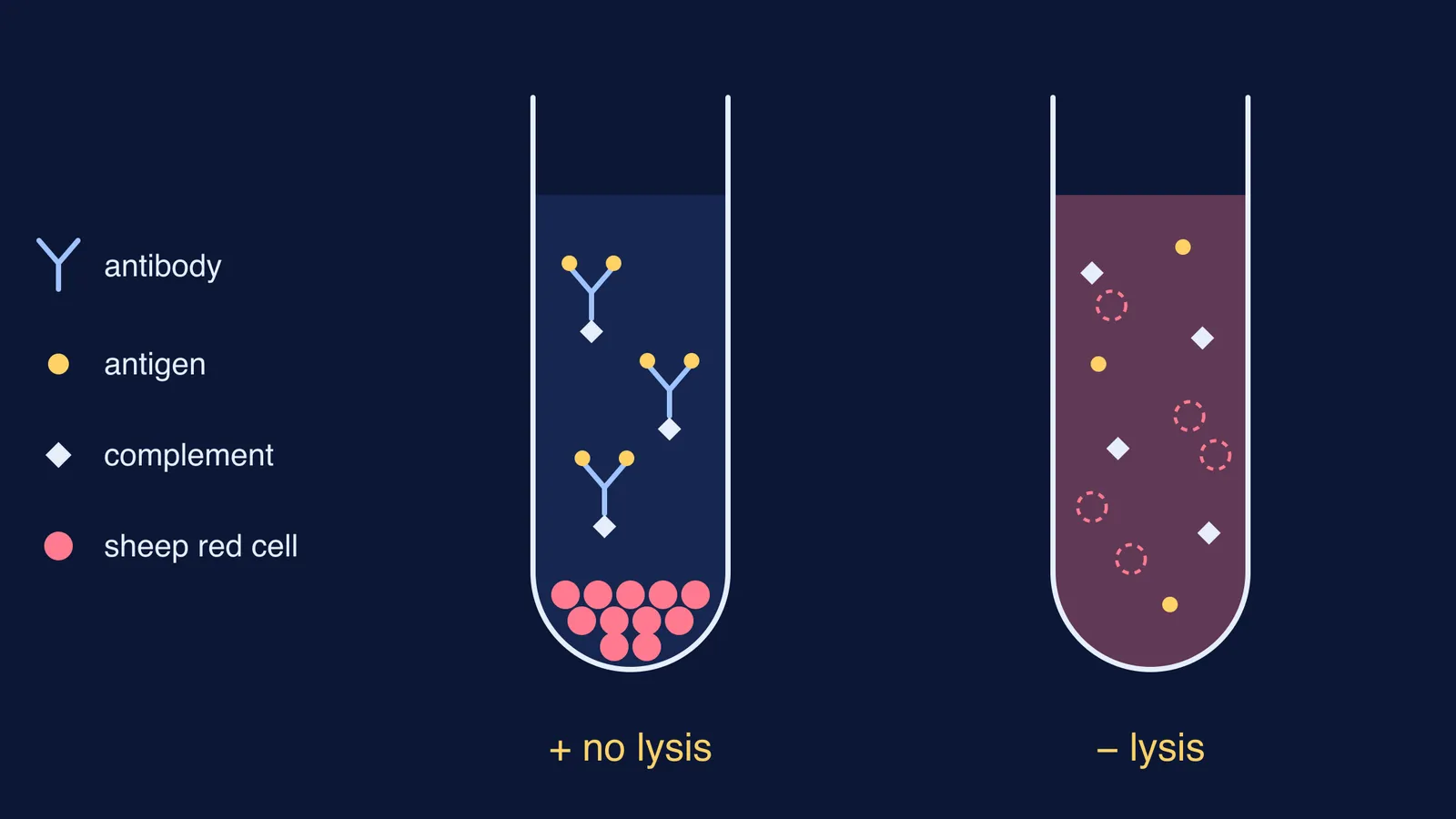
Read the tube. If free complement is left, it bursts the sheep cells and the liquid turns pink. Pink means negative. No bursting means positive.
Worked example: can you read the two tubes?
Two serum samples go through the same steps. In tube A, the red cells settle into a red button at the bottom under clear liquid. In tube B, the liquid is evenly pink and there is no button.
Ask what bursts sheep cells. Free complement does, once the cells carry anti-sheep antibody.
Tube A has whole cells, so no free complement was left. Something used it up: the patient's antibodies bound the antigen. Tube A is positive.
Tube B has burst cells, so complement was still free. Nothing in the serum bound the antigen. Tube B is negative.
Now test your logic. Suppose the heating step was skipped and the serum kept its own complement. The extra complement could burst the cells even in a positive sample, so a real positive could look negative. That is why the heating step matters.
Why was the Wassermann test so often wrong?
The antigen was not really syphilis-specific. The reaction can also turn positive in lupus, malaria and tuberculosis, as the Wassermann test entry on Wikipedia notes. The Deutsche Biographie adds that the team's theoretical assumptions were wrong, that it long stayed unclear what the test actually detected, and that its details were only worked out in the 1940s.
The problem survives today. The CDC says the antigens used in tests of this family are found both in the syphilis bacterium's membranes and in the host's own membranes (CDC, 2024). Reactive results caused by something other than syphilis, called biologic false positives, have been estimated to occur in 0.2% to 0.8% of the population (CDC, 2024).
In a town of 10,000 people without syphilis, 0.2% to 0.8% is 20 to 80 people whose screening test could come back reactive anyway. That is why one reactive result is never treated as the whole answer.
What replaced the Wassermann test?
The RPR and VDRL tests use cardiolipin, lecithin (phosphorylcholine) and cholesterol as antigens, according to the CDC. When a first test is reactive, the CDC recommends using these in combination with treponemal tests, which detect antibodies to antigens of the syphilis bacterium itself.
Syphilis still matters. The WHO estimates that 8 million adults aged 15 to 49 acquired syphilis in 2022, and says the infection is treatable and curable. The WHO also notes that rapid tests can give results in a few minutes.
How do you remember complement fixation for a biology exam?
Use this three-line chain whenever a question mentions complement fixation:
Antibody plus antigen uses up complement.
No complement left means no lysis of the indicator cells.
No lysis means positive.
Then check yourself with three questions. What is the indicator, and why must it already carry antibody? Why is the patient's serum heated? What would a false positive look like in the tube?
If antigen, antibody and complement still blur together, the Fermi Concept Library gives every concept in biology its own lesson and its place in the map, so you can see how the three connect. If you are not sure where to start on immunity as a whole, Fermi's AI tutor can work out what you already know and build a plan for the session.