

On this page
Most textbooks say antibodies fight bacteria. That is true, but in 1895 a young Belgian doctor showed that antibodies on their own often cannot finish the job. They need a partner that is already in your blood and that is destroyed by mild heat. That partner is complement, and the experiment that revealed it fits in three test tubes.
Who was Jules Bordet?
Jules Bordet was born in Soignies, Belgium, on 13 June 1870, qualified as a doctor in Brussels in 1892, and went to the Pasteur Institute in Paris in 1894, according to his Nobel Prize biography. In 1901 he returned home to found the Pasteur Institute in Brussels, and he died on 6 April 1961.
In 1895 he was working in the laboratory of Élie Metchnikoff at the Pasteur Institute, as the American Association of Immunologists notes. Metchnikoff is best known for cells that eat microbes. Bordet chose a different question: what in the liquid part of blood kills bacteria?
What did Bordet's 1895 experiment show?
He started from the Pfeiffer phenomenon: cholera bacteria (vibrios) injected into the abdomen of an immunised guinea pig fall apart, as described in a 2019 tribute in Frontiers in Immunology.
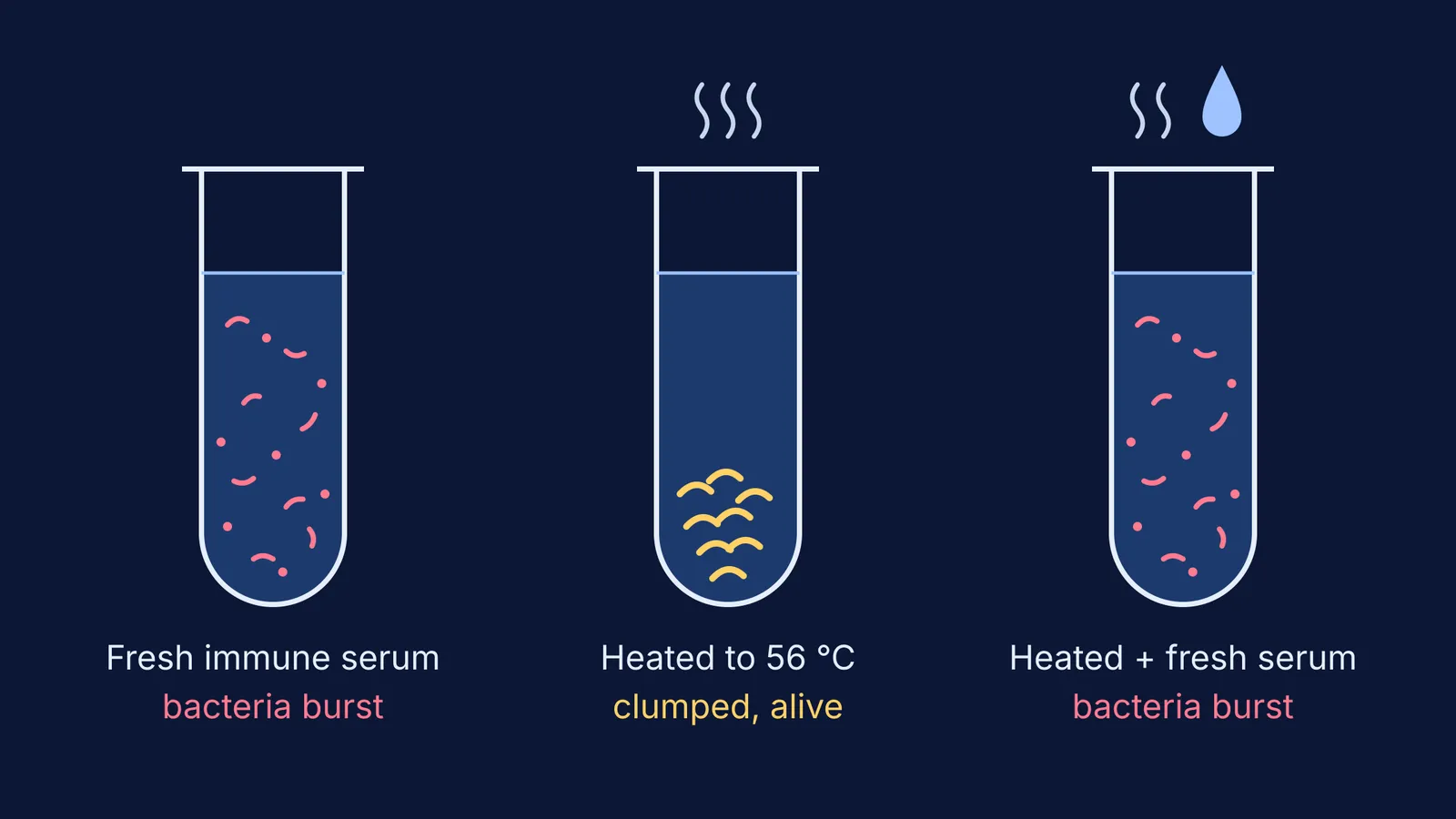
Bordet moved the reaction into glass. The same paper sets out what he found:
Fresh serum from an immunised animal killed and dissolved the vibrios.
The same serum heated to 56 °C for 30 minutes still made the vibrios clump together, but they stayed alive.
Adding fresh serum from an animal that had never been immunised to the heated serum brought the killing back.
The clumping factor survived heating and came from immunised animals: that is the antibody. The killing factor was destroyed by heat and was present even in normal blood: that is complement. Bordet called it alexin, a word coined by Hans Buchner, as the Frontiers tribute explains, and the AAI profile notes it is present in the blood of all animals, immunised or not.
In 1898 he found the same two-part system at work on red blood cells: a heat-sensitive factor in normal serum helped burst them, according to the Frontiers tribute.
How does complement burst bacteria?
We now know complement is not one substance but a cascade of plasma proteins, made mainly by the liver, that switch each other on, as described in a 2015 review by Merle and colleagues. The same review explains three pathways that start it: classical, lectin and alternative.
The classical pathway is the one Bordet saw. A protein called C1q recognises IgG and IgM antibodies bound in immune complexes, and the cascade runs from there. Near its end, C5b, C6, C7, C8 and C9 assemble into the membrane attack complex, which punches pores about 10 nm wide in the target membrane, according to Merle and colleagues. Enough pores can make the cell burst. Another fragment, C3b, tags bacteria so that phagocytes can eat them more easily, which links Bordet's serum work to Metchnikoff's cells.
For a refresher on the antibodies themselves, see our explainer on the H2L2 structure of IgA, IgM, IgE and IgG.
How do you remember antibody vs complement?
Try this before reading the answers. Predict what happens in each tube of cholera vibrios, set up as in Bordet's experiment:
Tube A: fresh serum from an immunised animal.
Tube B: the same immune serum, heated to 56 °C.
Tube C: the heated immune serum, plus fresh serum from an animal that was never immunised.
Answers: Tube A gives burst bacteria, because fresh immune serum holds both antibody and complement. Tube B gives clumps of live bacteria, because antibodies survive heat and complement does not. Tube C gives burst bacteria again, because the heated serum supplies antibody and the fresh normal serum supplies complement.
The pattern behind all three:
Antibody: specific, heat-stable, made after exposure or vaccination.
Complement: non-specific, heat-sensitive, already present in normal serum.
Together: the antibody marks the target, complement destroys it.
To keep the fluid parts of blood straight, see our guide to plasma vs serum. For where antibodies fit in the wider immune response, read humoral vs cell-mediated immunity.
If the cascade still feels like a list of letters, the Fermi Concept Library covers every concept in biology, each with its own lesson and its place in the map, so you can see how the ideas connect.
Why did Bordet's discovery matter?
Bordet turned his finding into a test. In 1901, with Octave Gengou, he developed the complement fixation test, the method August von Wassermann later built his syphilis test on, according to the AAI. In 1906 the pair grew the whooping cough bacterium, now called Bordetella pertussis, as his Nobel biography records.
He received the 1919 Nobel Prize in Physiology or Medicine "for his discoveries relating to immunity", awarded on 28 October 1920, according to the Frontiers tribute.
Next time you read that antibodies kill bacteria, remember Bordet's tubes: the antibody points, complement punches.


