On this page
For years we were told the Milky Way and Andromeda will crash in about 4 billion years. Then a 2025 study made it closer to a coin toss, and a 2026 study pushed the odds back up. Here is how the speed is measured, what each study found, and three calculations you can check with Class 11 physics.
Will Andromeda collide with the Milky Way?
The honest answer in 2026 is "likely, but not settled". In 2012, NASA said its astronomers could "predict with certainty" the collision, expected about four billion years from now (NASA, 2012). In 2025, Till Sawala of the University of Helsinki and colleagues ran 100,000 simulations with 22 uncertain inputs and found approximately a 50-50 chance of the two galaxies colliding within the next 10 billion years (ESA/Hubble release; Sawala et al., Nature Astronomy).
The same release puts the chance of a head-on collision within 4 to 5 billion years at around 2% (ESA/Hubble). Even in a merger, stars are so far apart they will not hit one another (NASA, 2012).
How do astronomers measure Andromeda's approach speed?
A galaxy's velocity has two parts, and they are measured in completely different ways.
Towards or away from us (radial velocity): measured with the Doppler effect. Light from a source moving towards you is squeezed to shorter, bluer wavelengths. NASA says this showed Andromeda approaching at about 250,000 miles per hour, roughly 112 km/s (NASA, 2012).
Across the sky (tangential or proper motion): measured by photographing the same patches of stars over years and tracking how far they shift. Hubble's team did this over a five-to-seven-year period (same source).
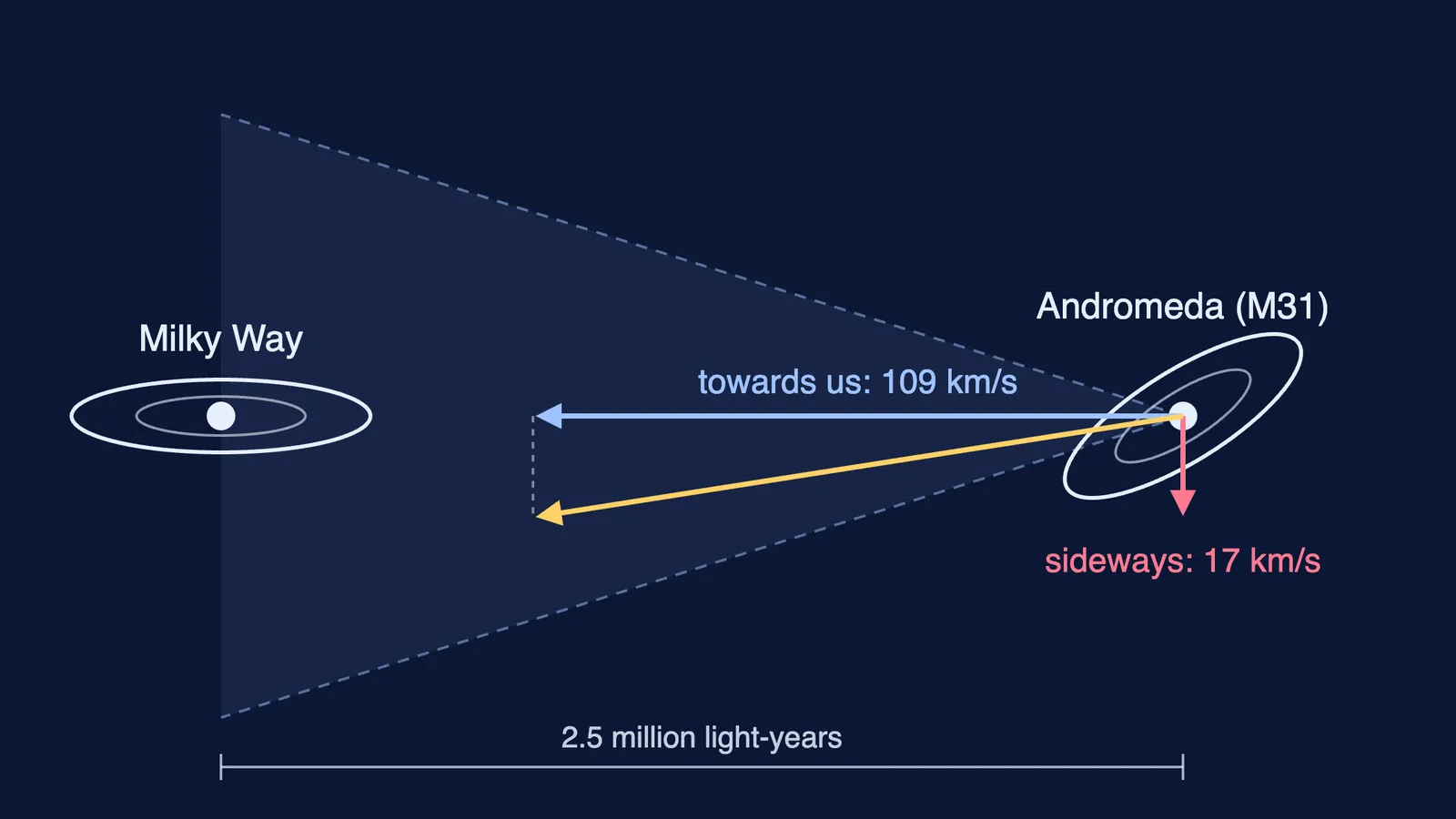
There is a catch with the Doppler part: the Sun itself orbits the centre of the Milky Way, so the raw shift mixes Andromeda's motion with ours. After correcting for the Sun's motion, van der Marel and colleagues found a radial velocity of 109.3 ± 4.4 km/s towards the Milky Way and a sideways velocity of just 17 km/s, under 34.3 km/s at 1-sigma confidence (van der Marel et al., The Astrophysical Journal, 2012; arXiv abstract).
If the Doppler effect feels slippery, our explainer on why a moving source and a moving observer give different pitch works through the sound version first.
Why does the sideways speed matter so much?
A small sideways speed means a near head-on path; a larger one lets the galaxies swing past each other. NASA said whether the encounter will be "a miss, glancing blow, or head-on smashup" depends on this sideways motion (NASA, 2012).
The 2025 study added the next two most massive galaxies in our Local Group. Andromeda's companion M33 makes a merger more likely; the Large Magellanic Cloud, whose orbit runs perpendicular to the Milky Way-Andromeda orbit, makes it less likely (Sawala et al., 2025).
In 2026, another team used the same framework with the latest Gaia proper motions for Andromeda and M33, corrected for systematic offsets in Gaia's measurements. Their main model gives a 90% merger probability with a median merger time of 6.5 billion years. But across the 2-sigma range of Andromeda's measured proper motion, the probability runs from 64.7% to 100%, and they say proper motions accurate to about 2 microarcseconds per year are needed to settle it (Wu et al., The Astrophysical Journal Letters, 2026; arXiv abstract).
Can you check these numbers yourself?
Yes. Use these published values: distance 2.5 million light-years (NASA, 2012), radial speed 109.3 km/s and sideways speed 17 km/s (van der Marel et al., 2012). One light-year is about 9.46 × 10^12 km.
Naive travel time. Distance = 2.5 × 10^6 × 9.46 × 10^12 ≈ 2.37 × 10^19 km. Divide by 109.3 km/s: about 2.2 × 10^17 s, or roughly 6.9 billion years. Real predictions are shorter because gravity speeds Andromeda up as it falls in.
Doppler shift. Δλ/λ = v/c = 109.3 / 300,000 ≈ 3.6 × 10^-4. For the red hydrogen line at 656.3 nm, that is a blueshift of about 0.24 nm. Small, but a spectrograph can measure it.
How tiny the sideways drift is. Proper motion (arcseconds per year) = v / (4.74 × d), with v in km/s and d in parsecs; 4.74 km/s is one astronomical unit per year. With d ≈ 766,000 pc and v = 17 km/s, you get about 4.7 microarcseconds per year, which is why a 2 microarcsecond error target matters.
Exercise 3 is the real lesson: the approach speed is well measured, but the forecast hinges on a sideways drift of a few millionths of an arcsecond a year. Orbits under gravity are easier to see than to read; the Fermi Simulation Lab has interactive simulations for ideas like these, and if a step such as the parsec conversion trips you up, the Fermi Concept Library has a lesson for each concept.
For where we sit in our own galaxy, read why the Milky Way looks like a band across the sky, and for the kind of galaxy a merger would leave behind, see Hubble's tuning fork diagram and galaxy types.