On this page
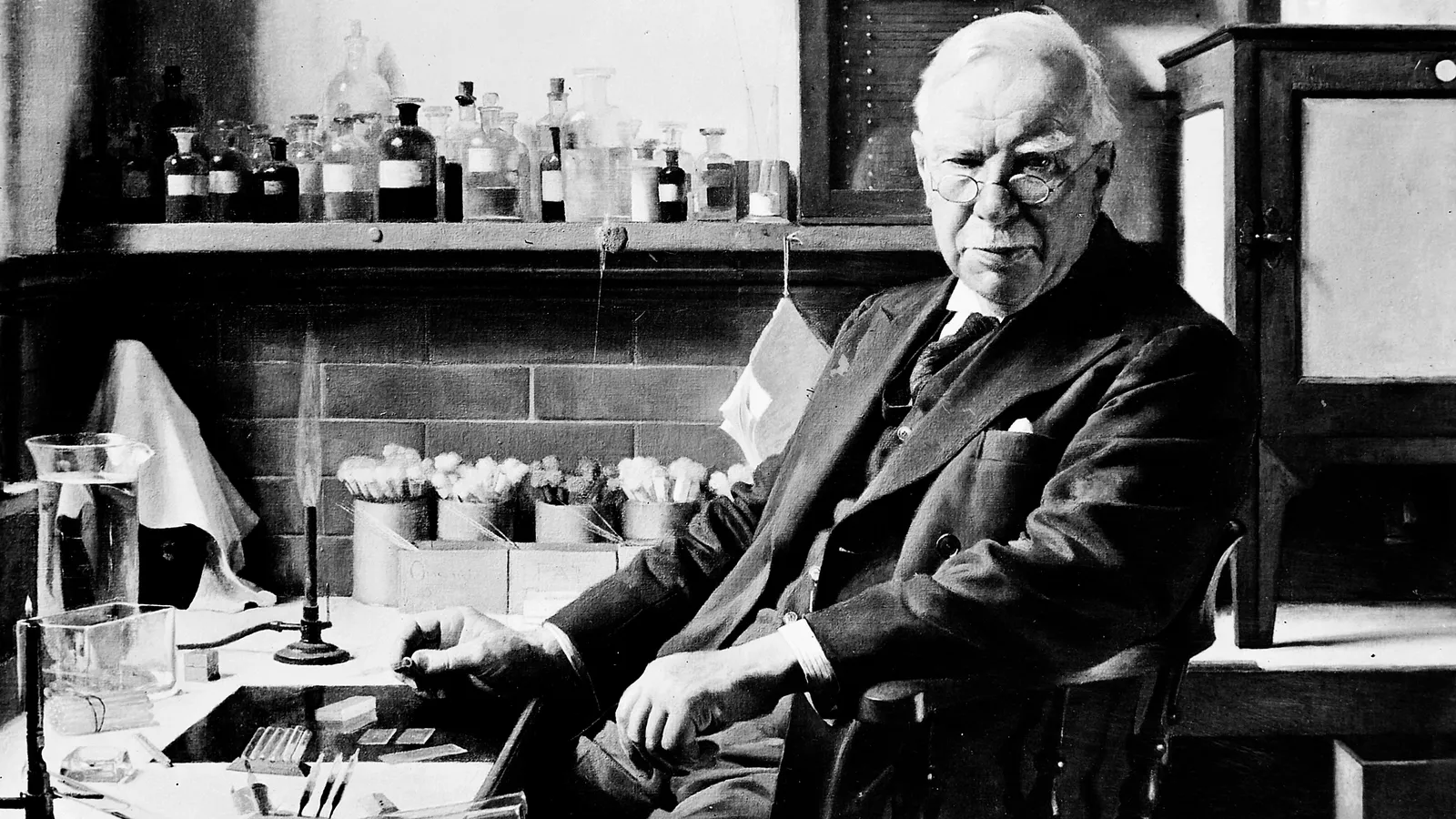
In 1896 Almroth Wright, a pathologist teaching at the British Army's medical school, began injecting people with typhoid bacteria that had already been killed by heat. Within three years he had inoculated thousands of soldiers in India. The arguments over his numbers are as instructive as the vaccine itself.
Who was Almroth Wright and what vaccine did he make?
Almroth Wright (1861–1947) began his typhoid vaccine research in 1896 and tested heat-killed typhoid bacteria first on himself and a co-worker, then on 15 soldiers, according to the Institute of Biomedical Science. From 1892 he was professor of pathology at the Army Medical School at Netley, where he worked on blood coagulation and bacteriology (Complete Dictionary of Scientific Biography).
The vaccine itself was simple. In his own 1904 book, A Short Treatise on Anti-Typhoid Inoculation, Wright describes using typhoid cultures sterilised by exposure to a temperature of 60°C. Heat kills the bacteria so they cannot multiply, but their surface molecules (antigens) survive, so the body still learns to make antibodies against them. That is active immunity: your own immune system does the work and keeps a memory.
How was the typhoid vaccine tested on soldiers in India?
Before India came Maidstone. During the 1897 typhoid outbreak there, Wright's vaccine was given to nurses and attendants at Barming Asylum: his own 1904 summary table lists 84 inoculated and 116 not inoculated. None of the 84 caught typhoid, against four cases among the rest, as the Institute of Biomedical Science reports.
India was the large test. Wright served on the India Plague Commission (1898–1900), and the vaccine was tested on soldiers in India (Dictionary of Scientific Biography). In the preface to his treatise, Wright lists the inoculation of 4,000 British soldiers all over India, and the supply of some 400,000 doses during the South African War. In India, and for most soldiers sailing to South Africa, he had to use one large dose. With that dose, he wrote, collapse and rigors (shaking chills) were not unusual, so he later advised two smaller doses where possible.
The army was not convinced. Wright writes that inoculation was suspended at the instance of a newly created Medical Advisory Board. The Royal College of Physicians, asked to judge the statistics, reported on 27 July 1903 that the inoculations brought “a lessened susceptibility to the disease” and that “the case mortality is largely reduced”, as quoted in the same treatise.
Did Almroth Wright really invent the typhoid vaccine?
Not alone. Wright himself wrote that the idea became workable only after Richard Pfeiffer told him, in conversation, that injecting a heated typhoid culture into people produced the typhoid agglutination (antibody) reaction. Wright's first two inoculations appeared in The Lancet on 19 September 1896; Pfeiffer and Wilhelm Kolle published two of their own on 12 November 1896 (Wright, 1904). A 2021 historical study in Vaccine concluded that Pfeiffer, not Wright, gave the first account of human typhoid vaccination (summary). Fairly put: Pfeiffer's claim to priority is strong; Wright took the vaccine to soldiers at scale.
How do you read an old vaccine table?
In 1904 the statistician Karl Pearson pooled typhoid inoculation figures from soldiers serving across the British Empire in the BMJ. A James Lind Library note explains that his correlations averaged 0.226 for inoculation and escaping the disease, which he judged too low to be convincing, and that he proposed inoculating only every second registered volunteer so the groups would be comparable. You can run the same checks yourself:
Turn counts into rates. Maidstone: 0 of 84 inoculated fell ill, and 4 of 116 others did (Institute of Biomedical Science; Wright, 1904). That is 0 against about 34 cases per 1,000 people.
Test how fragile it is. If just one inoculated nurse had fallen ill, the rate would be about 12 per 1,000. Small groups swing hard; Wright himself wrote that when the figures are small, the statistical conclusion is uncertain.
Ask how the groups were chosen. Volunteers may be more careful than those who refuse. That is why Pearson wanted every second volunteer inoculated.
Then look at big numbers. In the First World War, 570 typhoid cases occurred among 604,420 vaccinated British soldiers and 295 among 38,580 unvaccinated (Biselli and colleagues, 2022). That is about 0.9 against 7.6 per 1,000, roughly eight times lower, with 34 deaths against 89.
If rates and ratios like these trip you up, the Fermi Problem Library has worked problems with a step-by-step solver that explains the reasoning rather than printing an answer.
Why does this story matter for biology students?
Wright's vaccine sits behind several textbook ideas: killed vaccines, antibodies, and why a second exposure gets a faster response, which you can graph yourself. Compare it with Gaston Ramon's diphtheria toxoid, which used an inactivated toxin rather than whole bacteria. If any of these terms feel shaky, the Fermi Concept Library gives each biology concept its own lesson and its place in the map.
Today's typhoid vaccines are different products, and questions about them are for a doctor or travel clinic.