
On this page
Look up from your phone to a far wall and your eyes refocus without you noticing. The Swedish eye doctor Allvar Gullstrand spent about twenty years working out how light forms images inside the eye (Nobel ceremony speech, 1911). In 1911 he won the Nobel Prize in Physiology or Medicine "for his work on the dioptrics of the eye" (Nobel Prize facts). Dioptrics is the study of how lenses and curved surfaces refract light.
Who was Allvar Gullstrand?
Gullstrand was born in Landskrona, Sweden, on 5 June 1862 and became the first Professor of Ophthalmology at Uppsala University in 1894 (Nobel Prize biography). His official biography says he was "entirely self-taught" in geometric and physiological optics, the fields of his most important work.
What did Gullstrand discover about how the eye focuses?
In his Nobel lecture he put it plainly: the lens alters its shape so that the power of the whole eye changes, "in a way which resembles most closely that which takes place in a camera when one objective lens is exchanged for another without altering the extension of the bellows" (Gullstrand's Nobel lecture, 1911).
The hard part: the eye's lens is not uniform glass. Gullstrand wrote that it is built from fine fibres and is "a heterogeneous medium with, at least in the young, a continually varying refractive index." The laws of image formation in such a medium were unknown, so he set out to find them. He then argued that as the lens changes shape, its fibres shift relative to one another inside the lens capsule, adding to the gain in power: his mechanism of intracapsular accommodation.
That detail has not held up well. A 2022 re-analysis in Photonics found that 42% of the accommodation in Gullstrand's original model eye came from it, while a model built from modern imaging of real lenses showed a small opposite effect (López-Gil, 2022).
How does the eye lens change shape to focus?
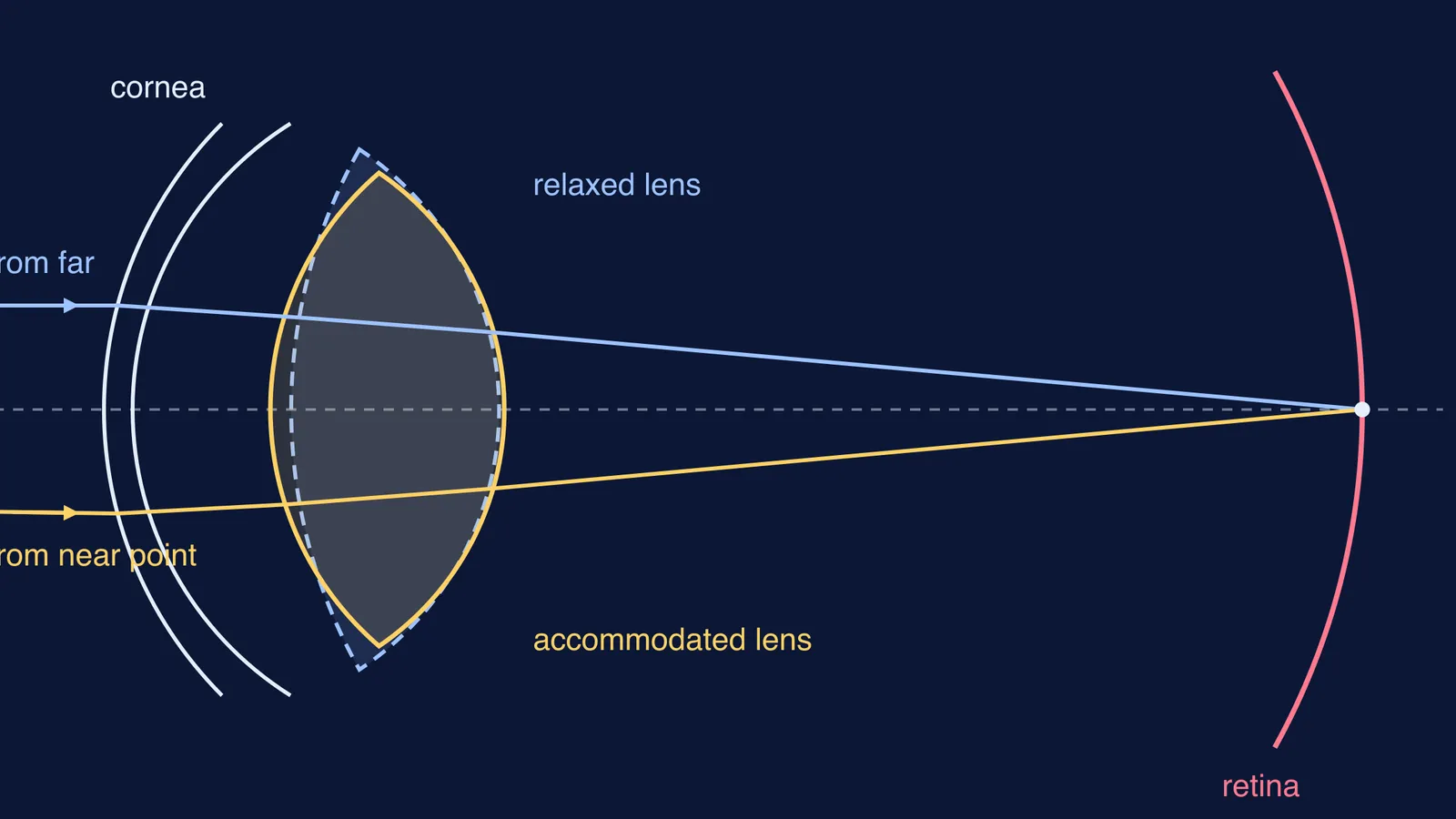
NCERT Class 10 explains the mechanism (NCERT Class 10 Science, Chapter 10). When the ciliary muscles relax, the lens becomes thin and its focal length increases, so you see distant objects clearly. When they contract, the lens becomes thicker and its focal length decreases, so you see near objects. Accommodation is the ability of the eye lens to adjust its focal length. The near point of a young adult with normal vision is about 25 cm, and the far point is infinity.
For more diagrams, see our explainer on how the lens changes shape for near and far vision.
How do you calculate power of accommodation and near point?
Treat the eye as one thin lens with the retina a fixed distance v behind it. For a far object, 1/f = 1/v; for an object at the near point d, 1/f = 1/v + 1/d. Subtract: the extra power needed is 1/d − 1/(far point), in dioptres with distances in metres. For d = 0.25 m and the far point at infinity, that is 4 D. (Unit trouble? See power of a lens when focal length is in centimetres.)
The Gullstrand–Le Grand teaching model, based on Gullstrand's eye, lists the lens in both states (Arizona Visual Optics Lab notes). To focus near, the front surface steepens from a 10.2 mm to a 6.0 mm radius, the back from 6.0 to 5.5 mm, the lens thickens from 4.0 to 4.5 mm, and its refractive index rises from 1.42 to 1.427. With the Class 12 single-surface formula, (n₂ − n₁)/R, and the notes' refractive indices:
Front lens surface: about 8.1 D relaxed, 14.9 D accommodated.
Back lens surface: 14.0 D, then 16.5 D.
Whole lens: about 21.8 D, then 30.7 D.
Whole eye: 59.94 D relaxed (the notes' own figure), about 67.7 D accommodated.
Traced paraxially, the accommodated model focuses about 14.2 cm in front of the cornea: about 7 D of accommodation. That exceeds the 25 cm rule's 4 D because NCERT defines 25 cm as the closest distance seen without strain, not the closest a young eye can focus.
A near-point numerical, step by step
A person's near point has moved to 50 cm. What lens lets them read at 25 cm?
Signs: the book is at u = −25 cm; its virtual image must sit at the near point, v = −50 cm.
Lens formula: 1/f = 1/v − 1/u = −1/50 + 1/25 = 1/50, so f = +50 cm.
Power: P = 100/f (in cm) = +2 D: a convex lens, as NCERT gives for hypermetropia.
To match each defect to its lens, see our guide to asking AI which lens corrects myopia and hypermetropia.
If this is hard to picture, the Fermi Simulation Lab has interactive simulations for ideas that are easier to see than to read. For numericals like this, the Fermi Problem Library has worked problems with a step-by-step solver that explains the reasoning rather than printing an answer.