On this page
In 1870, New Yorkers could ride an upholstered car through a tunnel under Broadway. The car had no engine; a huge blower pushed air into the tube behind it. It is still one of the clearest real examples of a Class 9 idea: pressure times area gives force.
What was Alfred Beach's pneumatic subway?
Alfred Ely Beach was an editor of Scientific American and an inventor. Scientific American's own retelling of the story says he showed a pneumatically powered train in a tube at the American Institute Fair in 1867, then built a real line under Broadway.
nycsubway.org's history of the Beach Pneumatic Transit says the line ran one block, about 300 feet in all, and opened to the public on 26 February 1870. The same page transcribes Beach's description in Scientific American of 5 March 1870, which says the tunnel was "eight feet in diameter in the clear" and that the car had seats for eighteen people. Later accounts differ a little: American Heritage magazine describes a nine-foot tube, 312 feet of track and a car that seated twenty-two.
American Heritage also reports that Beach spent $350,000 of his own money, that about 400,000 visitors came to see the tunnel over the next year, and that at a quarter a head the ride earned more than $100,000.
How did a fan push a train car?
The "giant fan" was a Roots blower, two lobed rotors spinning inside a casing. In his 1870 article, Beach wrote that a 100-horsepower steam engine drove it, and that it was calculated to deliver 100,000 cubic feet of air per minute at maximum speed.
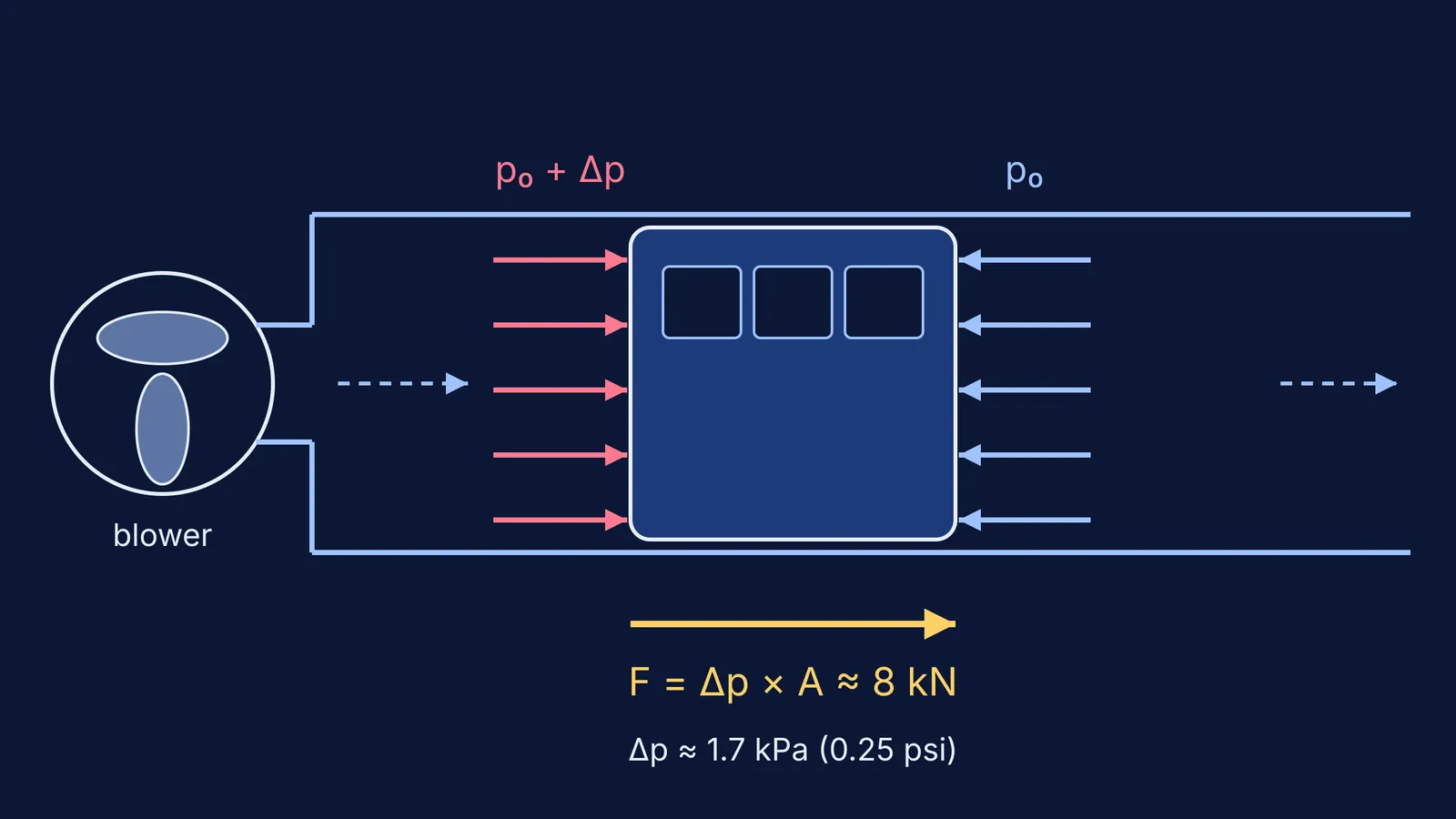
The car fitted the tube closely, like a loose piston. Air forced in behind it raised the pressure there slightly above the pressure in front, and that difference, acting over the back of the car, pushed it forward. In Beach's words, "When the air current is reversed a partial vacuum is produced in the tunnel, and the pressure of the atmosphere then propels the car in an opposite direction."
If force and pressure still blur together, our explainer on thrust versus pressure for Class 9 separates the two.
How much force did a quarter psi make?
Beach's article says that "a pressure of one fourth of one pound to the square inch would be an aggregate of three-fourths of a tun on the end of the car, far more than required for propulsion" (nycsubway.org transcription). Here is the same estimate in SI units, using the conversion factors in NIST's guide to the SI.
Convert. NIST gives 1 psi = 6,894.757 Pa, so 0.25 psi is about 1,724 Pa.
Compare. A standard atmosphere is 101,325 Pa, so the extra pressure was only about 1.7% of normal air pressure.
Find the area. The tunnel was 8 feet across and 1 foot = 0.3048 m, so r = 1.219 m and A = πr², about 4.67 m².
Multiply. F = Δp × A, about 1,724 Pa × 4.67 m², or roughly 8,000 N.
Sense-check. 8,000 N is the weight of about 820 kg. Beach's three-fourths of a ton (1,500 pounds-force, about 6,700 N using NIST's 1 lbf = 4.448 N) is a little lower. Our figure uses the full tunnel area, but the car's end did not fill the whole bore, so 8,000 N is an upper estimate.
Why did the Beach subway close?
The trouble was not the physics. American Heritage explains that Beach needed state permission to extend the line. The legislature passed his bill in 1871, but Governor Hoffman vetoed it, and he vetoed it again the following year. In 1873 Governor Dix signed a charter, then withdrew it late that year. Scientific American says Beach also took a hit in the 1873 financial crisis and closed Beach Pneumatic Transit.
American Heritage reports that in February 1912, workers cutting the new BMT subway broke into the sealed tunnel. Compressed air lasted elsewhere: George Westinghouse's air brake used it to stop trains.
How do you solve a 'gas pushes a piston' problem?
Beach's car is a template for syringe, piston and suction-cup questions in boards and JEE Main. Use this checklist.
Name the two faces and the pressure on each.
Use only the difference, Δp. Atmospheric pressure on both sides cancels.
Find the area the pressure acts on, in square metres.
Convert every pressure to pascals first (psi, atm, bar, cm of Hg).
Sense-check by turning newtons into an equivalent mass in kilograms.
Try one. A syringe plunger is 2 cm across, and the air inside is 0.1 atm above outside pressure. What force acts on the plunger? (Answer: Δp is about 10,130 Pa and A = π × (0.01 m)², about 3.14 × 10⁻⁴ m², so F is about 3.2 N.)
If pressure on two faces feels abstract, the Fermi Simulation Lab has interactive simulations for ideas that are easier to see than to read. If your numbers keep coming out wrong, the Fermi Problem Library has worked problems with a step-by-step solver that explains the reasoning rather than printing an answer.
Next time a question gives you a tiny pressure, check the area before deciding the force is small.