

On this page
When you hammer an iron nail into a wooden plank, the pointed tip slips through the grain with minimal effort. Turn the nail around and strike its broad, flat head against the wood, and the same swing barely leaves a dent. Your arm delivers the same total muscular push in both swings, yet the physical outcome is entirely different.
In school physics, confusion between total applied force and how that force distributes across a surface trips up many students. Mastering this distinction bridges fundamental mechanics from Class 9 laws of motion to the broader principles of weight and fluid behavior covered in our Class 9 gravitation guide.
What is the difference between thrust and pressure in Class 9?
Thrust is the total force acting perpendicular to the surface of an object, measured in newtons (N).
Pressure is the thrust acting per unit area of a surface, measured in newtons per square metre (N/m²) or pascals (Pa).
As defined in the NCERT Class 9 Science textbook, pressure represents the physical intensity of a perpendicular force rather than its gross total. The mathematical relationship is direct and foundational:
Pressure = Thrust ÷ Area
Because thrust is a directional push acting at a right angle to a specific plane, it behaves as a vector quantity with magnitude and direction. Pressure, by contrast, is a scalar quantity. At any given point within a substance or along a contact interface, pressure exerts an isotropic effect—meaning it acts uniformly in all directions across an infinitesimal element rather than pointing along an isolated spatial axis.
Why are nails pointed while school bag straps are made wide?
The inverse proportionality between pressure and contact area explains why engineers taper cutting tools to microscopic points while widening load-bearing surfaces.
Consider what happens when you drive a carpenter's nail into soft pine. Striking the nail delivers a modest perpendicular thrust of approximately 50 N. If the sharpened tip has a contact cross-section of 0.1 mm² (10⁻⁷ m²), the resulting contact pressure reaches 50 N ÷ 10⁻⁷ m² = 500,000,000 Pa, or 500 MPa. According to the USDA Forest Products Laboratory Wood Handbook, the compressive yield strength of structural timber perpendicular to the grain typically ranges from 2 to 15 MPa. Because 500 MPa exceeds this internal yield threshold by orders of magnitude, the pointed tip easily shears wood fibers apart. If you flip the nail and strike its broad head—which has an area of roughly 50 mm² (5 × 10⁻⁵ m²)—the resulting pressure drops to just 1 MPa, failing to pierce the timber.
The opposite design goal applies to the backpacks students carry every morning. In an ergonomic investigation published in *Work*, Golriz et al. (2017) evaluated shoulder interface pressure under a 20 kg load across strap widths of 5 cm, 6 cm, 7 cm, and 8 cm. The researchers found that interface pressure decreased significantly as strap width increased, with 8 cm straps producing the lowest interface pressure on the body.
This mechanical principle explains why school bags are manufactured with broad, padded straps rather than thin cords. When students carry a heavy load of books, the total downward thrust—the gravitational weight of the bag—remains constant. By distributing this load across a broad band of fabric over the shoulders rather than concentrating it along a narrow string, the contact area expands significantly. This area expansion lowers the compressive pressure on the trapezius muscle, sparing nerves and blood vessels from painful indentation.
How do you solve thrust and pressure numericals step by step?
Examiners frequently test this relationship by asking you to calculate how changing an object's orientation alters the pressure it exerts on a surface. Here is a standard NCERT examination problem worked from scratch:
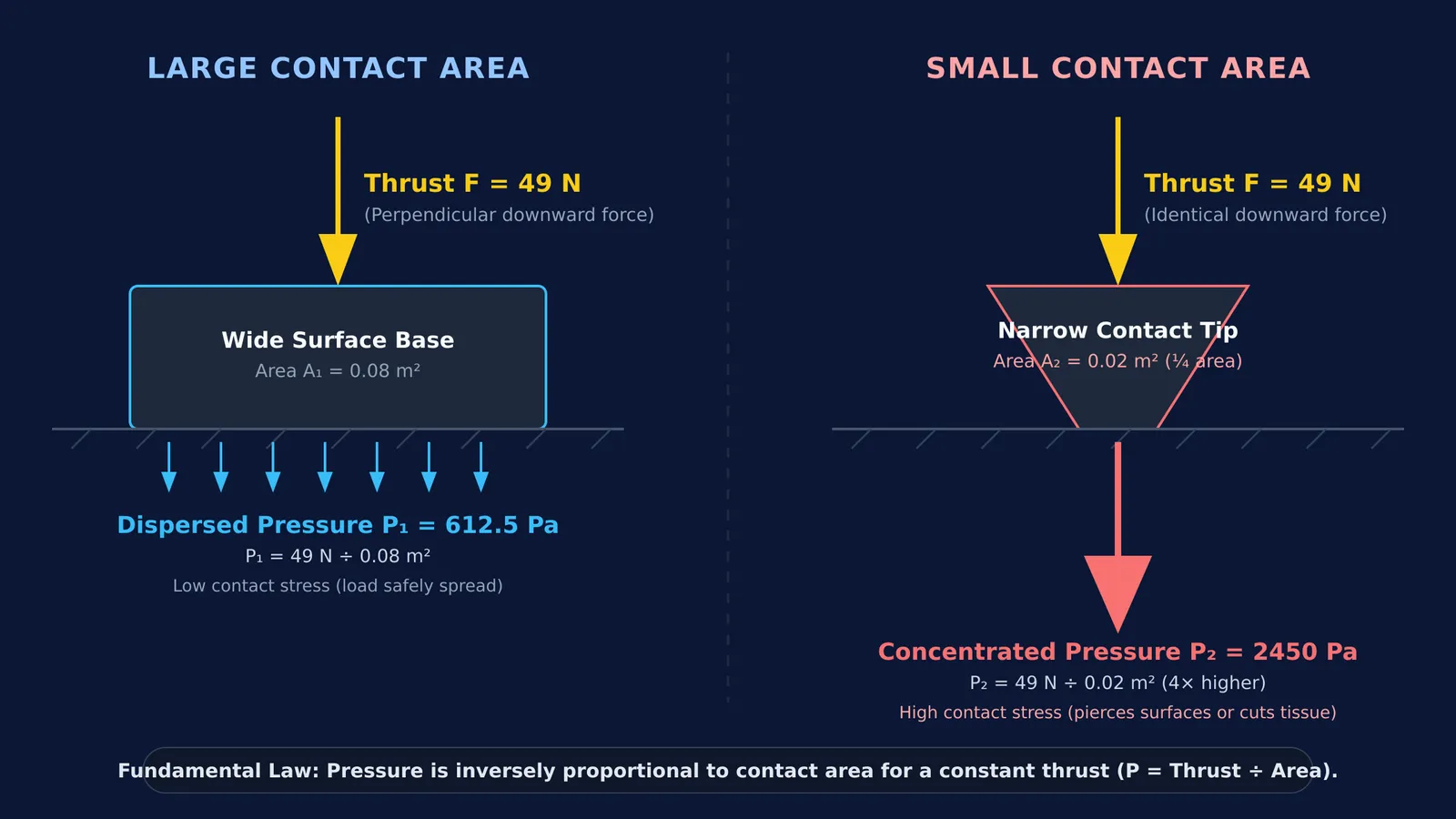
A wooden block of mass 5 kg rests on a tabletop. Its dimensions are 40 cm × 20 cm × 10 cm. Find the pressure exerted by the wooden block if it is placed on the tabletop on its sides with dimensions: (1) 20 cm × 10 cm, and (2) 40 cm × 20 cm. (Take acceleration due to gravity g = 9.8 m/s²).
Find the thrust: The perpendicular force exerted by the block is its weight acting downward due to gravity. Thrust = mass × g = 5 kg × 9.8 m/s² = 49 N. Because the block's mass does not change when turned over, the thrust remains 49 N in both orientations.
Convert dimensions to SI units and calculate contact area: For the first case, area A₁ = 0.20 m × 0.10 m = 0.02 m². For the second case, area A₂ = 0.40 m × 0.20 m = 0.08 m².
Compute the resulting pressure: For orientation 1, Pressure P₁ = 49 N ÷ 0.02 m² = 2450 Pa. For orientation 2, Pressure P₂ = 49 N ÷ 0.08 m² = 612.5 Pa.
Notice the symmetry: the contact area in the second orientation is four times larger (0.08 m² versus 0.02 m²), so the pressure exerted on the tabletop becomes exactly one-fourth as intense (612.5 Pa versus 2450 Pa). This same area-scaling principle governs how hydraulic presses amplify forces in Pascal's law in hydraulic machines.
What practical checklist helps you avoid Class 9 exam traps?
Before submitting answers in school assessments, run through this four-point check to verify that your calculations are mechanically sound:
Distinguish total force from intensity: If an exam question asks for the total downward push or gravitational pull on a surface, solve for thrust in newtons. If it asks about sinking into sand, cutting through an apple, or shoulder strain, solve for pressure in pascals.
Verify the perpendicular angle: Thrust only accounts for force acting at 90° to the contact boundary. Any tangential sliding force does not contribute to normal pressure.
Convert to base SI units immediately: Divide newtons by square metres, never by square centimetres or square millimetres. Remember that 1 cm² equals 10⁻⁴ m².
Sanity-check the inverse relationship: When area expands, pressure must decrease; when area shrinks, pressure must climb sharply.
The Fermi Problem Library provides worked problems with a step-by-step solver that explains the reasoning rather than printing an answer, helping students identify whether a mistake stems from unit conversions or vector alignment. For concepts that are harder to picture from raw equations, the Fermi Simulation Lab offers interactive simulations for ideas that are easier to see than to read, demonstrating how normal force vectors distribute across wide and narrow contact geometries.


