On this page
On paper, glass should be enormously strong. In practice, a window pane snaps easily. In 1921 a young British engineer, Alan Arnold Griffith, explained why, and his answer became the starting point of fracture mechanics, the science engineers now use to keep aircraft, bridges and pressure vessels in one piece.
Who was A. A. Griffith?
Griffith was born in 1893, studied mechanical engineering at the University of Liverpool and joined the Royal Aircraft Factory (later the Royal Aircraft Establishment) as a trainee in 1915, according to his Wikipedia biography. He moved to Rolls-Royce in 1939 and retired as the company's Chief Scientist, as his Who Was Who entry records. In 1926 he also wrote "An Aerodynamic Theory of Turbine Design", which sketched an engine with an axial compressor that Wikipedia calls a forerunner of the turboprop.
The fracture work began as a practical job. The abstract of his paper, "The phenomena of rupture and flow in solids" (Philosophical Transactions of the Royal Society A, volume 221, pages 163-198), says the original aim was to find how filing, grinding or polishing affected the strength of metal machine parts under repeated loads.
Why is glass so much weaker than theory says?
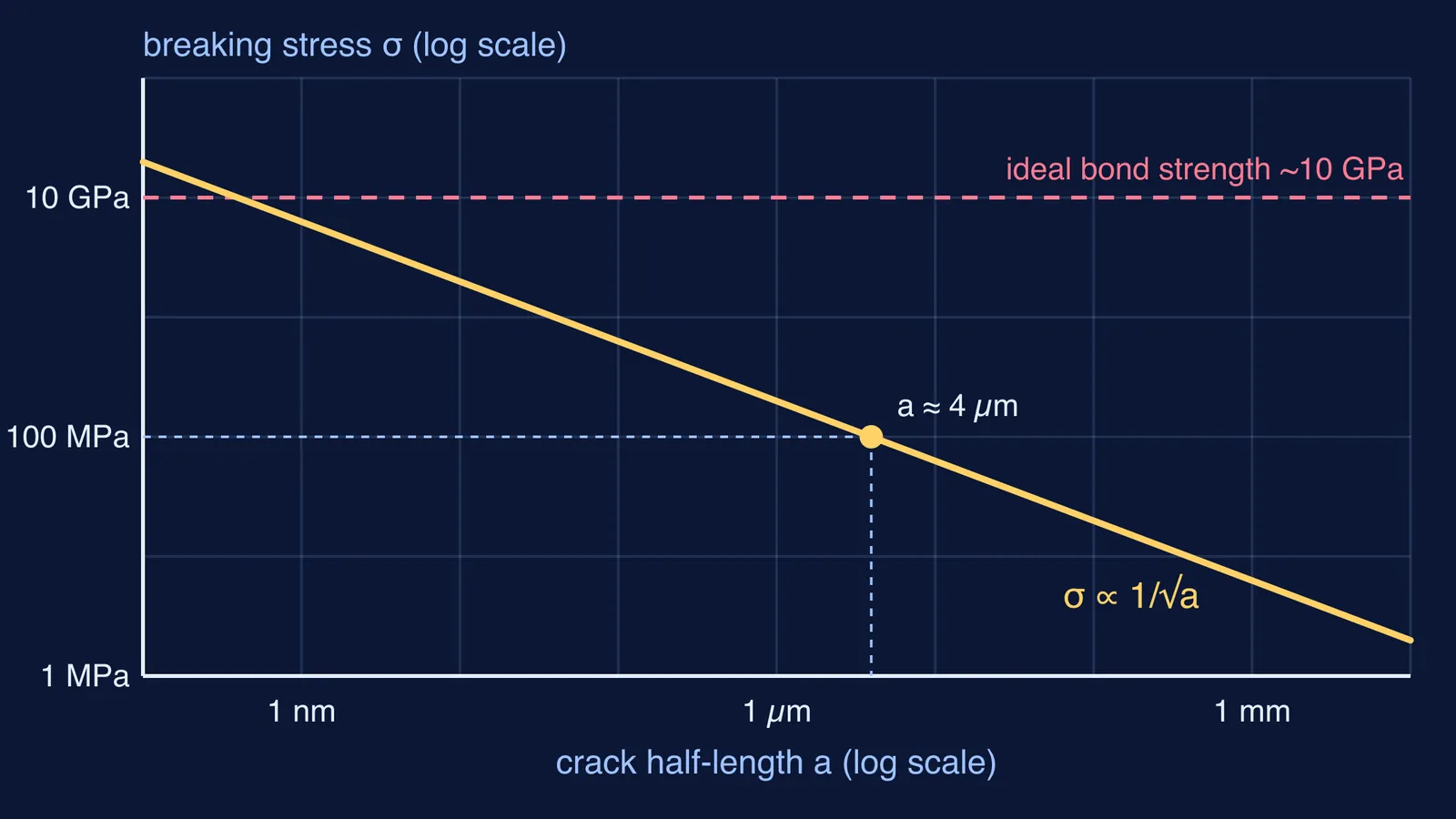
The stress needed to break the atomic bonds of glass is roughly 10,000 MPa, but bulk glass actually breaks at around 100 MPa, as the Wikipedia article on fracture mechanics summarises. That is a factor of about 100.
A Lehigh University lecture on the mechanical properties of glass by Rui Almeida gives sharper numbers for silica glass: a theoretical strength of 18 GPa, a measured 15 GPa for flame-polished glass tested at 4 K, and only about 100 MPa for ordinary glass at room temperature. The same lecture says Griffith blamed microscopic surface flaws, "usually the result of handling or abrasion", which act as stress concentrators.
Griffith built on a 1913 result by Inglis. For an elliptical crack of half-length c and tip radius ρ, the stress at the tip is σ_max = 2σ√(c/ρ). The Lehigh lecture works an example: a half-length of about 1 µm and a tip radius of about 0.2 nm multiply the applied stress roughly 140 times.
What does Griffith's energy balance say?
Griffith then switched from forces to energy.
When a crack grows a little, the material around it relaxes and releases stored elastic (strain) energy.
Growing the crack also creates two new surfaces, and surfaces cost energy: the surface energy γ, in joules per square metre.
The crack runs away once the energy released is at least the energy needed for the new surfaces.
For a crack of length 2a in a plate under tension σ, that balance gives the Griffith equation: σ_f = √(2Eγ/(πa)), where E is Young's modulus. The fracture mechanics article notes that with E = 62 GPa and γ = 1 J/m² for glass, this agrees well with experiment, and that Griffith's own experiments on glass fibres suggested the breaking stress rises as the fibre diameter falls.
If Young's modulus feels shaky, our post on Thomas Young and the modulus of elasticity is a quick refresher, and surface energy versus surface tension explains why γ has units of J/m².
Worked example: how big a crack makes glass 100 times weaker?
Use the glass values quoted in the fracture mechanics article, E = 62 × 10⁹ Pa and γ = 1 J/m², and ask what crack makes glass fail at 100 MPa.
Rearrange: a = 2Eγ / (πσ²).
Numerator: 2 × 62 × 10⁹ × 1 = 1.24 × 10¹¹.
Denominator: π × (10⁸)² = 3.14 × 10¹⁶.
Divide: a ≈ 3.9 × 10⁻⁶ m, about 4 micrometres.
So a crack only about 8 µm from end to end (remember, a is the half-length) is enough. Now try it the other way: a = 0.1 mm gives σ_f ≈ 20 MPa, and a = 1 mm gives about 6 MPa. Because σ_f depends on 1/√a, a crack four times longer halves the strength.
How do you use this in exams and beyond?
A short checklist for revising the ideas Griffith's equation rests on:
Can you explain stress, strain and Young's modulus without notes, and read a stress-strain graph for a brittle material?
Can you show that surface energy in J/m² and surface tension in N/m have the same units?
Given a formula like σ ∝ 1/√a, can you predict what doubling or quadrupling a does?
Can you name everyday cases: why glass cutters score a line before snapping, and why windscreens crack but don't shatter?
If one of these is a gap, the Fermi Concept Library has a lesson for each concept in physics and its place in the map, and the Fermi Simulation Lab has interactive simulations for ideas that are easier to see than to read.
Next time a glass slips from your hand, look at where the break started. Somewhere near the edge, a flaw too small to see did exactly what Griffith said it would.