

On this page
If you open a Class 11 physics textbook to the mechanical properties of solids, you will meet Young's modulus. It is the number that tells you how much a wire will stretch when you hang a mass from it, or how much a steel beam will bend under a heavy load.
But the history of this fundamental constant is not a straight line. Thomas Young was not the first person to study elasticity, nor was he the first to measure the constant that bears his name. However, his work helped shift engineering from guesswork into a predictive, exact science.
What was the problem before Thomas Young?
In 1678, the English scientist Robert Hooke published his famous law of elasticity, stating that the force needed to stretch an object is proportional to its extension (Wikipedia). In modern terms, we write this as F = kx.
Hooke's law was a major step forward, but it had a severe limit: the stiffness constant (k) belonged to the specific object, not the material. If you tested a short, thick iron spring, you got one number. If you tested a long, thin iron spring made of the exact same iron, you got a completely different number. An engineer building a bridge could not easily test a miniature model and scale the results up to the real thing, because they lacked a single universal number to describe "iron-ness" independent of the shape.
The Swiss mathematician Leonhard Euler theoretically described a material-specific constant in 1727 to fix this gap, but it remained largely a mathematical exercise and was not widely adopted by builders.
What is the history of Young's modulus of elasticity?
The first person to successfully measure a material's intrinsic elasticity was the Italian scientist Giordano Riccati. By tracking the acoustic frequencies of vibrating cylinders, Riccati found that the elastic modulus of steel was 2.06 times that of brass (St Andrews University). He published this 2.06 ratio in 1782, giving us a constant remarkably close to modern measurements. Because his method relied on sound rather than stretching giant metal bars, he avoided the need for heavy testing machinery.
Twenty-five years later, the British polymath Thomas Young published *A Course of Lectures on Natural Philosophy and the Mechanical Arts* in 1807 (Wikipedia). Young defined the modulus of elasticity not as a simple ratio of stress to strain, but as the weight that would be required to stretch a column of a material to double its original length, assuming it did not snap first.
His genius was showing that this modulus was an intrinsic property of the substance itself. Once you knew the modulus of steel, you could predict the deformation of any steel object, no matter its dimensions.
How did Claude-Louis Navier formalise it?
While Young popularized the idea in the English-speaking world, the modern mathematical definition we use today—the exact ratio of stress to strain—was formalised by the French engineer Claude-Louis Navier.
In 1826, Navier published a definitive engineering textbook that established the elastic modulus (E) as we know it today (Wikipedia). He moved structural analysis from empirical rules of thumb to rigorous mathematics. Navier correctly located the neutral axis in a bending beam (the line where there is zero stress) and provided the equations that allowed engineers to calculate stresses in complex structures safely. His work cemented elasticity as a cornerstone of civil and mechanical engineering.
Young's modulus in Class 11 physics
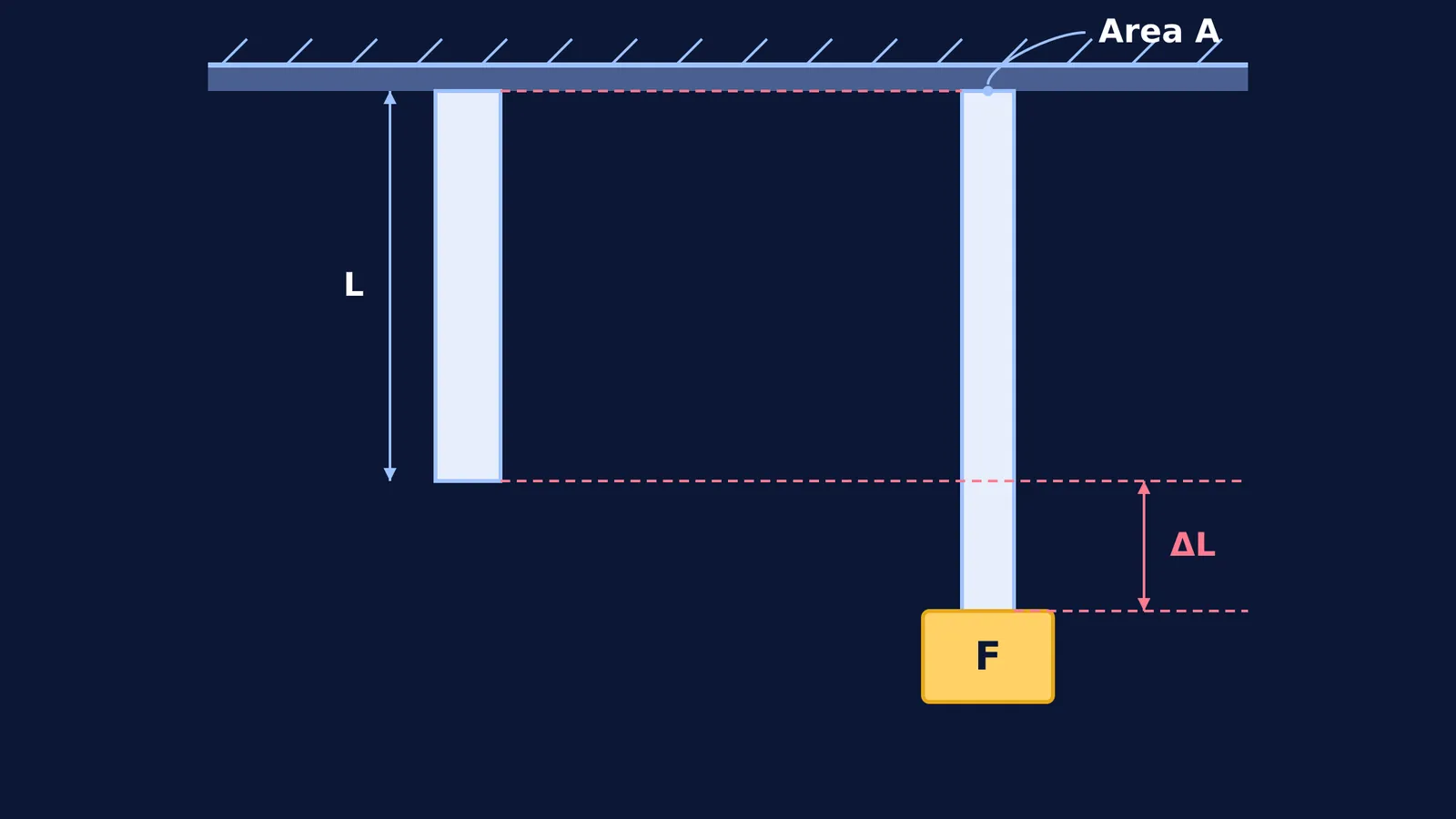
Today, students learn Young's modulus (Y or E) as longitudinal stress divided by longitudinal strain:
Y = (F / A) / (ΔL / L)
You will use this formula repeatedly to find the elastic potential energy in a stretched wire or to calculate a rod stretching under its own weight.
Checklist: How to avoid common mistakes in elasticity problems
When solving for Young's modulus in an exam, check these three things before submitting your answer:
Check your units: Modulus is typically measured in pascals (N/m²). Ensure your cross-sectional area is converted to m² (not mm² or cm²) and your lengths are in metres.
Identify the true length: In the fraction ΔL / L, the variable L is always the original, unstretched length of the wire, not the final extended length.
Use the correct radius: If the problem gives the diameter of the wire, remember to halve it before calculating the area using A = πr².
When you get stuck on exactly how the forces resolve in these problems, the Fermi Problem Library has worked problems with a step-by-step solver that explains the reasoning rather than just printing an answer. If you are struggling to grasp how strain propagates through different materials, the Fermi Concept Library breaks down every concept in physics with its own lesson.


