On this page
Two photons fly apart from the same atom. Measure one, and you can predict the other. Did each carry a hidden instruction from the start, or, as quantum mechanics says, did neither have a definite polarisation until measured? In 1982, at the Institut d'Optique in Orsay, France, Alain Aspect and his colleagues tested this more directly than ever before.
What did Alain Aspect's 1982 experiment test?
In 1935 Einstein, Podolsky and Rosen argued that quantum mechanics seemed incomplete, a puzzle now called the EPR paradox (Nobel Committee popular background). One proposed fix was local hidden variables: each particle secretly carries the information that decides what a measurement will show.
John Stewart Bell, at CERN, found a test. Bell's inequality is a limit on how strongly measurements on two particles can be correlated if hidden variables decide the results, and quantum mechanics predicts correlations above that limit (Nobel Committee popular background). We explain the theorem itself in our post on John Stewart Bell's theorem and hidden variables.
John Clauser and Stuart Freedman measured a violation in 1972, but fixed filters and few detected photons left loopholes (same source).
How did Aspect's team set up the experiment?
The July 1982 paper by Aspect, Philippe Grangier and Gérard Roger describes the apparatus (Physical Review Letters 49, 91):
Source: calcium-40 atoms excited by two lasers, giving off pairs of photons at 551.3 nm and 422.7 nm with correlated polarisation.
Analysers: a two-channel polarising cube on each side, sending a photon one way if parallel to the cube's axis (+1) and the other way if perpendicular (−1). Earlier tests only registered photons that passed.
Detectors: a photomultiplier behind each output, recording all four outcome pairs in one run.
Distance: the two polarisers were 13 m apart.
Each run lasted 100 s, with five runs at each setting, the polarisers 22.5° or 67.5° apart (same paper).
What did Aspect find?
The four correlations combine into one number, S, and any local hidden-variable theory must give S between −2 and 2 (PRL 49, 91).
Aspect's team measured S = 2.697 ± 0.015, while quantum mechanics predicted 2.70 ± 0.05 for their actual apparatus (PRL 49, 91).
That was 83% of the largest violation possible with ideal polarisers, against 55% for the best earlier result (same paper).
One gap remained: the settings were fixed in advance, so one side could in principle learn the other's setting. In December 1982, Aspect, Jean Dalibard and Roger reported a test with optical switches that sent each photon to one of two polarisers at different angles (PRL 49, 1804). The switches changed about every 10 ns, while light takes about 20 ns to cover the 6 m from the source to each polariser (Nobel Committee scientific background). That test gave S = 0.101 ± 0.020 against a local limit of 0, five standard deviations beyond it and close to the quantum value of 0.112 (same source).
Worked example: why does quantum mechanics beat 2?
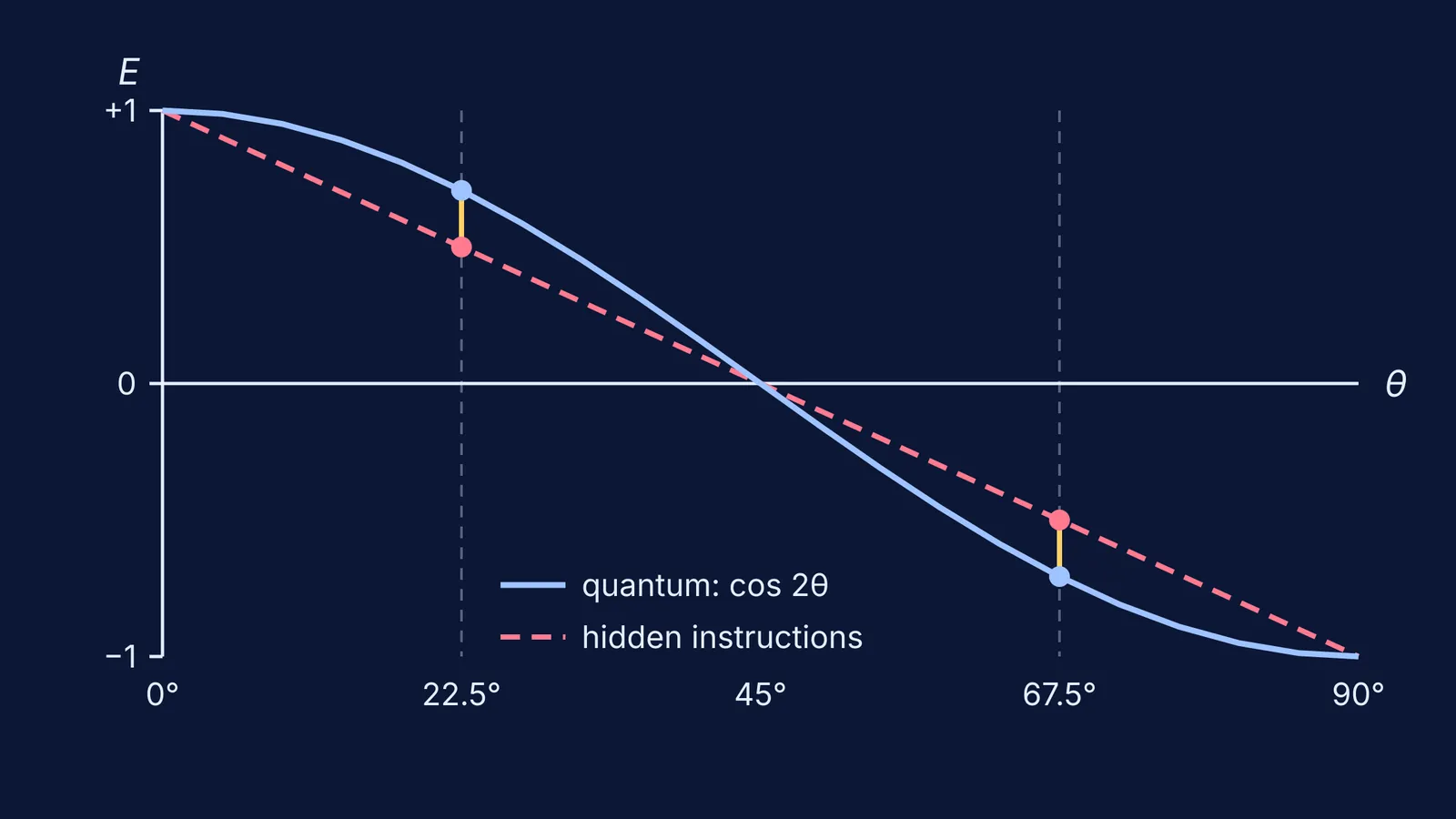
School trigonometry is enough to check the core of the result. For ideal polarisers at angle θ, quantum mechanics gives E = cos 2θ, the 1982 paper's formula without its correction for real equipment (PRL 49, 91). The test quantity is S = E(a,b) − E(a,b′) + E(a′,b) + E(a′,b′).
Three of the pairs are 22.5° apart, so each gives E = cos 45° = 0.707.
The pair (a, b′) is 67.5° apart, so E = cos 135° = −0.707.
S = 0.707 + 0.707 + 0.707 + 0.707 = 2.83, which is 2√2.
Now a hidden-instruction model: give each pair a shared random angle λ, and let each photon count +1 if its polariser is within 45° of λ. The chance the two sides disagree grows in step with the angle between them, so E = 1 − θ/45°, a straight line.
At 22.5°, E = 0.5. At 67.5°, E = −0.5.
S = 0.5 + 0.5 + 0.5 + 0.5 = 2.
The model reaches the limit and stops. The quantum curve bulges beyond the straight line at 22.5° and 67.5°, and that bulge is what Aspect measured. Real equipment blurs the correlation slightly, which is why his apparatus was predicted to give 2.70, not 2.83.
If polarisation is the shaky part, the Fermi Concept Library has a lesson for every concept in physics, and the Fermi Simulation Lab has interactive simulations for the ideas that are easier to see than to read.
Did Aspect's experiments settle the debate?
Not entirely. The Nobel Committee notes the polarisers were too close for truly random settings, and more than 15 years passed before Anton Zeilinger's group tested the inequality with observers 400 m apart (Nobel Committee scientific background). See where that led in our post on Anton Zeilinger and quantum teleportation.
In 2022 Aspect, Clauser and Zeilinger shared the Nobel Prize in Physics "for experiments with entangled photons, establishing the violation of Bell inequalities and pioneering quantum information science" (Nobel Committee popular background).
If you are not sure where to begin with quantum topics, Fermi's AI tutor can work out what you already know and build a plan for the session.