

On this page
In 1935, Albert Einstein, Boris Podolsky and Nathan Rosen argued that quantum mechanics was incomplete. They disliked the idea of entanglement, where measuring one particle instantly determines the state of another far away. Einstein famously called this "spooky action at a distance". He argued that if a pair of gloves is separated and you find a left-handed glove in your box, you instantly know the other box contains the right-handed glove. No spooky signal was sent; the gloves' "handedness" was decided the moment they were packed. Einstein believed particles worked the same way. He championed "local realism": that things cannot influence each other faster than light, and that particles must have definite properties (hidden variables) even before we look at them.
For decades, this was just a philosophical debate. You could not run an experiment to see what a particle was doing when you were not looking at it.
What did the 1964 John Bell theorem prove?
In 1964, John Stewart Bell published a paper titled "On the Einstein Podolsky Rosen paradox" in the journal *Physics Physique Fizika* (Crossref). Bell, a theoretical physicist at CERN, wondered if Einstein's "glove" analogy could fully explain the mathematics of quantum mechanics. His genius was to ask what happens if you measure the particles not just straight up and down, but at various tilted angles.
He took Einstein's assumption of hidden variables and asked a mathematical question: if local hidden rules exist, what is the hard limit on how correlated two particles can be? Bell proved that any theory built on local hidden variables must obey a strict mathematical limit, now known as Bell's inequality. However, quantum mechanics predicts that entangled particles will violate this limit. Bell's theorem turned a philosophical argument into a testable physics experiment.
How does a quantum entanglement test work?
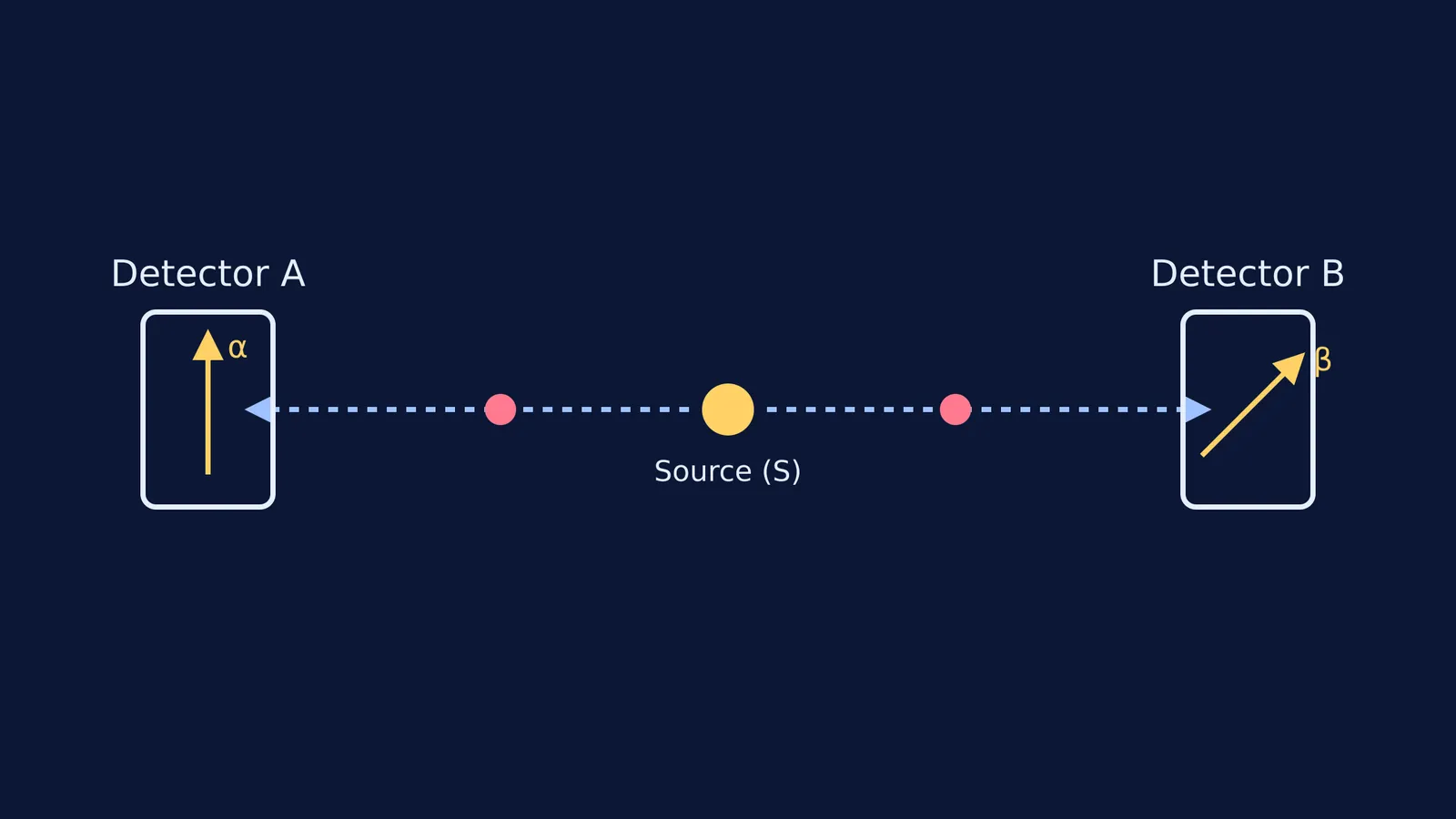
To test Bell's theorem, you need a source that fires a pair of entangled particles in opposite directions. Two detectors then measure their state, such as the spin of the electron or the polarisation of a photon.
If both detectors are aligned at the exact same angle, they will always record opposite spins, just like the left and right gloves. The real test happens when you tilt the detectors at different angles. Bell's mathematics showed that if the particles carried hidden instructions, their measurements would only match up to a certain percentage of the time. Quantum mechanics predicted a higher percentage of matches at specific angles.
In 1972, John Clauser ran the first practical test using entangled photons, finding a clear violation of Bell's limit. When Clauser ran his test, the technology to produce and measure entangled photons was barely capable of the task. In the 1980s, Alain Aspect refined the experiment by switching the detector angles rapidly while the photons were in mid-flight. Because the settings changed faster than light could travel between the detectors, there was no way a hidden signal could tip off the other particle. The 2022 Nobel Prize in Physics was awarded to Alain Aspect, John Clauser and Anton Zeilinger for experiments establishing the violation of Bell inequalities (Nobel Prize).
How can you test your own hidden variables?
Bell's breakthrough was realising that assumptions have limits you can test. Students often carry their own "hidden variables"—untested assumptions about how a concept works. You might assume the tension in a string is always mg, or that the photon-energy formula applies to a massive electron. In a difficult exam, questions are designed to flush out these hidden variables. If you memorize a shortcut without understanding its limits, you are relying on an assumption that will eventually fail.
In learning, you cannot just guess whether your mental model is complete; you must run the experiment. The Fermi Problem Library has worked problems with a step-by-step solver that explains the reasoning rather than printing an answer, letting you test your own assumptions line by line. Just as Bell found a way to measure the invisible, a good problem reveals the hidden gaps in your reasoning.


