

On this page
Science fiction has long promised teleportation machines that beam physical matter across space. When Austrian physicist Anton Zeilinger and his team at the University of Innsbruck actually achieved teleportation in the lab in 1997, it did not move a physical object. Instead, it transferred quantum information.
The results, published in *Nature* on December 11, 1997, detailed the first experimental verification of quantum teleportation (Crossref). The team proved that you can transfer the exact quantum state of one photon to another distant photon without the two ever interacting directly.
How did quantum teleportation work in the 1997 experiment?
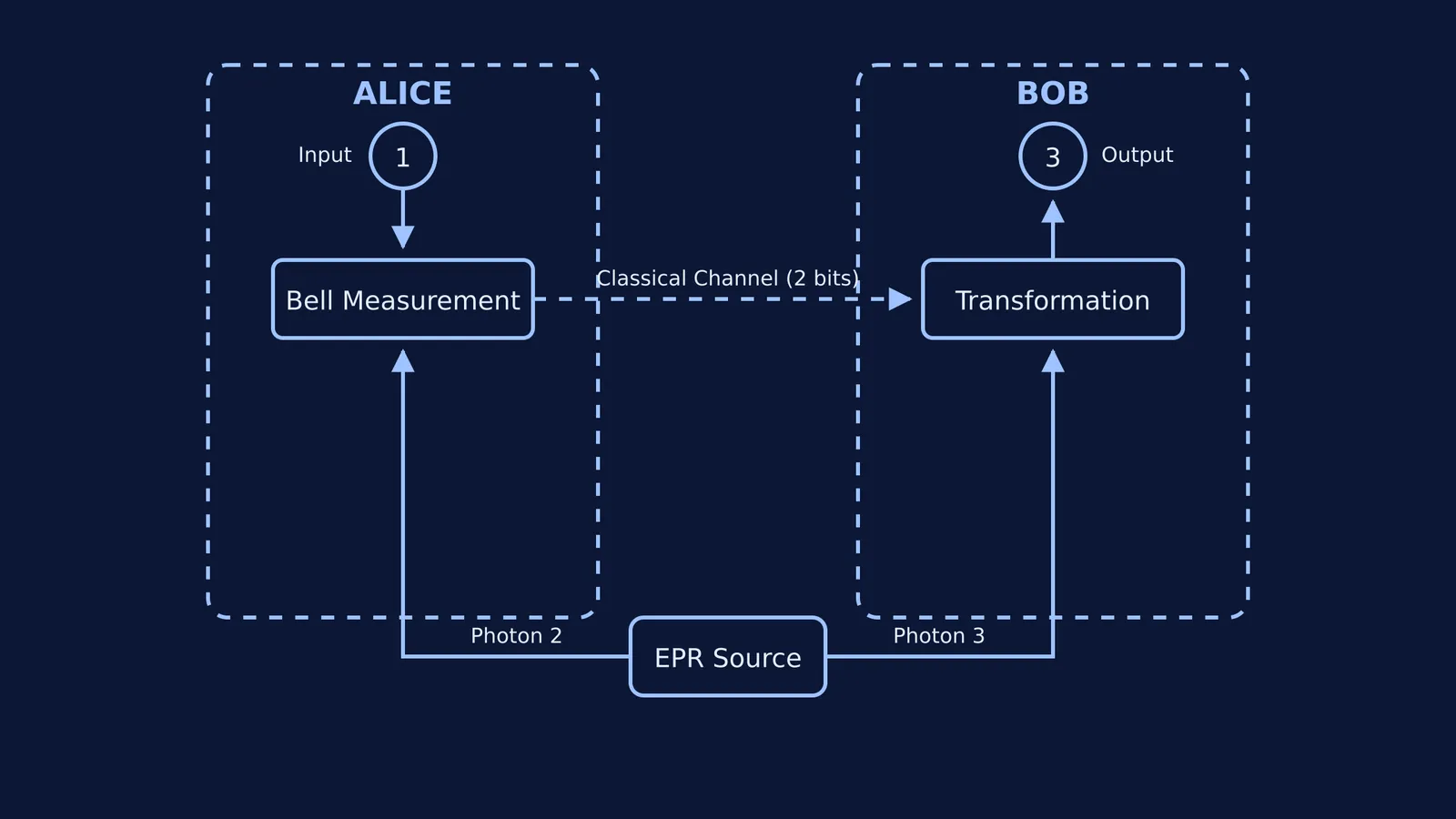
Quantum teleportation relies on three particles and a phenomenon called quantum entanglement, where two particles behave as a single connected unit regardless of the distance between them. In the 1997 experiment, the team used three photons and measured their polarization states.
The entangled pair: The researchers first created two entangled photons using a process called parametric down-conversion (let's call them Photon 2 and Photon 3). The sender, traditionally called Alice, kept Photon 2, and the receiver, Bob, took Photon 3.
The original state: Alice was given a third photon (Photon 1). This was the "input" photon, possessing an unknown polarization state that she needed to teleport to Bob.
The Bell state measurement: Alice performed a joint measurement on Photon 1 and Photon 2 together. Because you cannot measure a quantum state without altering it, this crucial step permanently destroyed the original state of Photon 1.
The classical message: The joint measurement yielded one of four possible outcomes, generating two bits of classical information (like "01" or "10"). Alice then sent this 2-bit result to Bob using a standard communication channel, such as an optical cable or radio signal.
The reconstruction: Armed with Alice's classical message and his entangled Photon 3, Bob applied a specific transformation. Because Photon 3 was already inextricably linked to Alice's system via entanglement, this final adjustment forced Photon 3 to become an exact replica of the original Photon 1.
The experiment was a success. The team achieved a teleportation fidelity of 0.80 ± 0.05, exceeding the classical limit of 0.67 and proving that the transfer was truly quantum (Nature).
Why doesn't quantum teleportation move matter?
When we think of teleportation, we picture an object dissolving in one place and reassembling in another. Quantum teleportation is fundamentally different because it moves information, not matter.
In the experiment, you are not physically moving a photon across the room. You are extracting the information that makes the photon what it is—its quantum state—and using the invisible thread of entanglement to imprint that exact information onto a different, waiting photon. The original state is destroyed in the process. This obeys a fundamental rule of quantum mechanics called the no-cloning theorem, which dictates that you can never create a perfect copy of an unknown quantum state.
Furthermore, the transfer is not faster than light. Even though the entanglement link between Photon 2 and Photon 3 implies an immediate connection, Bob cannot complete the teleportation until he receives Alice's classical 2-bit message. Since that classical signal travels at or below the speed of light, Albert Einstein's laws of relativity remain unbroken.
A checklist for learning quantum concepts
Abstract physics concepts like teleportation and entanglement challenge our everyday intuition. When studying quantum mechanics, it is easy to get lost in the philosophy and forget the physics. Use this three-step checklist to test your understanding of any quantum thought experiment:
Define the system: What are the actual physical particles involved (photons, electrons, atoms), and what specific property (like polarization or spin) is being measured?
Track the information: What information is quantum (shared via entanglement) and what is classical (sent via a standard channel)?
Check the rules: Does the process obey the speed of light? Does it destroy the original state before recreating it elsewhere?
When you get stuck on the mathematics or the conceptual leaps, Fermi's AI tutor can help. Rather than just handing you an answer, the tutor works out what you already know and builds a plan for the session. It teaches through the problem, holding a line of reasoning, writing on a board, and checking your understanding as it goes. For physical phenomena that are difficult to picture, the Fermi Simulation Lab provides interactive simulations for the ideas that are easier to see than to read.


