On this page
German botanists Adolf Engler and Karl Prantl developed one of the first widely used phylogenetic systems of plant classification. First published in detail between 1887 and 1915 in their monumental 23-volume work, *Die Natürlichen Pflanzenfamilien*, the system moved away from earlier artificial groupings to organize the entire plant kingdom based on evolutionary relationships (Engler system - Wikipedia). Their approach aimed to trace the descent of plants from simple ancestors to highly specialised modern species. By proposing that taxonomy should reflect evolutionary history, Engler and Prantl changed how biologists thought about plant relationships. Their work became the dominant system in Europe and North America well into the 20th century.
What were the key principles?
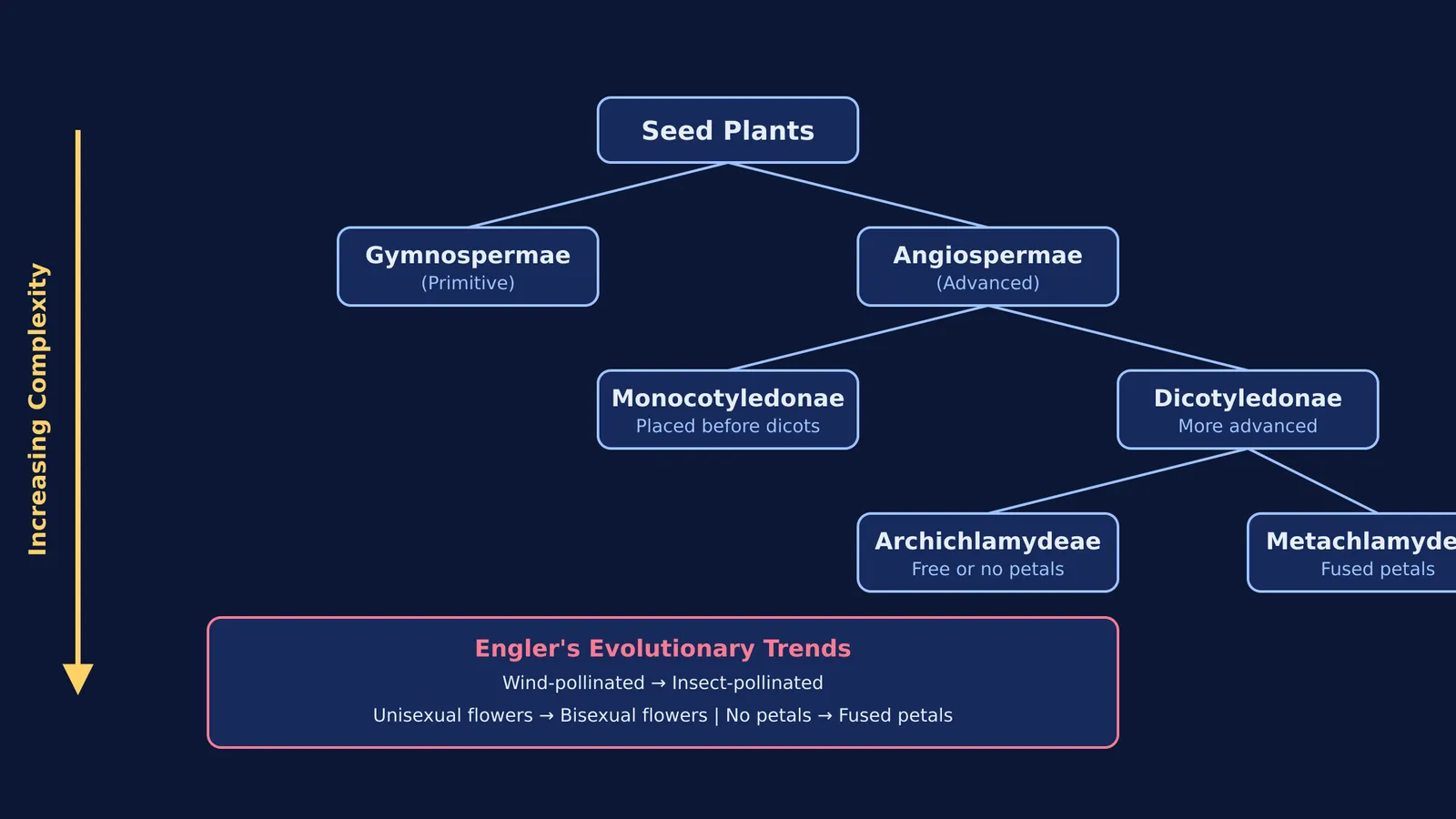
The Engler and Prantl system was built on the fundamental idea that plants should be ordered from the most primitive forms to the most advanced. They used specific floral traits to decide a plant family's level of evolutionary complexity, assuming that evolution always moves from simple structures to complex ones.
Pollination: Wind-pollinated (anemophilous) flowers were considered the original, primitive state of angiosperms, while insect-pollinated (entomophilous) flowers were seen as a derived, advanced trait (Wikipedia).
Flower parts: Unisexual flowers (having only male or only female parts) were treated as more primitive than bisexual flowers (having both).
Petals: Plants without petals (apetalous) were placed early in the system. As complexity increased, they were followed by plants with free petals (polypetaly) and finally by those with fused petals (sympetaly).
How did they divide the seed plants?
Engler and Prantl mapped out the entire plant kingdom in 13 divisions (Wikipedia), covering everything from bacteria and algae to flowering plants. They made a major improvement over the earlier system designed by George Bentham and Joseph Hooker. Instead of sandwiching Gymnosperms (such as pines and cycads) between dicots, they correctly placed them before Angiosperms (the flowering plants), recognising them as a distinct, more primitive group.
The 13th division, containing all seed plants, split Angiosperms into two main classes:
Monocotyledons: Following the thought of the time, Engler placed monocots before dicots, incorrectly assuming they were more primitive. He placed families like Typhaceae (cattails) early due to their simple wind-pollinated flowers, and orchids at the end.
Dicotyledons: The dicots were split into two subclasses based on their perianth.
The dicot subclasses were the Archichlamydeae and the Metachlamydeae. The Archichlamydeae contained plants with no petals or free petals. Engler placed the "Amentiferae" (catkin-bearing plants like oaks and birches) at the very start of this group because of their simple, wind-pollinated structure. The Metachlamydeae (also known as Sympetalae) contained the most advanced plants with fused petals, culminating with the Asteraceae (sunflower family) at the peak of dicot evolution.
What were the merits and demerits?
The system's greatest merit was its comprehensive phylogenetic approach. It successfully abolished artificial groupings and provided a vast, detailed framework that reached down to the genus level. For decades, it served as the global standard for organizing museum herbaria and writing regional plant lists, and its influence remains visible in many botanical institutions today.
However, the system had significant demerits that modern botany has since corrected. Modern molecular phylogenetics has shown that dicots are not a single advanced group derived from monocots; instead, monocots branched off from early basal dicots. Furthermore, the assumption that simple, wind-pollinated flowers like those of the oak or birch are primitive was incorrect. Botanists now understand that these simple flowers are actually highly evolved, reduced forms that lost their petals over time to adapt to wind dispersal (Wikipedia). Another demerit of the system was its assumption that angiosperms were polyphyletic—meaning they evolved from several different gymnosperm ancestors. Today, most evidence points to a single common ancestor for all flowering plants. Yet, despite these errors, Engler and Prantl's monumental effort laid the groundwork for modern phylogenetic classification.
Understanding how these early classification systems worked helps you grasp the bigger picture of taxonomy, a common topic in exams like NEET. If you are revising plant classification and evolution, the Fermi Concept Library contains every concept in biology, each with its own lesson and its place in the map.
If you are exploring the history of taxonomy further, you can read about John Ray's seed test: an early definition of species, trace the progression of evolutionary thought in Theodosius Dobzhansky and evolution seen through genetics, or look at outliers in Viruses, viroids and lichens: the misfits of five-kingdom biology.