On this page
Beat a bowl of chilled cream for a few minutes and a pourable liquid becomes something that stands in peaks on a spoon. Only air was added. What changed is how the fat is arranged, a clear kitchen example of Class 9 colloids.
What is cream made of before you whip it?
NCERT's new Class 9 science book describes a colloid as a mixture whose particles stay spread through it and do not settle over time, and calls its two parts the dispersed phase and the dispersion medium (NCERT Exploration, Grade 9, Chapter 5). The same chapter calls milk an oil-in-water emulsion and says proteins in milk act as emulsifying agents that keep it stable.
Cream is the fat-rich part of milk (why cream rises to the top of milk), so it is the same emulsion with far more fat droplets.
Fat content matters for whipping. Under US food standards, light whipping cream contains at least 30% but less than 36% milkfat (21 CFR 131.157). Heavy cream contains at least 36% milkfat (21 CFR 131.150).
Why does cream turn thick when you whip it?
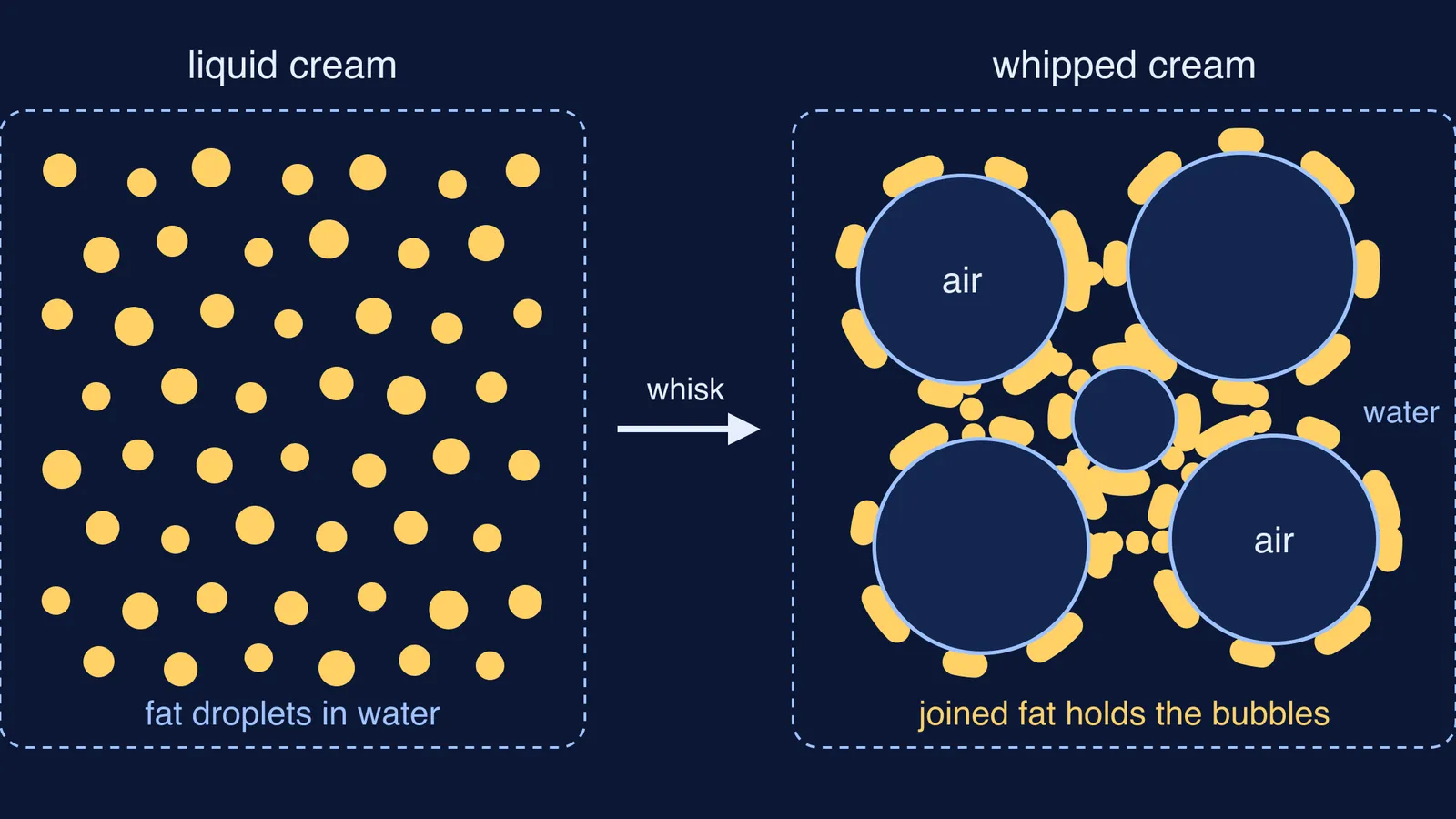
The whisk folds in air and throws fat droplets against each other and against the new bubbles. A 2019 paper in Food Science and Technology Research describes whipped cream as air bubbles, clumps of fat globules and a water phase (Ihara and colleagues, 2019). Summing up earlier work, the paper describes whipping in three stages: air bubbles go in and proteins coat them, fat globules settle onto the bubble surfaces, and a network of fat-globule clumps forms.
The joining step is called partial coalescence. A 2010 review explains that, unlike true coalescence, it needs solid particles (fat crystals) inside the oil droplets and forms irregular clusters rather than one bigger round drop (Fredrick, Walstra and Dewettinck, 2010). The review also notes that it must be avoided for a long shelf life in sauces, creams and several milk products, while ice cream, butter and whipped toppings need it.
Picture two droplets bumping. Fat crystals let them stick where they touch but stop them flowing into one sphere. Chains of half-joined droplets line each bubble and reach across to the next: a soft scaffold of fat holding air, with water in the gaps. That is why a dollop keeps its shape.
Why won't warm or thin cream whip?
The same review lists what controls how fast droplets join: how the liquid flows, how much of it is fat, the temperature, the temperatures the cream went through earlier, and its recipe (Fredrick and colleagues, 2010).
Warm cream: with the fat softened there is less solid fat to make droplets stick without merging, so the foam slumps.
Thin cream or milk: too few fat droplets to coat the bubbles and link them, so you get froth that collapses.
Too much whipping: the clusters keep growing until the network breaks and the fat separates out as butter.
That last change is part of a 2026 Massey University master's thesis, which studied how cream volume, temperature and fat content affect whipping, including the transition from good foam to overwhipping and butter formation (Eluvathingal, 2026).
How does whipped cream fit the Class 9 colloid chapter?
One carton of cream walks you through three kinds of colloid. The NCERT chapter lists milk and vanishing cream as oil-in-water emulsions and butter as a water-in-oil emulsion (NCERT Exploration, Grade 9, Chapter 5).
Liquid cream is an emulsion: fat droplets (dispersed phase) in water (dispersion medium).
Whipped cream is a foam: air bubbles dispersed in a liquid, held up by the network of joined fat.
Over-whipped cream becomes butter, a water-in-oil emulsion, where the two roles have swapped.
For every colloid type by phase, see types of colloids: aerosol, emulsion, foam and gel. To tell a colloid from a solution or a suspension, see how to tell a true solution, colloid and suspension apart.
If structures like this are hard to picture, the Fermi Simulation Lab has interactive simulations for ideas that are easier to see than to read. To revise the rest of the chapter, the Fermi Concept Library covers every concept in chemistry, each with its own lesson.
Try it: cold cream against warm cream
Predict, then test. Ask an adult before using an electric beater, and cook with what you make.
Note the fat percentage on the pack and split the cream into two cups.
Chill one cup and a steel bowl for an hour; leave the other cup on the counter for that hour.
Predict which reaches soft peaks first, and whether the warm one gets there at all.
Whip each at the same speed; time how long until a peak holds on the lifted whisk.
Keep whipping the cold cup. When it turns grainy and liquid seeps out, butter is forming.
For each stage, write down the dispersed phase and the dispersion medium.
Next time a recipe says whip until stiff peaks, you will know you are building a fat scaffold around air, one half-joined droplet at a time.