On this page
You lift the lid of the rooftop tank in April and the walls are coated with a slippery green film. That colour is algae, and it is the same photosynthesis you meet in Class 10 biology, running on your terrace. Once you know what algae need, you know what to take away.
Why does a water tank turn green inside?
Algae are simple organisms that make their own food by photosynthesis, so they need light, water, carbon dioxide and a few dissolved minerals. The two things that decide whether a tank turns green are nutrients and light.
The US Geological Survey explains that algal growth is usually limited by the supply of either phosphate or nitrate, and that algae feeding on these nutrients grow, spread and turn water green. Supply water can carry small amounts of both, and dust, leaves and bird droppings that get past a loose lid add more.
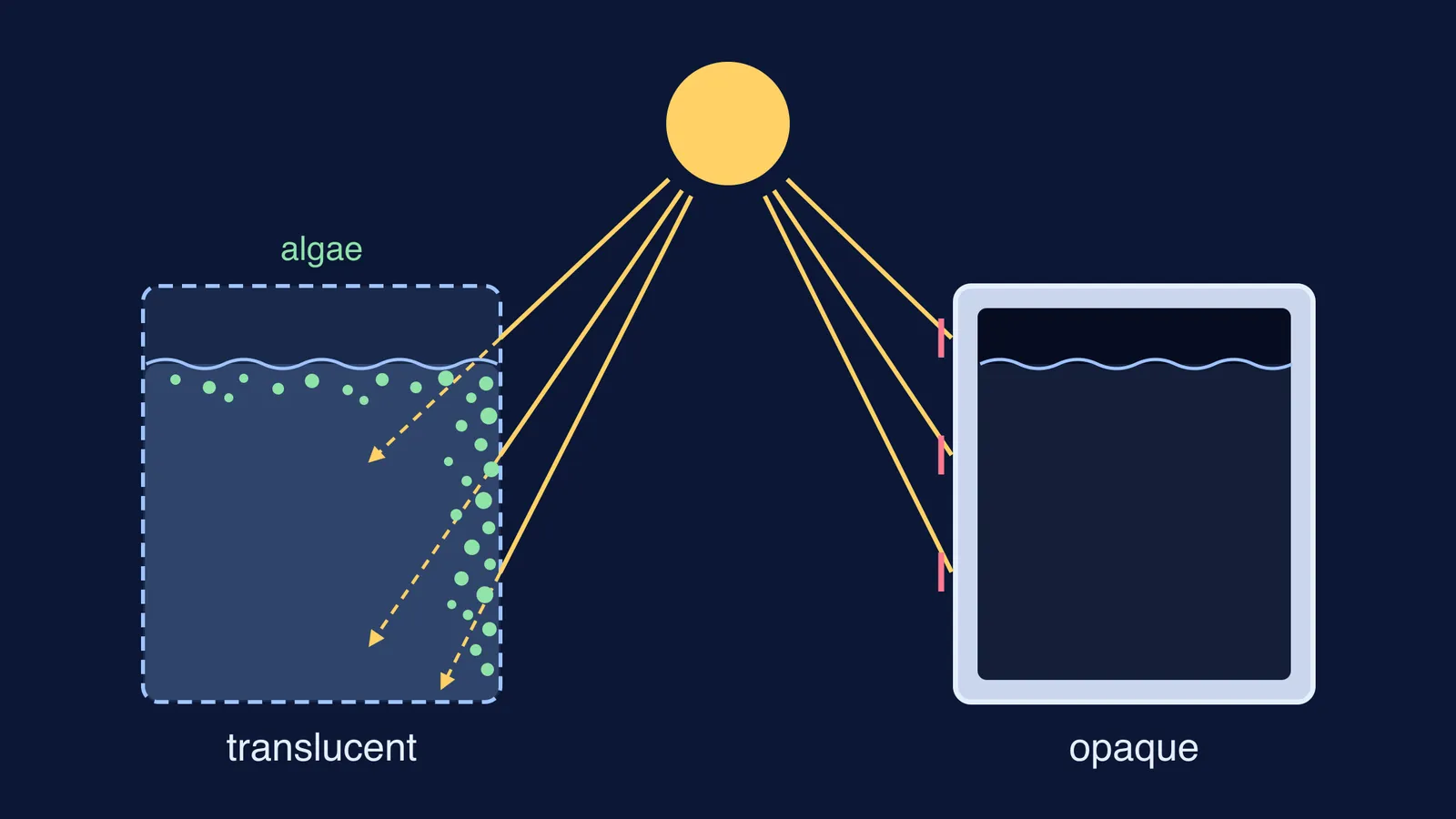
Light is the other half. Pale or translucent tanks let some daylight through their walls, and a cracked or badly fitting lid lets in more. Algae then tend to grow where light is strongest: on the sunny wall and just under the water surface.
Does sunlight make tank water dirtier?
It can, and not only because of the colour. In a 2021 study in the journal Sustainability, Andriamanantena, Kim and Han followed two household rainwater tanks for three months, one exposed to sun and one not.
Counts of bacteria stuck to the walls were significantly higher in the tank exposed to sun.
Counts of bacteria floating in the water fell 10 times faster in the tank kept out of the sun, especially near the top and middle.
The authors explain that light let photosynthetic microbes make nutrients that fed other bacteria, and they recommend shading tanks that sit in sunlight.
The same authors also suggest not disinfecting a rainwater tank, because it weakens the self-cleaning work of its microbes. That is about stored rainwater; the cleaning plan below follows Mumbai's civic advice for supply tanks.
Why do dark, opaque tanks help?
An opaque wall stops light before it reaches the water. With no light, algae cannot photosynthesise, so they cannot build up even when nutrients are present. That is the idea behind multi-layer tanks, which add a dark layer inside the wall to block light.
For a pale tank you already own:
Shade it with a simple roof or cover so direct sun does not fall on its walls.
Check that the lid sits tight and is not cracked.
Put a mesh over the overflow and vent pipes so leaves and insects stay out.
Choose an opaque, multi-layer tank when you next replace it.
If limiting factors still feel shaky before a biology test, the Fermi Concept Library gives every concept in biology its own lesson.
How often should you clean a water tank?
The Brihanmumbai Municipal Corporation's guidelines for housing societies say a water tank should be cleaned and disinfected at least twice a year, with moss and dirt removed using chlorine and a high-pressure jet. The BMC gave that advice after finding that contaminated water was reaching homes because underground and terrace tanks were not being cleaned.
Here is a plan a family can follow, built around that twice-a-year rule and India's seasons:
Once a month: shine a torch inside. Look for green film or a smell, and check the lid and meshes.
April or May, before the monsoon: full clean and disinfection.
October or November, after the monsoon: a second full clean.
Any time: if the green film comes back within weeks, look for the light leak, not just the dirt.
For a full clean, close the inlet and drain the water, scoop out the sludge, scrub the walls with a stiff brush, then disinfect, rinse and refill. Disinfection uses chlorine, so follow the product label exactly or hire a trained tank cleaner. Never climb into a tank alone, and never mix bleach with toilet cleaner.
A clean tank does not make water safe to drink by itself. Read what boiling water can and cannot remove, and if your water smells or looks odd, or someone at home gets stomach trouble, stop drinking it, tell your local water department and see a doctor.
Can you see this happen at home?
Yes. Fill two clear plastic bottles with the same tap water and add a pinch of garden soil to each. Wrap one completely in black paper, and leave both on a sunny windowsill. The bottle that gets light should turn green first. It is the same logic as the Hydrilla bubble experiment for measuring photosynthesis: change one factor, keep the rest the same. For ideas that are easier to see than to read, the Fermi Simulation Lab has interactive simulations.
Next time you lift the tank lid, you will know what the green is telling you.