On this page
If you live on the top floor, you know the feeling: at 10 pm the fan is on full, the ceiling feels warm, and your friend two floors down is sleeping comfortably. All three kinds of heat transfer from your physics syllabus are working against you, and the main fix, a cooler roof, has been measured in Indian homes.
Why is the top floor hotter than the ground floor in summer?
Your ceiling is the only one in the building that faces the sky. The US weather agency NOAA defines the three routes heat can take: radiation through space, conduction through a material, and convection inside a fluid such as air.
All three reach your flat:
Radiation: sunlight falls on the roof slab all day, and a dark roof absorbs most of it.
Conduction: that heat moves slowly down through the concrete to its underside, which is your ceiling.
Radiation again: the hot ceiling gives off infrared radiation into the room. Because a thick slab stores heat, this carries on for hours after sunset, which is why nights stay hot.
Lower floors are protected because each has a flat above it. A 2019 fact sheet from the Natural Resources Defense Council (NRDC) says more than 60% of the roof surface in urban India is galvanised metal, asbestos or concrete, materials that trap heat inside buildings.
Does hot air rise to the top floor?
Yes, and that is the convection part. NOAA describes how warm air rises while cooler, denser air moves in to take its place. In a building, air warmed by people, cooking and appliances drifts upward through stairwells and shafts. In your own rooms, the warmest air collects under the ceiling, which is already the hottest surface in the flat.
So the top floor gets heat from both directions: the sun heating the roof from above, and warm air rising from below.
Do cool roofs and roof shade actually work?
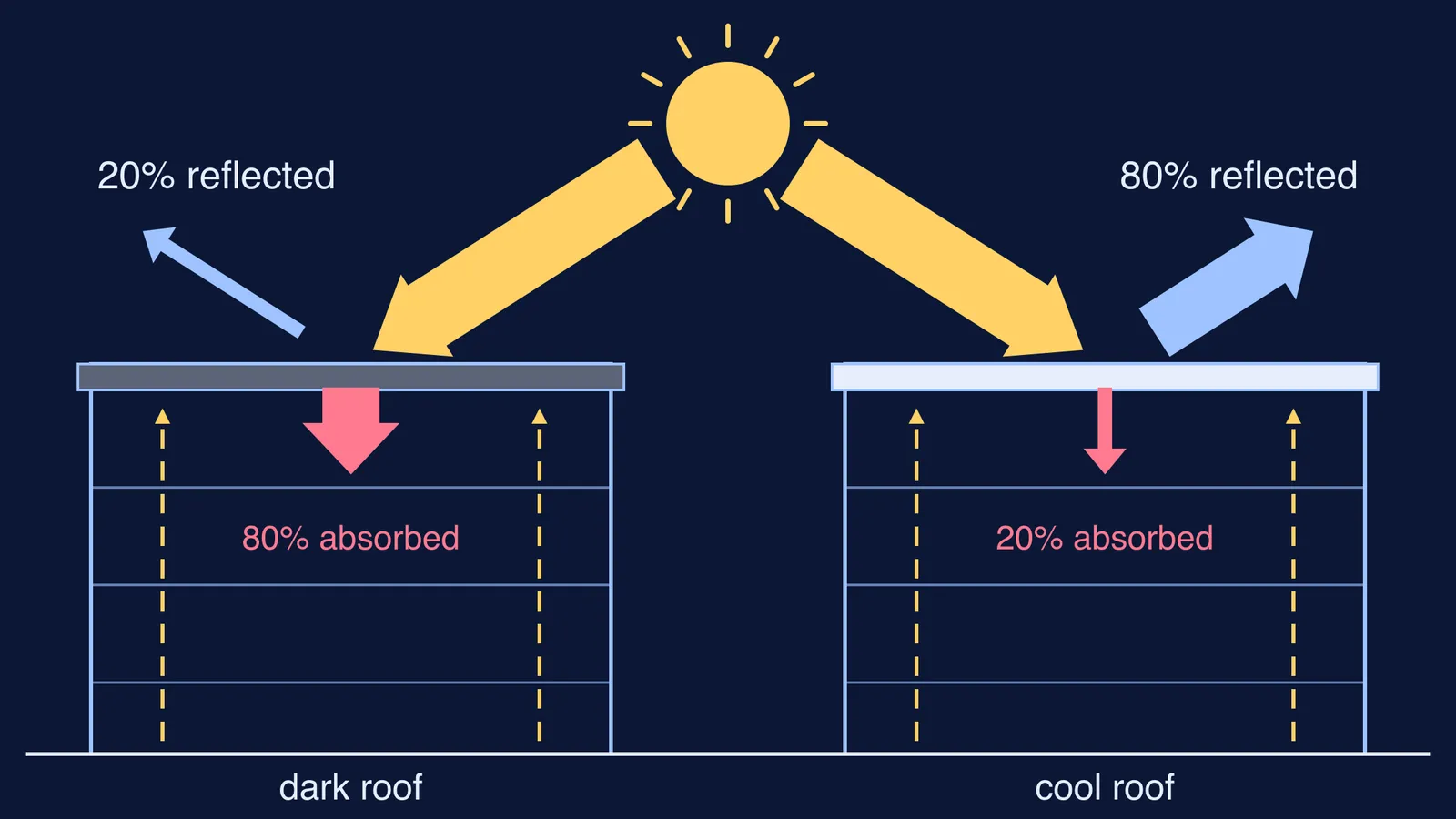
A cool roof is a roof coated or covered so that it reflects more sunlight and absorbs less. The US Environmental Protection Agency says high solar reflectance is the most important property of a cool roof, and that cool roofs can lower maximum indoor temperatures in homes without air conditioning by 1.2 to 3.3°C. In air-conditioned homes, they can cut peak cooling demand by 11 to 27%.
In a Hyderabad pilot described by NRDC, homes with a reflective roof membrane were on average 2°C cooler indoors than similar homes without one. The fact sheet also cites a Hyderabad study finding that cool roofs can cut cooling energy demand on a building's top floor by 10 to 19%. Ahmedabad's heat action plan included a cool roofs pilot covering 3,000 roofs, using white lime paint that cost about ₹1.50 per square foot.
Shade blocks sunlight before it reaches the slab. In a peer-reviewed San Diego study by Anthony Dominguez, Jan Kleissl and Jeffrey Luvall (Solar Energy, 2011), daytime ceiling temperatures under rooftop solar panels were up to 2.5°C cooler than under the exposed roof. At night the pattern reversed: the ceiling under the panels was warmer, because the panels also act as insulation. Their simulations showed a 38% cut in yearly cooling load.
A cooling plan for a top-floor flat
Work through these in order: permission first, then the roof, then daily habits.
Talk to your society or RWA. The terrace is usually shared property, so ask before you paint or build on it. Take the NRDC cool roofs fact sheet along.
Make the roof white. Clean it, then apply lime wash or a reflective roof paint over the area above your flat.
Keep it white. A coating only reflects while it stays clean. Check it before each summer and recoat when it turns grey.
Add shade where you can. Solar panels, a shade structure or potted plants stop sunlight before it reaches the slab.
Use the cool night air. Open windows when it is cooler outside than inside; close them and draw curtains in the afternoon.
Watch heat alerts. On heatwave days, follow your state's advisories. If anyone feels dizzy, confused or very unwell, get medical help straight away.
Worked example. Say the terrace above your flat is 1,000 square feet. At the Ahmedabad pilot's lime-paint price of ₹1.50 per square foot, one coat would cost about 1,000 × 1.50 = ₹1,500. That price was published in 2019, so get a current quote before you budget.
How does this connect to your physics syllabus?
This is the heat transfer chapter in your own home: reflection and absorption at the roof, conduction through the slab, radiation from the ceiling and convection in the air. If one of the four is still fuzzy, the Fermi Concept Library gives each physics concept its own lesson. If you can't picture how they fit together, Fermi's AI tutor can draw the figure and check your understanding as it goes.
For more everyday heat physics, read why mud houses stay cool in summer, why space suits are white and why the noon sun feels hottest.