

On this page
You come back from a cricket match or a crowded bus ride in June. Right after, your shirt smells of very little. A few hours later, the smell builds up. That delay is the clue: the smell is not in the sweat itself. It is made on your skin, by bacteria, after the sweat comes out.
Is fresh sweat actually odourless?
Mostly, yes. You have two main kinds of sweat glands. A 2019 review of sweat gland physiology in the journal Temperature reports that humans have about 2 to 4 million eccrine glands, and their sweat is mostly water and salt (Baker, 2019). That watery sweat cools you as it evaporates, which our post on why we sweat when we exercise explains.
The smell starts with the other kind. The same review says apocrine glands sit mainly in the armpits, breasts, face, scalp and groin, and only start secreting at puberty (Baker, 2019). That is why young children rarely have body odour and teenagers suddenly do.
Apocrine glands release an odourless, lipid-rich, sticky secretion, according to a 2018 study in eLife (Minhas et al., 2018). The classic proof came in 1953, when dermatologist Walter Shelley and colleagues found that apocrine sweat is sterile as secreted, but specimens left standing for several hours acquired the typical armpit odours (Shelley, Hurley and Nichols, 1953; summary in the Journal of the Society of Cosmetic Chemists).
Which bacteria make sweat smell, and how?
A 2015 DNA survey of armpit microbes found that three groups, Staphylococcus, Corynebacterium and Propionibacterium, made up 96% of the bacterial sequences (Troccaz et al., 2015).
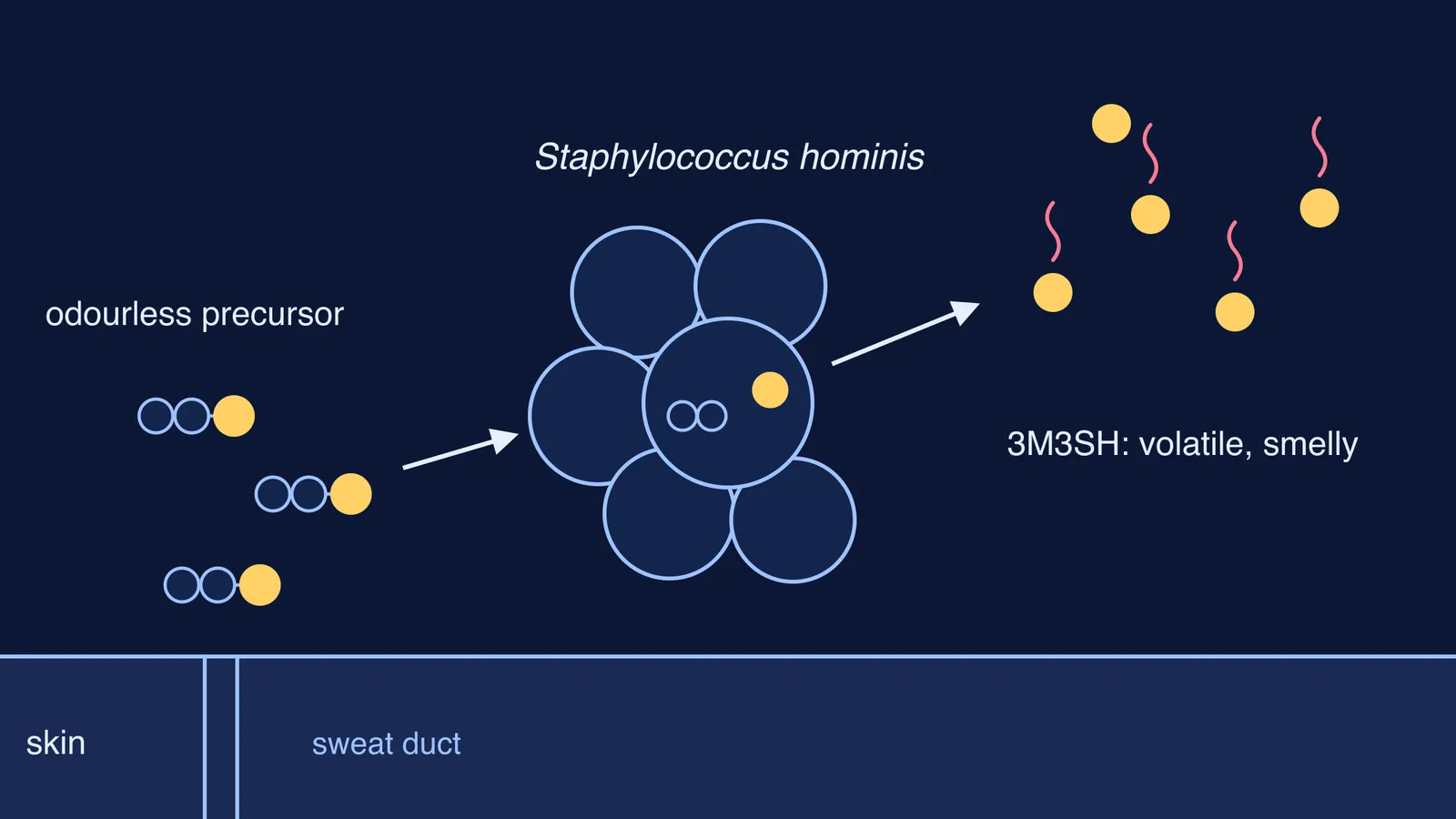
They do not eat sweat whole. Your glands release odourless "precursor" molecules, and bacterial enzymes snip off the smelly part. A 2020 review by Andreas Natsch and Roger Emter describes body odour as an interplay between what your glands secrete and the enzymes of armpit bacteria, producing smelly carboxylic acids and sulphur compounds (Natsch and Emter, 2020).
The most abundant and pungent of the sulphur compounds is 3-methyl-3-sulfanylhexan-1-ol, or 3M3SH. Staphylococcus hominis pulls the odourless precursor into its cell and converts it to 3M3SH, which is then released (Minhas et al., 2018). The same paper notes 3M3SH can be detected at picogram-per-litre levels, which is why a little goes a long way.
A 2020 study in Scientific Reports found the enzyme that does the cutting, and showed that giving it to non-smelly staphylococci made them produce odour too (Rudden et al., 2020). The authors estimate the enzyme entered this group of bacteria about 60 million years ago.
Why does sweat smell after some time and not straight away?
Because each step takes time. Here is the timeline for a sweaty afternoon:
Secretion. Apocrine glands release odourless precursor molecules onto the skin.
Uptake. Skin bacteria such as Staphylococcus hominis take the precursors into their cells.
Cutting. Bacterial enzymes break a big, non-volatile molecule into smaller pieces.
Release. The small pieces, such as 3M3SH and short acids, evaporate easily and reach your nose.
Build-up. In warm, damp skin and cloth, bacteria keep working and the smell grows over hours.
If this feels familiar from biology class, it should. It is the same logic as decomposers breaking down organic matter: microbes split large molecules into smaller ones, and some of those small molecules smell. You can picture where the glands sit using our post on the structure of human skin.
Molecules you cannot see are hard to picture from text alone. The Fermi Simulation Lab has interactive simulations for the ideas that are easier to see than to read.
Why do some people barely smell at all?
Genes matter. A 2010 study in the Journal of Investigative Dermatology linked a single change in the ABCC11 gene to a near-complete loss of typical odour precursors in armpit sweat (Martin et al., 2010). ABCC11 makes a pump in apocrine glands that pushes these molecules out; the same variant also decides whether earwax is wet or dry. The Natsch and Emter review notes this mutation explains why many people in East Asia do not form typical armpit odour (Natsch and Emter, 2020).
What can you do about sweat smell?
The chemistry tells you where to act: fewer bacteria, less time, less damp.
Wash armpits with soap after sports or a long hot day, so fewer bacteria and less precursor are left.
Dry skin fully before dressing; damp skin helps bacteria work.
Change out of sweaty clothes soon. Smell builds over hours, so a quick change beats a late one.
Dry washed clothes completely, in the sun where you can.
Antiperspirants cut sweat, and with it the bacteria's food. The 2015 survey found people who did not use them carried on average about 50 times more armpit bacteria than users (Troccaz et al., 2015).
If your body odour changes suddenly or strongly without a clear reason, mention it to a doctor rather than guessing.
If microbes and enzymes still feel shaky for your board exams, the Fermi Concept Library covers every concept in biology and chemistry, each with its own lesson.


