

On this page
A fresh glass of ganne ka ras is pale green-gold. Leave it on the table and it turns brownish, and by evening it smells sour. Two processes are at work: a chemical one driven by enzymes and air, and a biological one driven by microbes. Both start the moment the cane goes through the rollers.
Why does sugarcane juice turn dark if kept for long?
The darkening is called enzymatic browning. Inside the living cane, enzymes and the compounds they act on are kept in separate parts of the cell. The roller press breaks the cells, mixes everything into one liquid and whips air into it.
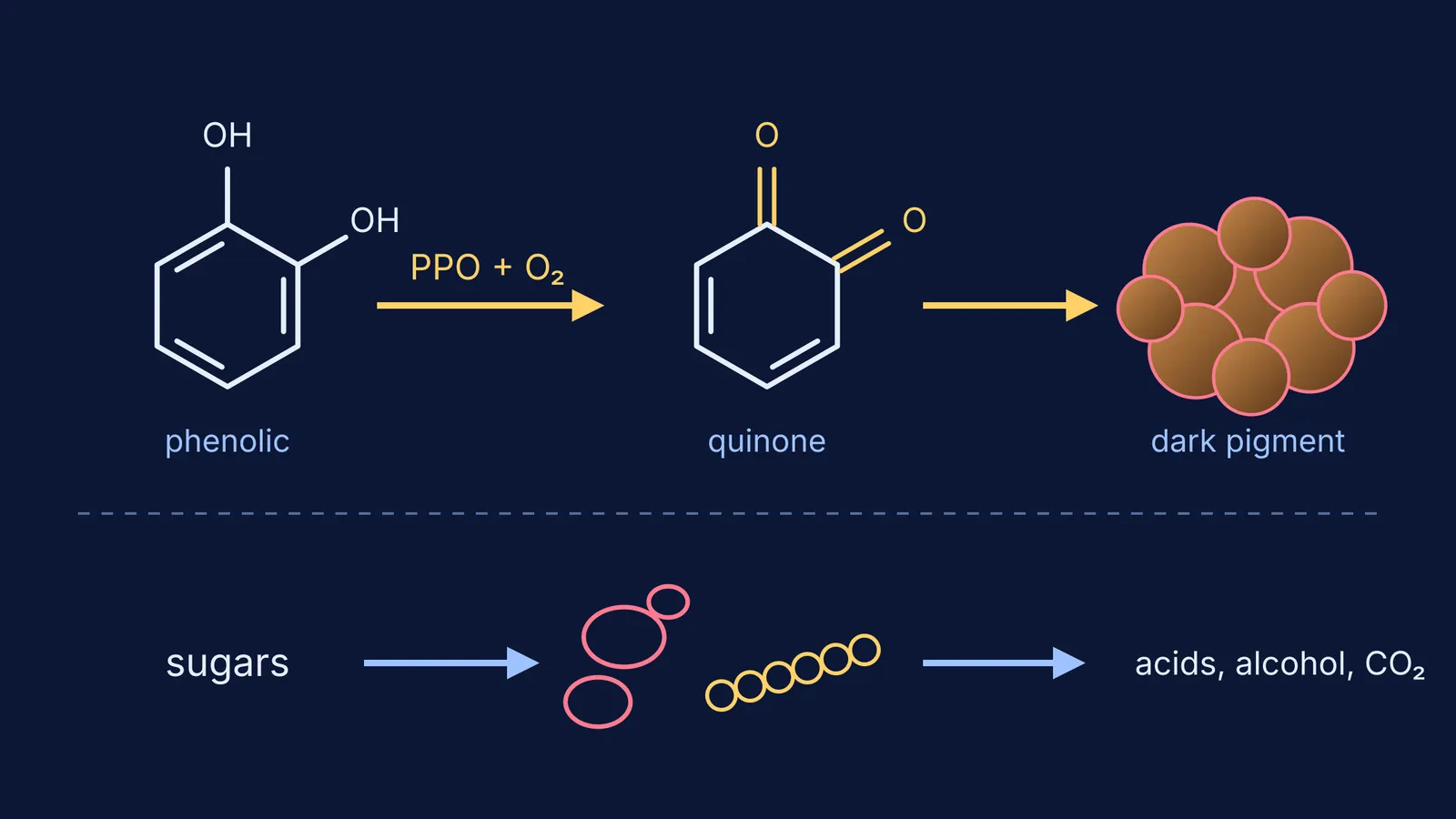
Polyphenol oxidase (PPO) is an enzyme that, in the presence of oxygen, converts phenolic compounds into dark-coloured pigments, as a 2018 study of browning in sugarcane juice explains. The same paper describes a second enzyme, peroxidase, which can oxidise phenolics to quinones using hydrogen peroxide, but notes it may add little colour under normal extraction because the juice has too little hydrogen peroxide.
A 2017 study on preserving fresh sugarcane juice puts the problem plainly: the juice "turns blackish during storage due to the enzymatic activities".
Worked example: what the enzyme does to one molecule
Take catechol, the simplest phenolic, as drawn in the diagram above.
Start with a benzene ring carrying two –OH groups on neighbouring carbons.
PPO uses oxygen from the air to pull two hydrogen atoms off those –OH groups, which become two C=O groups. The product is an ortho-quinone.
Overall: catechol + ½ O₂ → o-benzoquinone + H₂O. Oxygen is a reactant, so more air means faster browning.
Quinones are reactive and go on to form the brown-black pigments you see in the glass.
It is the same reaction that makes a cut apple turn brown so quickly; only the fruit is different.
Why does stored sugarcane juice turn sour and frothy?
While the enzymes darken the juice, microbes from the cane, the rollers and the air start eating its sugar. A 2021 paper in Food Science and Nutrition describes the juice as about 80% water and 20% dissolved solids, with a pH above 4.6, and says fermentation sets in within a few hours of extraction. The 2017 preservation study names bacteria such as Leuconostoc among the microbes that ferment its sugars, and measured a pH of 4.72 in the fresh juice it tested.
How fast do the microbes multiply? In a 2020 Tanzania Journal of Science study, untreated juice kept at room temperature had yeast and mould counts of 5.48 log CFU/ml after 12 hours and 9.48 log CFU/ml after 168 hours.
In plain numbers:
5.48 log CFU/ml means 10^5.48, about 3 lakh colony-forming units in every millilitre.
9.48 log CFU/ml means 10^9.48, about 300 crore per millilitre.
A rise of 4 log units is a 10,000-fold increase.
Yeasts turn sugar into alcohol and carbon dioxide, so old juice froths, while bacteria make acids that turn it sour. See alcoholic vs lactic acid fermentation for why cells take these routes.
Does lemon stop sugarcane juice from turning dark?
The 2018 browning study reports that PPO works best at pH 6–7 and shows no enzymatic activity below pH 3. It also explains how common acidulants fight browning: ascorbic acid (vitamin C) acts as an antioxidant that blocks the browning reactions, citric acid binds the copper the enzyme needs, and both enzymes were less active at lower pH. Lemon juice contains both acids, so a squeeze should slow the browning, though it will not stop the microbes.
Factories need something stronger. The 2017 study found that a pressure of 600 MPa at 60 °C completely inactivated the spoilage microbes within 6 minutes and both browning enzymes within 8 minutes. That pressure is roughly 6,000 times normal air pressure.
Try it: a one-hour kitchen experiment
You need fresh juice, three clear glasses and a sheet of white paper.
Glass A: plain juice on the table.
Glass B: juice with a few drops of lemon, on the table.
Glass C: plain juice in the fridge.
First predict which glass darkens first, using the words enzyme, oxygen, pH and temperature.
Hold each glass against the paper at 0, 15, 30 and 60 minutes and note the colour.
Compare: B tests acid, C tests temperature, A is your control.
Do not drink the samples afterwards. If enzyme activity or reaction rate still feel abstract, the Fermi Simulation Lab has interactive simulations for ideas that are easier to see than to read, and the Fermi Concept Library gives oxidation, enzymes and fermentation each its own lesson.
For the other half of the sugarcane story, read why jaggery is brown and sugar is white.


