

On this page
Switch off the lights, crush a sugar cube, and you may see a faint blue-white flicker. You are not imagining it. People have noticed it for centuries: Francis Bacon wrote in 1620 that hard sugar "will sparkle when broken or scraped in the dark", as quoted in the Wikipedia article on triboluminescence. The explanation brings together two chapters you study separately: electric charge and the way atoms and molecules give out light.
What is triboluminescence?
Triboluminescence is light given out when a material is put under mechanical force, such as rubbing, cracking or crushing. That is how a 2021 review in the journal Materials, by Szukalski and colleagues, defines it (Materials, 2021). The word comes from the Greek *tribein*, to rub.
The same review notes that when the light from crushed sucrose was recorded in 1922, it was found to be identical to the emission spectrum of a nitrogen gas discharge (Materials, 2021). In other words, the light does not come from the sugar at all. It comes from the air.
Why does sugar flash when you crush it in the dark?
Linda Sweeting, a chemist at Towson University, calls it "lightning on a very small scale" in her home-experiment guide on candy sparks. Here is the chain of events, step by step:
The crystal cracks. Crystals that glow this way often lack symmetry and are poor conductors (Wikipedia), so the two new faces of a crack do not end up with equal charge.
Charge separates. One face is left with more positive charge, the other with more negative charge, the way rubbing pulls charge apart in ordinary static electricity.
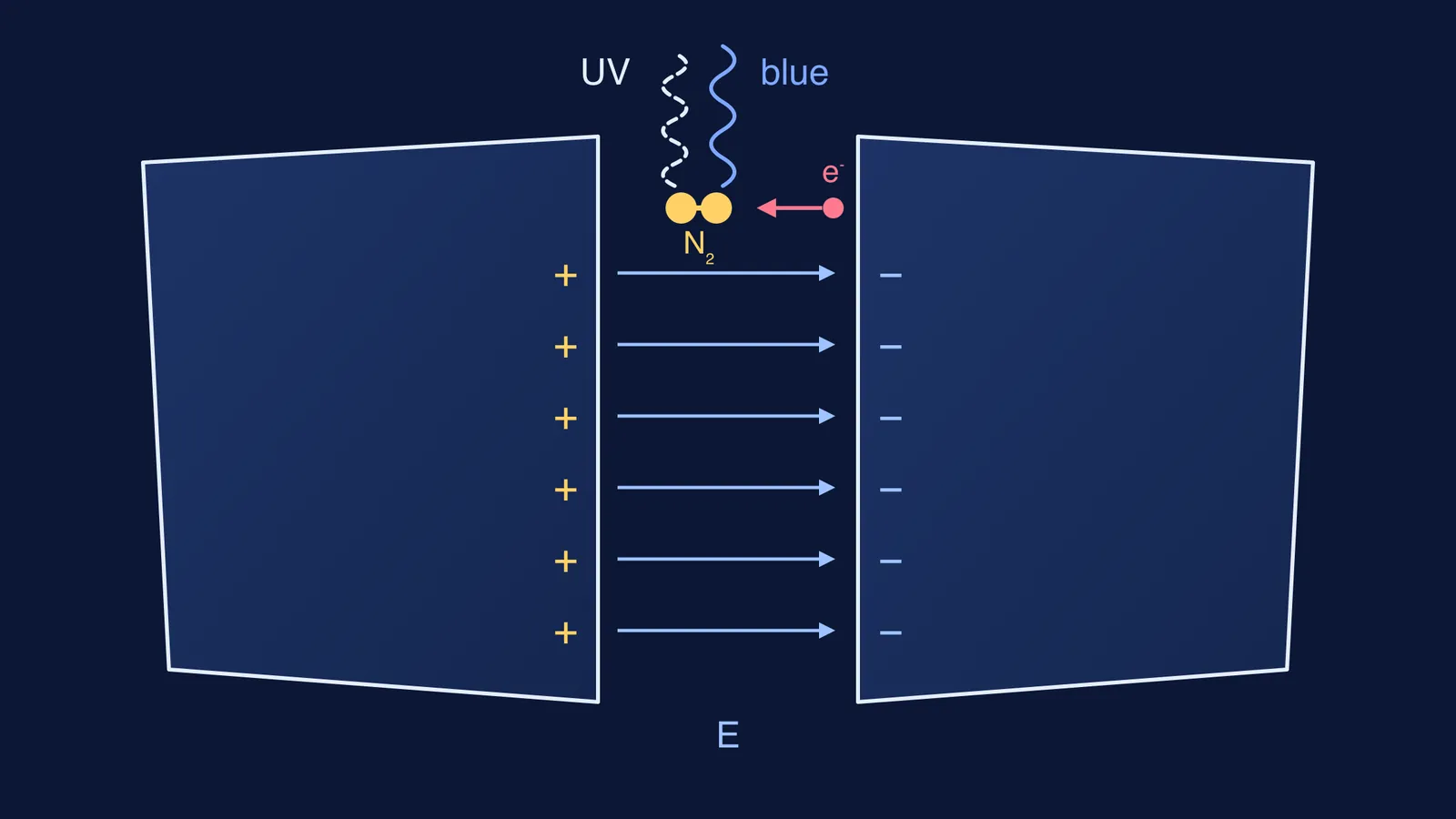
A strong field builds across the gap. Two oppositely charged faces a tiny distance apart act like the plates of a capacitor, with an electric field pointing from + to −.
Electrons jump. Once the field is strong enough, electrons race across the air in the crack. Sweeting describes them "colliding with and exciting the nitrogen molecules" (Towson University).
Nitrogen gives out light. An excited nitrogen molecule drops back to a lower energy state and releases the energy as a photon.
According to Sweeting, most of that emission is at ultraviolet wavelengths below 380 nm, which your eyes cannot detect (Towson University). You only see the small visible, bluish part, so the flash from plain sugar is dim.
Why does wintergreen candy glow brighter than plain sugar?
Wintergreen flavouring is fluorescent: it absorbs ultraviolet light and re-emits it as visible light. Sweeting explains that the ultraviolet from the tiny sugar "lightning" excites the wintergreen molecules, which then shine at about 400 to 500 nm, right where your eyes are sensitive (Towson University). Same spark, more visible light.
She also notes that it fails with transparent candy, with sugar-free candy sweetened with saccharin or aspartame, and with candy that has gone soggy (Towson University). A likely reason for the soggy case is that water lets charge leak away before a spark can form.
How can you see sugar sparks at home?
This takes only a few minutes and works well as a parent-and-child experiment. A simple plan:
Pick a closet or a room with no windows. Sweeting suggests waiting 5 to 10 minutes in the dark so your eyes adjust (Towson University).
Put a few dry sugar cubes or pieces of hard white mishri in a clean zip bag.
Press down sharply with the back of a steel spoon or a pair of pliers. Watch the crack, not the tool.
Repeat with a wintergreen mint if you can find one, and compare.
Then try a cube left in a humid spot overnight.
Before each step, write down a prediction and the reason for it. For example: "Damp sugar will glow less, because water conducts and lets charge leak away before the field gets strong enough." Then check it. Predicting first and reasoning out loud is what turns a party trick into real understanding.
What does a sugar spark teach you about charge and light?
One flash links four ideas from your syllabus:
Charge separation: the same physics as why rubbing two objects charges them.
Electric field and breakdown: the field across the crack grows until air stops being an insulator, the process behind how lightning forms in clouds.
Mechanical force into electricity: compare the crystal in a gas lighter that sparks without a battery.
Excitation and emission: a molecule absorbs energy, then releases it as a photon of a definite wavelength.
The effect is not limited to sugar. A 2008 study in Nature linked peeling sticky tape to nanosecond X-ray flashes that track the tape's stick-slip motion (Camara et al., Nature, 2008).
If field lines across a gap are hard to picture from a textbook figure, the Fermi Simulation Lab has interactive simulations for ideas that are easier to see than to read. Switch the lights off tonight, crush a sugar cube, and you may be watching that field turn into light.


