

On this page
You can stick a sticky note on your notebook, peel it off, and stick it on your mirror, and it still holds. Ordinary tape cannot. The difference is the shape of the glue.
What is the glue on a sticky note made of?
In 1968, 3M chemist Spencer Silver made a "low-tack" adhesive of tiny acrylic spheres that "would stick only where they were tangent to a given surface", according to the Lemelson-MIT Program. His colleague Art Fry later put it on paper bookmarks, and Post-it Notes were introduced across the US in 1980, the same page says.
Silver's patent, US 3,691,140, granted in 1972, describes the spheres. They are a rubbery acrylate copolymer with diameters from about 1 to 250 microns, most between about 5 and 150 microns. A micron is a thousandth of a millimetre.
The patent calls the spheres "inherently tacky", "elastomeric" (rubbery) and "infusible", meaning they do not melt. It says they give "a low degree of adhesion permitting separation, repositioning and rebonding of adhered objects", and "permit easy removal of bonded paper from the substrate without tearing".
Why does touching only at points make the grip light?
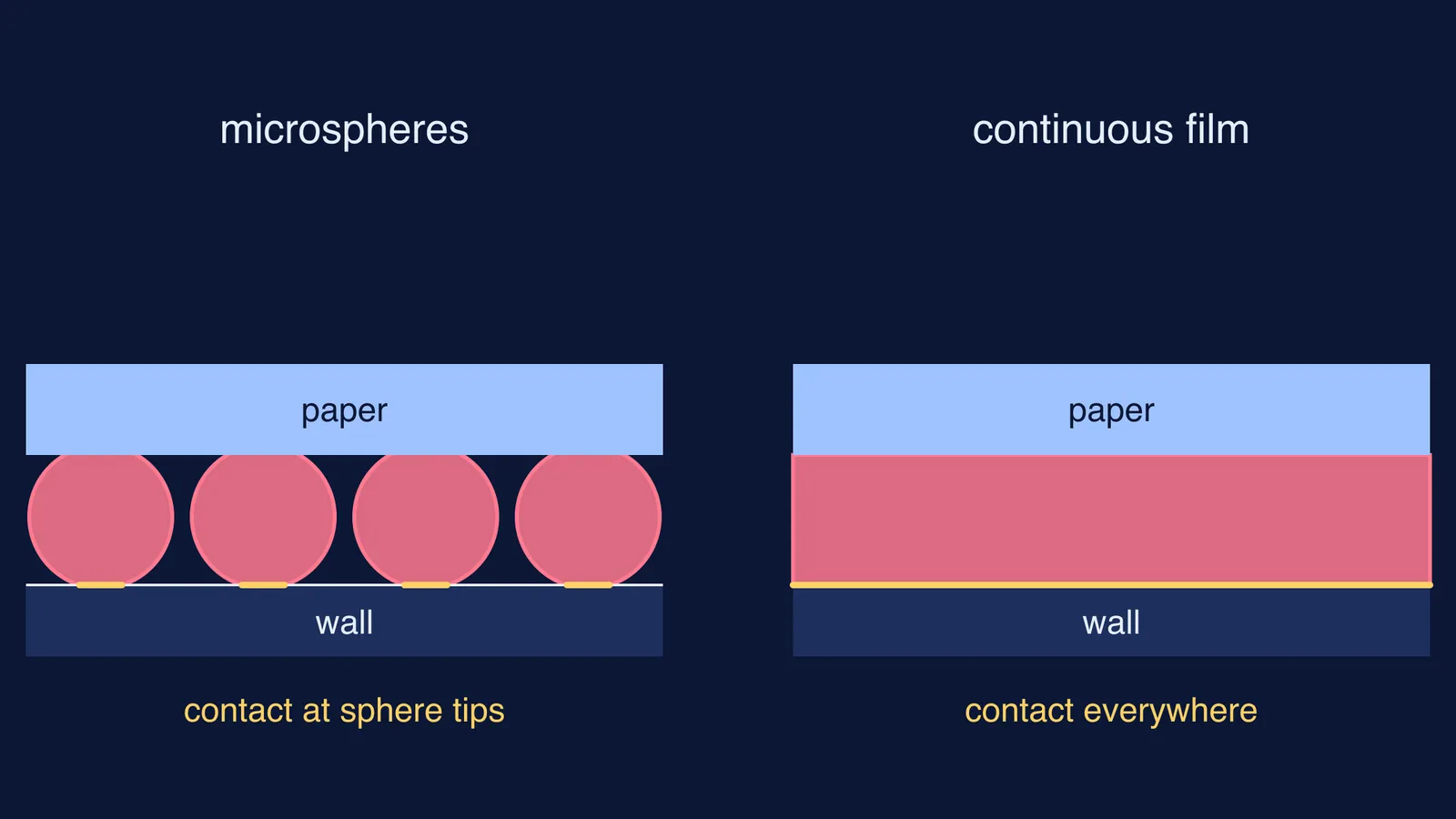
Sticky-note glue is a pressure-sensitive adhesive: a soft solid that bonds through simple contact under light pressure, with no chemical reaction, as Costantino Creton explains in an introductory review in MRS Bulletin. The grip comes from attractions between molecules wherever glue and surface actually touch. More real contact means more of these attractions and a harder peel.
Tape glue is a continuous film that flows into the bumps of a surface; a layer of spheres cannot. In the words of adhesive maker H.B. Fuller, "In the microsphere adhesive system, contact is limited to the tops of the spheres." Because the film is broken up, the company says, microsphere adhesives give low peel adhesion, easy removal and a grip that stays stable over time.
Because the spheres are rubbery and do not melt into a film, they can largely recover their round shape after a peel, ready for the next stick. Tiny contacts adding up is also why a house lizard can hang from a ceiling; see how lizards walk on ceilings with van der Waals forces.
How much of the wall does a sticky note actually touch?
Here is a worked estimate from our own simplified geometry, not a measurement.
Take spheres 25 microns across, one of the average sizes H.B. Fuller lists for its microspheres. The radius is R = 12.5 µm.
Pack them side by side in a square grid, each sphere in a 25 µm by 25 µm cell. That is 625 µm² of wall per sphere.
Press the note so each sphere flattens by h = 0.5 µm. A sphere flattened by h touches in a circle of radius a = √(2Rh) = √12.5 ≈ 3.5 µm.
Contact area per sphere = πa² = 2πRh ≈ 39 µm².
Fraction of the wall touched = 39 ÷ 625 ≈ 6%.
So even packed side by side, the glue touches roughly one-sixteenth of the area under the note. The formula also shows:
Flatten each sphere twice as far (h = 1 µm) and the contact area doubles to about 13%. That is one reason running your thumb along the strip can make a note hold better.
Space the sphere centres 50 µm apart instead, and each sphere has 2,500 µm² of wall, so the fraction falls below 2%.
Why does a sticky note stop sticking after a while?
A later 3M patent, US 5,571,617, says microsphere adhesives are partly self-cleaning: dust and other contaminants "tend to be pushed aside and trapped between the microspheres" as the note is pressed down. The same patent describes a known problem: spheres coming off the paper and staying on the surface. Self-cleaning has limits, though: when spheres are lost, or dust coats their tips, fewer tips can touch, so the grip fades.
Glue left behind is a chemistry problem, covered in why oil removes sticker residue. For grip with no glue at all, read why cling film sticks to bowls.
Try it: a 10-minute contact-area experiment
You need three sticky notes from the same pad, some identical coins, a little tape and a smooth cupboard door.
Note A: stick it with one light finger tap.
Note B: stick it and run your thumbnail firmly along the glue strip.
Note C: press it on a dusty shelf and peel it off five times, then stick it on the door like note B.
Predict the order first, using the worked example.
Tape coins to the bottom edge of each note one at a time until it falls. Write down the count.
If a result surprises you, ask which step changed the real contact area.
Contact area is easier to see than to read about, which is what the Fermi Simulation Lab is for: interactive simulations for ideas like this one. If the forces behind adhesion feel shaky, the Fermi Concept Library has a lesson for each concept in physics and chemistry.


