On this page
Peeling a price tag or a barcode off a new purchase often leaves a gummy, stubborn residue. You scrub it with a wet sponge, but the glue only smears and traps more dirt. Then, someone suggests rubbing a drop of cooking oil or baby oil on it, and the glue easily wipes away.
Why does a kitchen staple work better than dedicated cleaning water? It comes down to a fundamental rule of chemical solubility and the interactions between different types of molecules.
Why does the glue stay behind when you peel a sticker?
Before you even reach for the oil, you might wonder why the sticker did not peel off cleanly in the first place. The answer lies in the balance between two physical forces: adhesion (the grip between the glue and the surface) and cohesion (the internal strength of the glue itself).
When you pull a sticker, you are applying mechanical stress. If the cohesive forces holding the polymer chains together are weaker than the adhesive forces binding them to your new mug, the glue tears down the middle. Part of the adhesive stays on the paper, and part stays on the object. This is known in materials science as a cohesive failure.
This failure becomes more likely over time. As an adhesive sits on a shelf, changes in temperature and exposure to ultraviolet light can cause the polymers to slowly break down or become brittle, making them more prone to snapping and leaving a stubborn layer behind.
What makes sticker glue so sticky?
The back of a standard sticker is coated in a pressure-sensitive adhesive (PSA). Unlike wood glue or superglue, which cure and harden chemically, PSAs remain permanently tacky.
According to the *Encyclopedic Dictionary of Polymers* (DOI: 10.1007/978-0-387-30160-0_9266), these adhesives are typically made from long-chain polymers like natural rubbers or synthetic acrylics. These long molecules tangle together, creating a thick, flexible matrix that grabs onto a surface when you press down.
Crucially, these rubber and acrylic polymers are generally non-polar. Their electrons are distributed evenly across the molecule, meaning they do not have distinctly positive and negative ends. Instead of strong chemical bonds, they rely on weak, temporary interactions called van der Waals forces to stick to surfaces. Because the polymer chains are so long and tangled, these weak forces add up, creating a strong overall grip.
Why does water fail to remove the glue?
Water is a highly polar molecule. Its oxygen atom pulls electrons away from its two hydrogen atoms, giving the molecule a slightly negative end and a slightly positive end. This is why water is so good at hydrogen bonding, sticking tightly to other polar molecules.
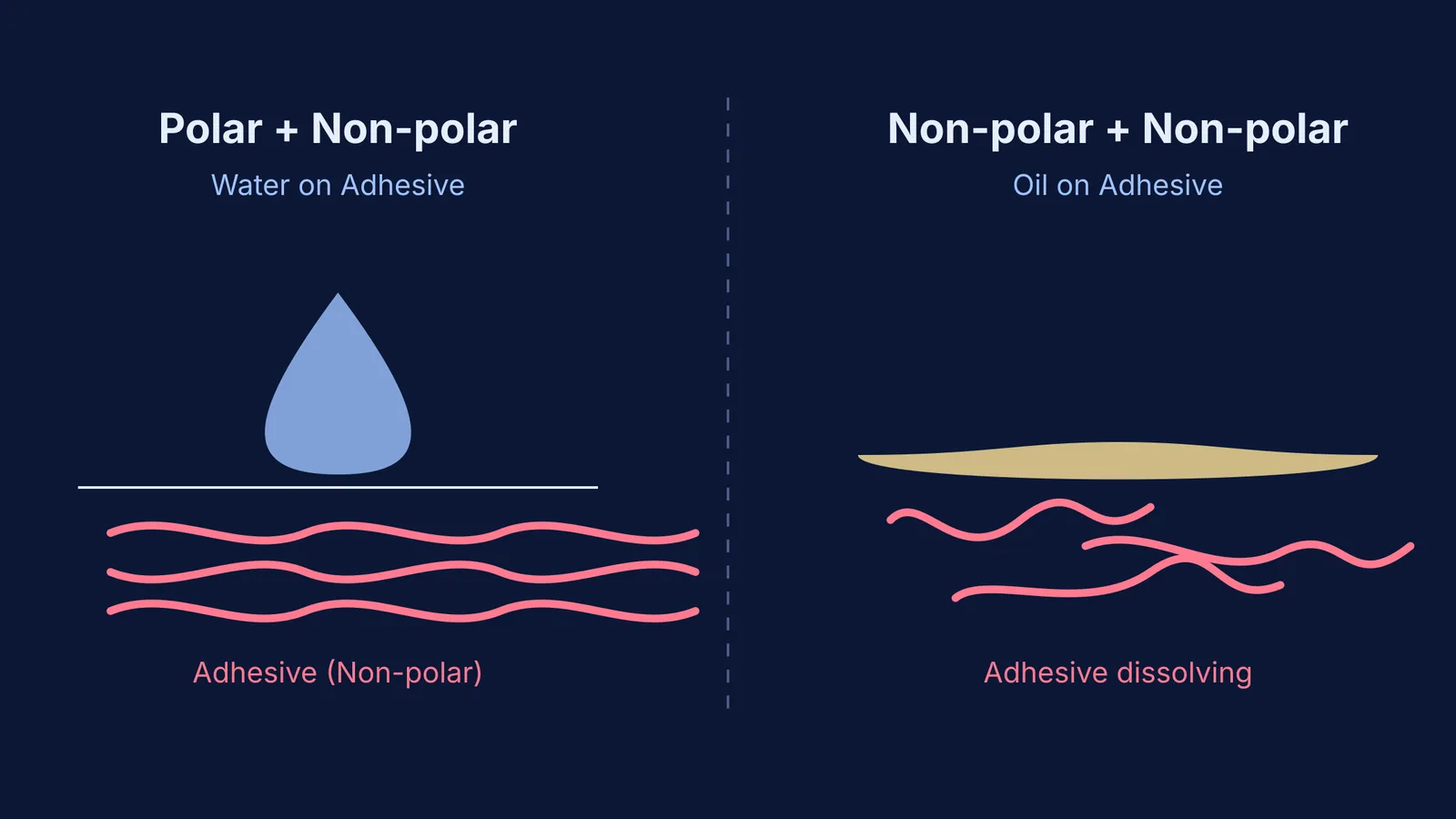
When you apply a wet sponge to a non-polar sticker residue, the water molecules are far more attracted to each other than to the glue. The water simply beads up and rolls off, unable to penetrate or break the chemical bonds holding the adhesive to the surface. It is like trying to mix magnets with wooden blocks; the magnets will just clump together and ignore the wood.
Why does oil remove sticker residue?
The secret to removing the glue lies in the "like dissolves like" principle, a core concept in chemistry (DOI: 10.1021/ed054p228.2). This rule states that polar solvents dissolve polar solutes, and non-polar solvents dissolve non-polar solutes.
Cooking oils (like canola or olive oil) and mineral oils are made of long hydrocarbon chains. Just like the sticker adhesive, these oils are non-polar.
When you apply oil to the residue, the non-polar oil molecules mingle freely with the non-polar adhesive polymers. Because they share similar intermolecular forces, the oil wedges itself between the tangled rubber chains, disrupting the weak van der Waals forces holding them together. Over a few minutes, the adhesive loses its grip on the surface and dissolves into the oil, turning into a slippery liquid that you can easily wipe away.
If you struggle to picture how polar and non-polar molecules interact, the Fermi Simulation Lab has interactive simulations for the ideas that are easier to see than to read.
A practical plan for removing residue
To use this chemistry in your kitchen, you do not need expensive commercial solvents. A simple, step-by-step approach works best:
Apply a non-polar solvent: Coat the sticky residue with a generous drop of vegetable oil, baby oil, or even peanut butter.
Give it time: Wait a few minutes. The oil needs time to diffuse into the polymer matrix and weaken the bonds.
Wipe it away: Use a paper towel to wipe off the dissolved glue. It should slide off without resistance.
Bridge the gap: You will now have a greasy oil spot left behind. Use a drop of dish soap—which has both a polar end and a non-polar end—to surround the oil in micelles and wash it away with water.