

On this page
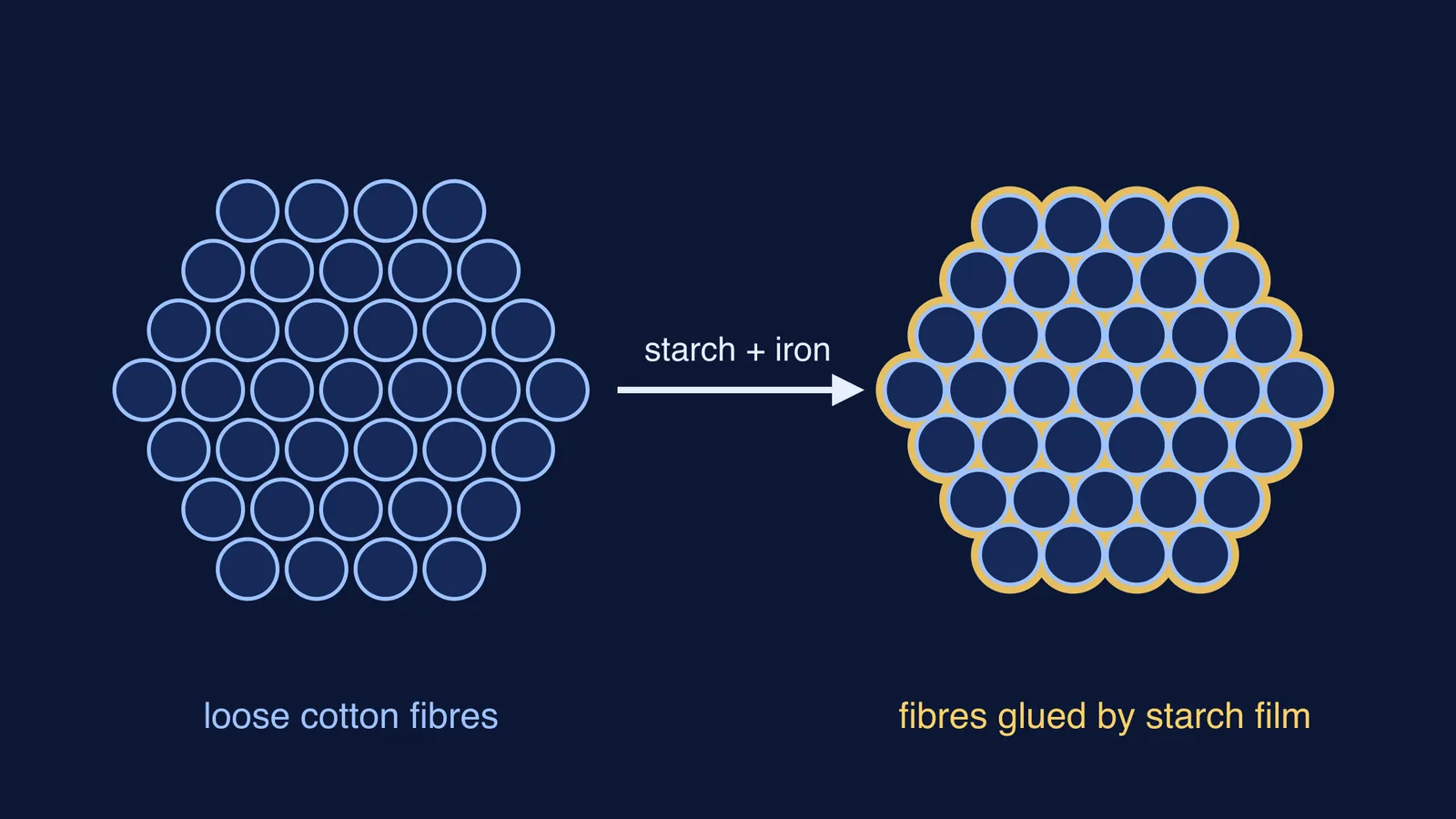
A starched cotton kurta or school shirt stands up on its own because every fibre in it has been glued to its neighbours by a thin coat of dried starch. The fibres can no longer slide past each other, so the cloth stops draping. The explanation needs three syllabus ideas: carbohydrates, polymers and hydrogen bonds.
Why does starch make clothes stiff and crisp?
Start with the cloth. Cotton, linen and hemp are made mostly of cellulose, a long chain of glucose units, and each glucose unit can stick to neighbouring chains through hydrogen bonds, as chemist Mark Lorch of the University of Hull explains in The Conversation. Those same bonds hold creases in place, which is why a cotton shirt wrinkles so easily.
Starch is also a polymer of glucose, so it can form the same sticky hydrogen bonds. Lorch describes starch on cloth as acting like scaffolding that holds the cellulose molecules in place. The textile industry uses this too: an IIT Delhi course on NPTEL notes that starch bonds well to cotton because both are polymers of glucose. It also says starch forms a smooth, even coat on yarn, but that the film is very stiff.
That stiffness is the point. Each fibre ends up in a hard shell, and where two fibres touch, their shells merge, so bending the cloth means bending every glued joint at once.
What happens to starch when it is cooked and ironed?
Raw starch powder stirred into cold water does very little, because starch sits in tight granules. Heating opens them up. According to this overview of starch gelatinisation, some native starches start swelling at 55 °C and others at 85 °C; water gets into the granule, it swells, and amylose molecules leak out into the water. The same leaking explains why rice water turns thick and cloudy when you cook rice.
A Procter & Gamble patent on starch-based fabric conditioners describes the laundry version: starch swells and dissolves at 50 to 75 °C, forming a hydrophilic film that binds to the cellulose fibres, and the crispness comes through after heat such as steam ironing or tumble drying. The iron does two jobs. Its heat and steam loosen the cotton's own hydrogen bonds so the fibres lie flat (we explain this step in why ironing removes creases from cotton), and then it drives off the water so the starch film dries hard around fibres that are already flat.
Why do some starches stiffen cloth more than others?
Starch is not one molecule but two. Amylose is a straight chain of glucose units joined C1 to C4, while amylopectin is branched, according to this LibreTexts chemistry chapter on starch. Straight chains can line up and pack closely, which helps explain why amylose tends to make tougher films than branched amylopectin.
A 2019 study in the journal Polymers by Domene-López and colleagues (doi:10.3390/polym11071084) made films from four starches and found their strength depended on amylose content, molecular weight and crystallinity. Wheat starch (24.5% amylose) and corn starch (24.8%) gave the most resistant, least stretchable films, while rice starch (16.9%) gave the most stretchable, weakest ones. Their films had glycerol added and were not ironed onto cloth, but the result fits the idea that amylose-rich starches make harder films.
How do you explain it in an exam answer?
If a question asks why starching makes cloth stiff, build the answer as a chain of four links:
Cotton is cellulose, a glucose polymer whose chains are held together by hydrogen bonds.
Heating starch in water makes the granules swell and release amylose (gelatinisation).
The starch solution coats the fibres; starch is also a glucose polymer, so it hydrogen-bonds to the cellulose.
Ironing removes the water, and the dried film locks neighbouring fibres together, so the cloth resists bending.
A home experiment: does cooking the starch matter?
You can test link 2 with three old cotton handkerchiefs and two spoons of cornflour.
Handkerchief A: dip in plain water.
Handkerchief B: dip in cornflour stirred into cold water.
Handkerchief C: dip in cornflour that an adult has heated in water until it turns clear and thick, then cooled until warm.
Wring out each one, iron it dry, and lay it on a table with half hanging over the edge. Measure how far the free edge droops, in centimetres, with a ruler. If gelatinisation matters, C should droop least, though the hot iron may cook some of B's starch too. Write your prediction down first.
Polymer chains and fibre bundles are hard to picture from a textbook diagram. The Fermi Simulation Lab has interactive simulations for ideas that are easier to see than to read. To revise amylose, amylopectin and cellulose side by side, the Fermi Concept Library gives each concept its own lesson and its place in the map.
For the next step, read why glucose dissolves in water but starch does not, which uses the same chains to answer a different question.


