

On this page
Watch a squirrel run along a thin branch, or along a cable above a busy Indian street, and its tail is never still. The tail is a balancing tool, a mid-air steering device and a flag, and each job links to school ideas: centre of gravity, angular momentum and adaptation.
What does a squirrel's tail do on a branch?
On a narrow branch, an animal stays up only while its centre of gravity stays over the support. Researchers filmed Siberian chipmunks, which belong to the squirrel family, running on a branch 2 cm across. They found that the turning effects (torques) about the centre of mass usually did not cancel within one stride, and concluded that the animals may balance them out over two or more strides (Lammers and Zurcher, Zoology, 2011). The same researchers proposed that the tail might act as a counterweight that keeps the animal's weight over the branch (SICB conference abstract).
Squirrels also pick take-off points with care: fox squirrels on the UC Berkeley campus weighed branch bendiness against gap width, and none of them fell during the experiments (Hunt and colleagues, Science, 2021; Berkeley News).
Is a squirrel's tail heavy enough to be a counterweight?
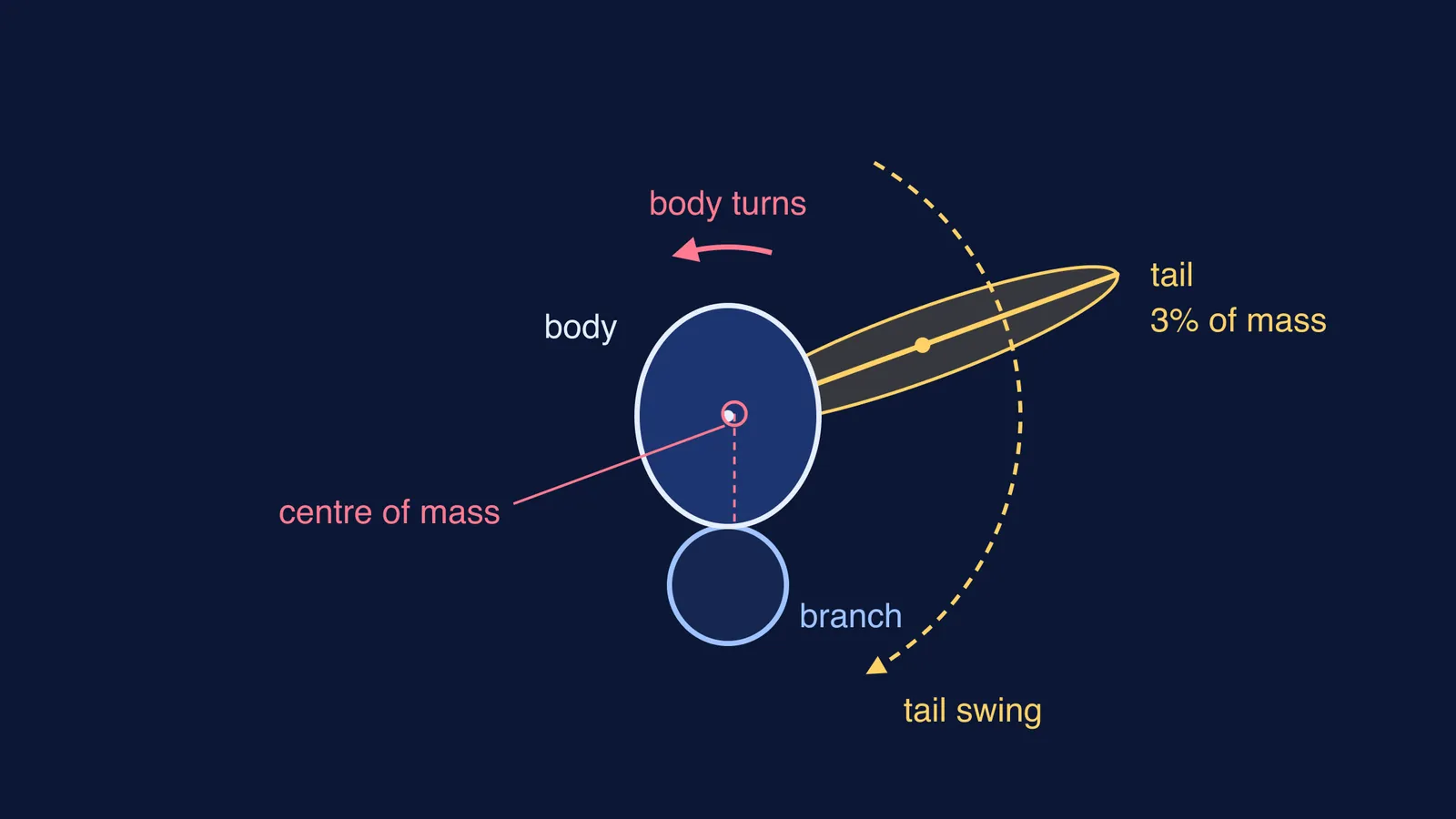
In the squirrel model used in a 2021 study of falls, the tail was 3.3% of body mass but 91% of body length (Fukushima and colleagues, Integrative and Comparative Biology, 2021). Here is what that means, worked out (see the diagram above):
Treat the tail as a uniform rod 0.91 L long, where L is body length. Its own centre of mass sits about 0.46 L from the base.
Swing the tail straight out sideways. The whole animal's centre of mass moves by 0.033 × 0.46 L, which is about 0.015 L.
For a body 20 cm long (an illustrative figure), the shift is about 3 mm.
So as a dead weight, the tail does little. Its real strength is rotation. Because its small mass is spread a long way from the base, the same paper calculated that the tail's moment of inertia about its base is 25% of the torso's (Fukushima and colleagues, 2021). Flick the tail one way and, because angular momentum is conserved, the body turns the other way. Mass spread far from an axis also explains why tightrope walkers carry a long pole.
You can find a centre of gravity by hand with the plumb line method for an irregular lamina. Angular momentum is harder to picture from a page; the Fermi Simulation Lab has interactive simulations for ideas that are easier to see than to read.
How does a squirrel use its tail when it falls?
Fukushima and colleagues analysed a widely shared video in which squirrels were flung off a track by a catapult (Integrative and Comparative Biology, 2021). The squirrels started tumbling at more than 1,080° per second. They first used the tail to help hold the head steady so the eyes could fix on a landing spot, then rotated the tail to steady the body, spinning it several times in less than one second. The team built a squirrel-like robot with a tail to test this strategy.
What about the tail as a parachute? The same paper notes that bushy fur makes the tail's side-on area reach around 55% of the body's size during jumps, which may add a noticeable aerodynamic effect that studies rarely take into account. So the parachute idea is plausible, but the turning effect is what scientists have tested more directly.
Why do squirrels wave their tails at predators?
The tail is also a signal. California ground squirrels wave, or flag, their tails at snakes, and when the snake is a rattlesnake, which senses heat, they also warm the tail; with gopher snakes, which cannot sense infrared, they flag without the extra heat (Rundus and colleagues, PNAS, 2007). When the researchers added heat to a robot squirrel's tail flag, rattlesnakes shifted further from hunting towards defending themselves.
Grey squirrels watch each other's tails too. Shown a robot squirrel, wild grey squirrels reacted most to a tail flag plus an alarm bark, and urban squirrels responded more to tail flags than rural ones (Partan and colleagues, Current Zoology, 2010).
How can you use the squirrel's tail in an exam answer?
A strong adaptation answer links a structure to a job and a reason. Use this frame for any adaptation, from a squirrel's tail to a lizard dropping its tail:
Structure: what is it? (A long, light, bushy tail.)
Principle: what physics or behaviour makes it work? (Large moment of inertia for its mass; a visible moving signal.)
Advantage: how does it help survival? (Safer landings after a slip or fall; warning predators and other squirrels.)
Try the physics at home: sit on a swivel chair with your feet off the floor, hold a heavy book at arm's length and swing it sharply to one side. The chair turns the other way. If a concept such as moment of inertia still feels shaky, the Fermi Concept Library gives each concept its own lesson and its place in the map.


