

On this page
Before you read on, make a prediction. A walker on a wire carries a long, heavy pole. Does the extra weight make them tip over faster, or does the pole slow the tipping down? Write your answer down, with one sentence saying why. Then check it against the physics below.
Why do tightrope walkers carry a long pole?
The pole makes the walker harder to rotate. On a wire, a walker who leans sideways starts to rotate about the rope, like an upside-down pendulum. Gravity supplies the torque that turns a small lean into a fall.
Moment of inertia measures how hard something is to spin, and for a point mass it is I = mr², where r is the distance from the axis (HyperPhysics). For a thin rod turning about its centre, it is I = ML²/12, so doubling the length makes it four times larger (HyperPhysics).
A University of Kentucky physics answer sheet puts the result simply: the beam increases the moment of inertia, so for the same torque the walker "will tip slower" and has "more time" to adjust (University of Kentucky, PHY 211). A similar question appears in Giancoli's *Physics: Principles with Applications*, and the solution rests on α = τ/I: more inertia, less angular acceleration for the same torque (Vaia solution to Giancoli 8-13Q).
Does a long pole make you tip faster or slower?
Slower. Let us put numbers on it. Philippe Petit walked between the Twin Towers on 7 August 1974, and Biography.com describes his balancing pole as 50 pounds and 26 feet long (Biography.com). That is about 23 kg and 7.9 m.
Here is a worked example. Model the walker as a 65 kg mass whose centre of mass sits 1.0 m above the wire, and assume they hold the pole level at the same height. This is a deliberately simple model, so treat the answers as a comparison rather than a measurement.
Without the pole: I = 65 × 1.0² = 65 kg m². The torque per unit of lean is proportional to 65 × 1.0, so the lean grows at a rate set by g/h = 9.8 per second squared.
With the pole: the pole adds 23 × 7.9²/12 ≈ 120 kg m² about its own centre, plus 23 × 1.0² = 23 kg m² for its height above the wire (the parallel axis theorem). Total I ≈ 208 kg m², more than three times the original.
The pole also adds torque, because its 23 kg also leans. The torque grows by about 35% (from 65 to 88 units), while the inertia roughly triples.
The net result: the rate falls from 9.8 to about 4.2 per second squared. Starting from rest, a small lean grows as θ = θ₀ cosh(ωt), with ω = √rate.
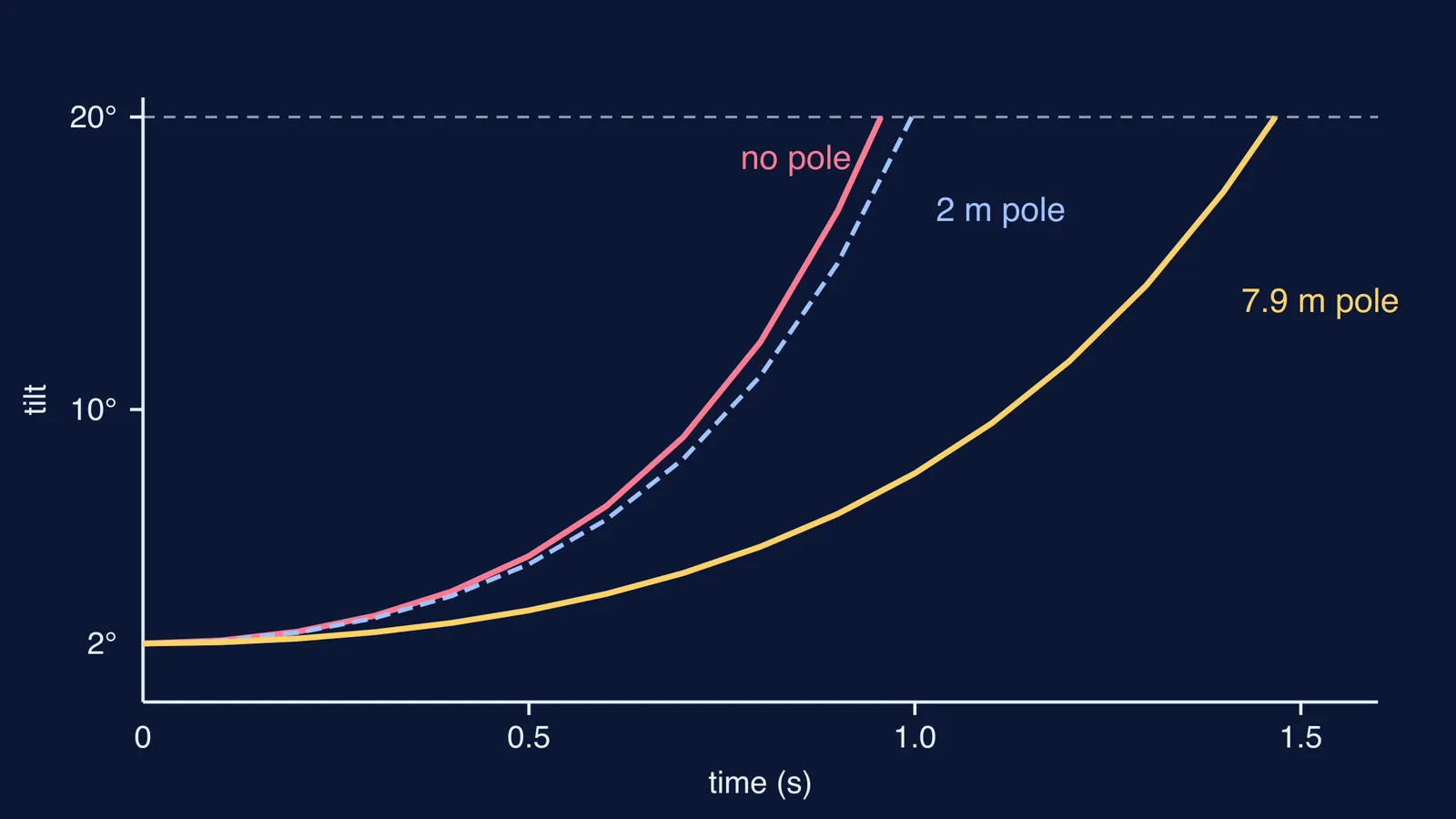
Going from a 2° wobble to a 20° lean takes about 0.96 s without the pole and about 1.47 s with it.
That extra half second matters. In this model the walker has roughly 50% more time to notice the lean and fix it. If you want to revise the theorem used in step 2, our post on moment of inertia and the axis theorems works through it.
Why does the length of the pole matter more than its weight?
Run the same sum with a 23 kg pole that is only 2 m long. Its own term is 23 × 2²/12 ≈ 8 kg m², so the total I is about 96 kg m². The torque is the same 88 units as before, so the rate comes out near 9.0 per second squared, and the 2° to 20° fall takes about 1.0 s. A short, heavy pole barely helps: it adds almost as much torque as inertia.
How can you test this yourself?
You do not need a wire. Try this with a friend and a stopwatch.
Draw a straight line on the floor. Stand on it on one foot, arms folded, and time how long you last before your other foot touches down.
Repeat holding a broom level across your body, gripped near its middle.
Repeat holding a short ruler with your hands close together.
Do five trials of each, in mixed order, and compare the averages. Write your prediction before trial one.
Mixing the order matters because you get better with practice. If the physics holds, the broom should help more than the ruler.
Real walkers do more than carry a pole. A model by Paoletti and Mahadevan at Harvard treats balancing on a rope as a control problem in which the body both drives and responds to the rope, and finds an optimal rope sag where balancing takes the least effort (Journal of the Royal Society Interface, 2012).
To practise predicting how torque turns into rotation, read our post on learning torque and rotation with a simulation, or explore more ideas that are easier to see than to read in the Fermi Simulation Lab.


