

On this page
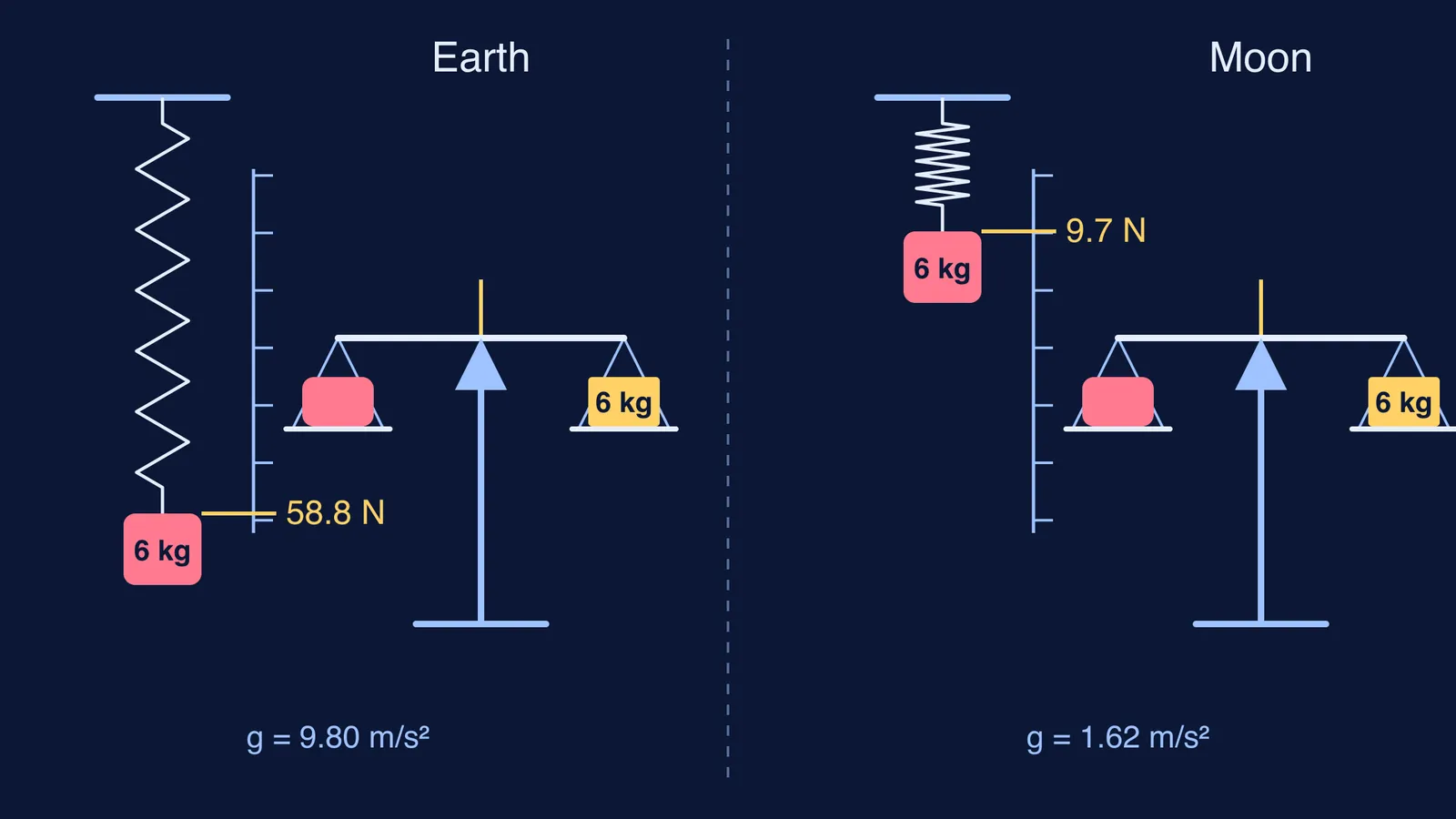
Hang a bag of rice from the spring balance at a kirana shop and the pointer says 6 kg. Take the same balance and the same bag to the Moon, and the pointer stops near 1 kg. Nobody has taken any rice out of the bag. What changed is how hard gravity pulls on it, and that pull is what a spring balance measures.
Does a spring balance measure mass or weight?
Weight. The US National Institute of Standards and Technology defines the two separately: mass measures how much matter a body contains, and weight is the force exerted on it by gravity, measured in newtons.
Weight is written as w = mg, where m is mass and g is the acceleration due to gravity, and the mass of an object is the same on Earth, in orbit or on the Moon (OpenStax University Physics, section 5.4).
A spring balance works by Hooke's law: the spring stretches in proportion to the force on it. Hang an object and the spring stretches until its upward pull equals the object's weight. So the stretch tells you mg, not m.
So why does the shop balance say kilograms? The maker divided the force by Earth's g when printing the scale. A University of Illinois physicist answering Ask the Van put it plainly: on a different planet, a spring scale gives the wrong kilogram reading but the right newton reading.
Why does a spring balance read less on the Moon?
NASA's Moon fact sheet gives the Moon's surface gravity as 1.62 m/s², against 9.80 m/s² on Earth, a ratio of 0.165, or about one-sixth.
Here is the 6 kg bag of rice, worked out with those numbers:
On Earth, the weight is W = 6 × 9.80 = 58.8 N. The spring stretches to the 58.8 N mark, and the kilogram scale, printed for Earth, shows 6 kg.
On the Moon, the weight is W = 6 × 1.62 = 9.72 N. The spring stretches only 0.165 times as far.
The kilogram scale still assumes g = 9.80 m/s², so it shows 9.72 ÷ 9.80, about 0.99 kg.
The mass is still 6 kg. Only the force changed.
Gravity varies slightly on Earth too, which is why you weigh a little more at the poles than at the equator. Digital kitchen and bathroom scales belong to the same family: a digital weighing scale measures weight, a force, and converts it to kilograms.
Why does a beam balance read the same on the Moon?
A beam balance has no spring. It compares two weights: rice on one pan, standard masses on the other, the beam pivoted at its middle.
The beam is level when the turning effects on both sides are equal: m₁ × g × d = m₂ × g × d, where d is the arm length. The same g sits on both sides and cancels, leaving m₁ = m₂. On the Moon, gravity is about one-sixth of Earth's on both pans alike, so the same 6 kg of standard masses still balances the rice. The Illinois answer says the same: a balance-type scale gives the right kilogram reading on another planet.
The same reasoning works in a lift that is speeding up as it goes up. A spring balance reads m(g + a), more than the true weight, but a beam balance stays level, because both pans feel the same extra push.
For the bigger picture, read why you weigh less on the Moon but your mass stays the same.
How do you answer mass-or-weight questions without slipping?
Exam questions change the place and test what stays fixed. Run this checklist:
Ask what the instrument does. If something stretches or compresses, it measures force, so weight. If it compares the object with standard masses, it measures mass.
Check the unit. Weight is in newtons, mass in kilograms. A kilogram reading on a spring balance is converted, not measured.
Change g, keep m. Wherever you are, m stays the same and only mg changes.
For a spring balance marked in kilograms, the new reading = true mass × (local g ÷ Earth's g). For the rice on the Moon, with NASA's ratio of 0.165: 6 × 0.165 ≈ 1 kg.
For a beam balance, ask whether both pans feel the same g. If they do, the reading does not change.
If you keep mixing up m and mg partway through a numerical, the Fermi Problem Library has worked problems with a step-by-step solver that explains the reasoning rather than printing an answer. To go back over the definitions first, the Fermi Concept Library gives each physics concept its own lesson.
Next time you pass a shop scale, ask yourself what it would read on the Moon, and why.


