

On this page
Your mass is the same everywhere on Earth. Your weight, the force a spring scale feels, is not. Stand on a bathroom scale at the North Pole and then at the equator, and the second reading will be lower. Two separate effects cause this, and exam questions often test whether you can keep them apart.
How much does g change from the equator to the poles?
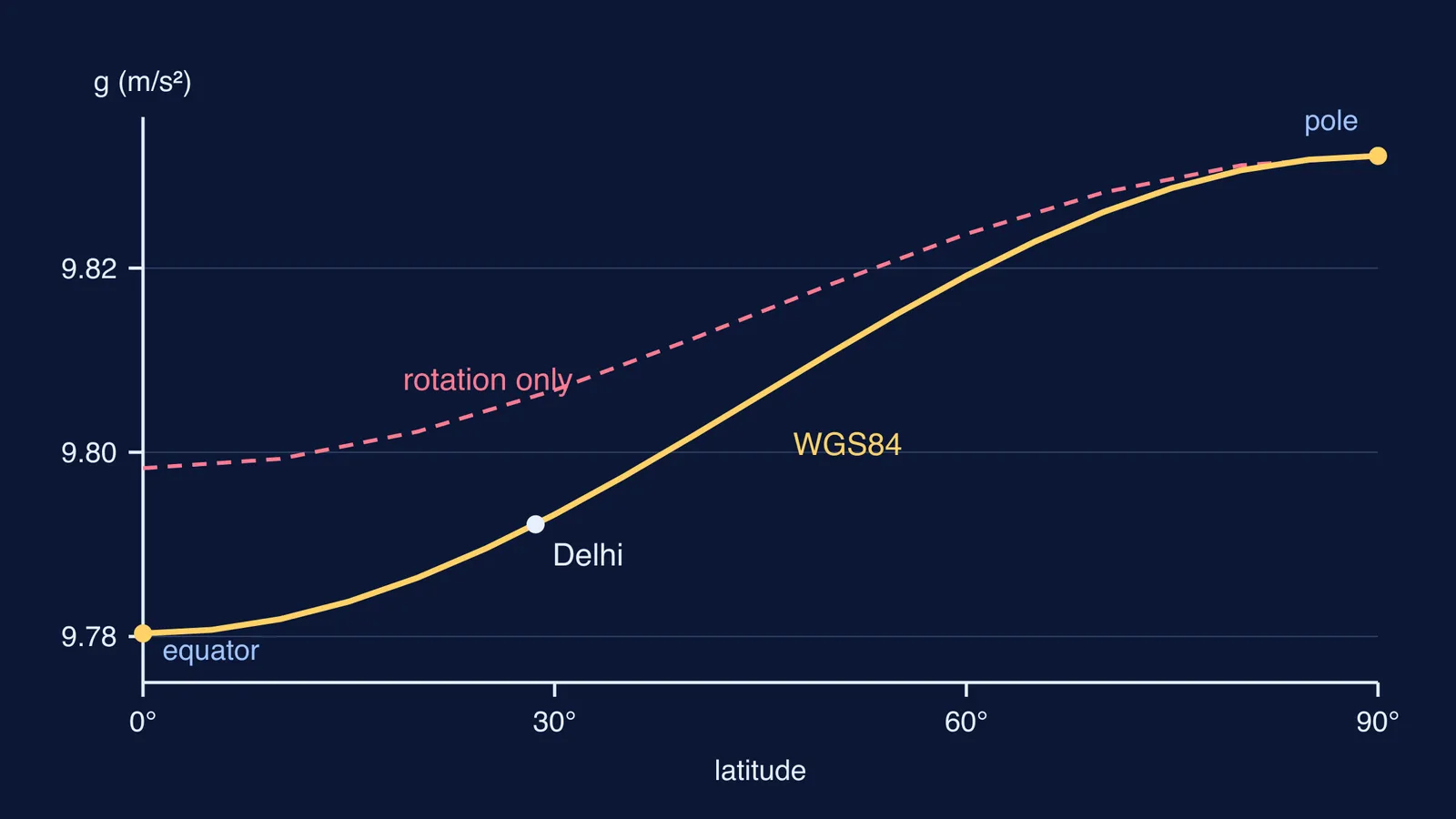
NASA's Earth fact sheet lists the surface acceleration due to gravity as 9.780 m/s² at the equator and 9.832 m/s² at the poles. That is a difference of 0.052 m/s², or about 0.53% of g.
The same fact sheet gives Earth's equatorial radius as 6378.137 km and its polar radius as 6356.752 km. So the equator sits about 21 km farther from Earth's centre than the poles do.
Geodesists use a standard formula for how g changes with latitude. The WGS84 normal gravity formula, set out on the theoretical gravity reference page, runs from 9.7803 m/s² at the equator to 9.8322 m/s² at the poles. The graph at the top of this post is drawn from that formula.
Why does Earth's rotation reduce weight at the equator?
A point on the equator moves in a big circle once every sidereal day, which NASA's fact sheet puts at 23.9345 hours. Moving in a circle needs a net inward (centripetal) force. Some of gravity's pull goes into keeping you on that circle, so less of it presses you into the scale.
In the rotating frame, the usual JEE way to say this is that a centrifugal term ω²R cos²λ is subtracted from g, where λ is the latitude. At the equator cos λ = 1, so the full amount is subtracted. At the poles cos λ = 0, so nothing is subtracted, because you are only turning on the spot. If the two names confuse you, our explainer on centripetal vs centrifugal force separates them.
Why does Earth's flattened shape matter too?
Earth is also slightly flattened, bulging at the equator. NASA gives the flattening as 0.003353 on the same fact sheet. At the equator you stand farther from the centre, so gravity's pull is a little weaker there before rotation is even counted.
The theoretical gravity reference page splits the 0.53% drop into two parts. About 0.18% comes from mass attraction (the shape effect), and about 0.35% comes from rotation. That makes rotation roughly twice as large as shape.
For a fuller picture of how height and depth also change g, read our post on variation of g with height, depth and Earth's rotation.
Worked example: how much lighter are you at the equator?
Work this through with the NASA values from the Earth fact sheet: ω = 2π / (23.9345 × 3600 s) and R = 6378.137 km.
Angular speed: ω = 2π / 86,164 s ≈ 7.29 × 10⁻⁵ rad/s.
Rotation term at the equator: ω²R ≈ (7.29 × 10⁻⁵)² × 6.378 × 10⁶ ≈ 0.0339 m/s².
Compare with the total gap: 9.832 − 9.780 = 0.052 m/s². Rotation explains about 0.034 of it, roughly two-thirds. The remaining 0.018 m/s² or so is the shape effect.
Weight of a 60 kg student: 60 × 9.832 ≈ 589.9 N at the pole and 60 × 9.780 ≈ 586.8 N at the equator, a difference of about 3.1 N.
On a spring scale set to read 60 kg at the pole, the equator reading would be 60 × 9.780 / 9.832 ≈ 59.68 kg, about 320 g less.
For India, put Delhi's latitude (about 28.6° N) into the WGS84 formula above and you get a sea-level value of g ≈ 9.792 m/s². That sits between the two extremes, as the graph shows.
What mistakes do students make in these questions?
Saying mass changes. It does not. Only weight, mg, changes.
Using cos λ instead of cos²λ. One factor of cos λ gives the radius of your circle, and the second gives the part of the centrifugal term that points along the vertical.
Measuring λ from the pole instead of the equator. Latitude is 0° at the equator.
Forgetting the shape effect when a question asks why g differs, not just how much rotation changes it. Mention both.
Using 24 hours instead of the sidereal day. In most exam answers this makes almost no difference, but know which one you are using.
If you want to go further, try the latitude problem in effective g at latitude due to Earth's rotation. If a step like cos²λ still feels shaky, the Fermi Concept Library gives each physics concept its own lesson and shows where it sits in the map. Fermi's AI tutor can draw the figure and check your understanding as you go, so you can see why the pole and the equator behave differently.


