

On this page
Toss a big bunch of palak into a hot kadhai and it soon slumps into something that fits in a katori. Most of the leaf is still there. What has gone is the structure that held it up.
Why does a big bunch of spinach shrink when cooked?
A raw spinach leaf is stiff because each cell works like a water balloon inside a box. The box is the cell wall; the balloon is the cell membrane, wrapped around a large, watery vacuole.
Vacuoles occupy up to 90% of the volume of plant cells, according to a 2019 review of plant vacuoles in the journal Plants. Water in the cell pushes outward against the wall, and that pressure, called turgor, makes the leaf crisp. Our explainer on turgor pressure and why plants wilt covers this in more detail.
Heat breaks the balloon. A review by Maria Gonzalez and Diane Barrett in the Journal of Food Science notes that plant cell membranes are significantly altered by heat, and explains why keeping the cell's compartments separate matters for the quality of fruit and vegetables. Once the membrane leaks, the cell can no longer hold pressure against its wall.
Studies of blanched carrots point the same way. Paciulli and colleagues, studying cooked carrots, describe blanching causing a loss of turgor pressure and softening, linked to changes in pectin, the glue between neighbouring cells. Water seeps out of the cells, some of it steams away, and the limp leaves fold onto each other.
Where does all that volume actually go?
Leaves are full of air. Intercellular air spaces can form up to 70% of a leaf's volume, according to an article in PLOS Biology on how leaves make these spaces. The largest spaces sit in the spongy mesophyll on the underside of the leaf, where they help gases move in and out.
When the cells go soft, these spaces get squashed or flooded with the water the cells release. A pile of raw leaves also traps air between leaves, because stiff leaves do not lie flat. Cooked leaves do.
USDA FoodData Central lists raw spinach at 91.4 g of water per 100 g, with one cup weighing 30 g. It lists boiled, drained spinach at 91.21 g of water per 100 g, with one cup weighing 180 g.
The share of water barely changes, yet a cup holds six times the mass. For boiled spinach, these numbers suggest the shrinking is mostly lost air and lost stiffness, not a leaf that has dried out. Sauteing can drive off more water as steam.
How much does a bunch of spinach cook down to?
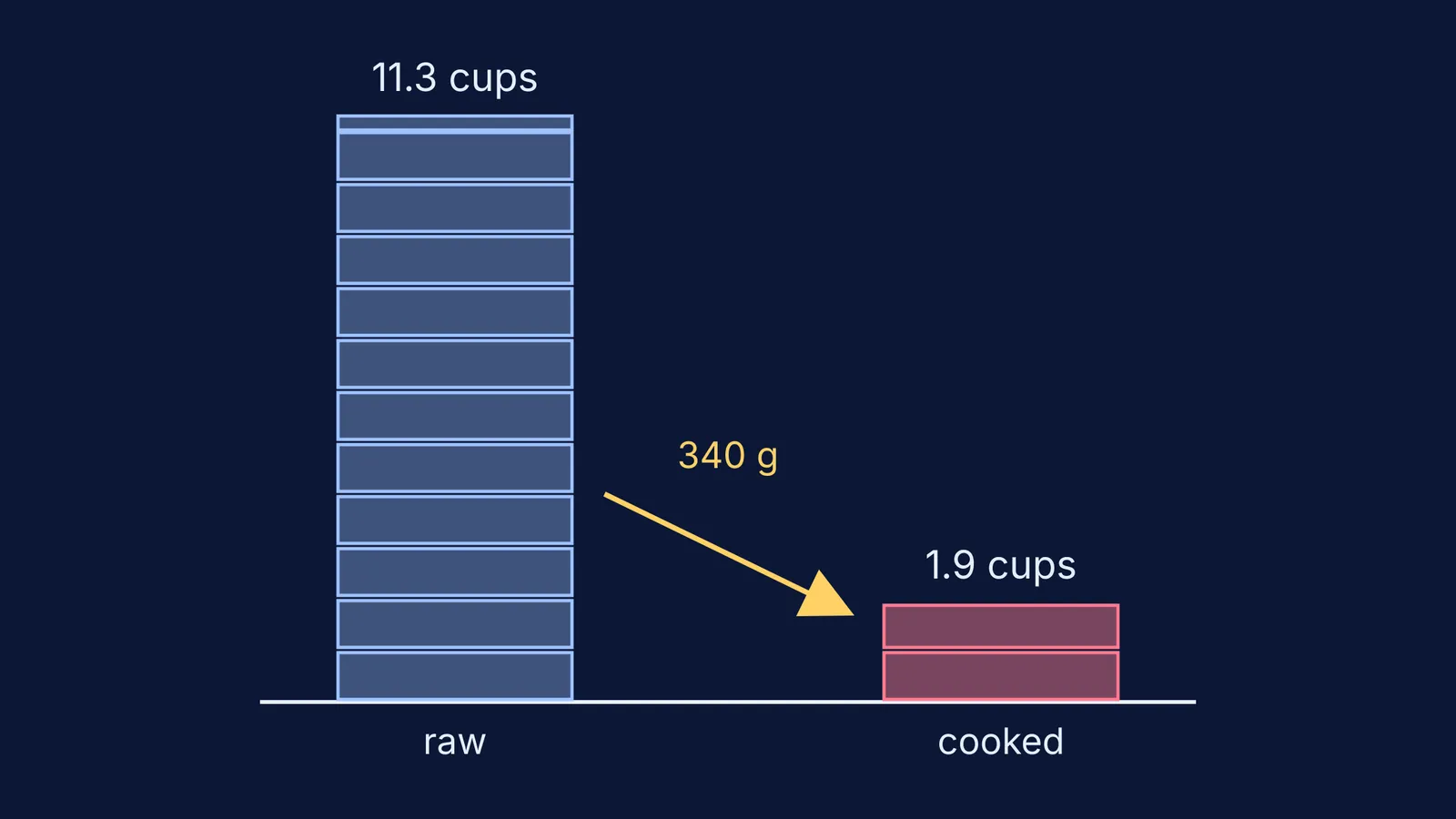
Here is a worked example using the same USDA record for raw spinach, which gives one bunch as 340 g, and the USDA record for boiled spinach.
One bunch of raw spinach weighs about 340 g.
At 30 g per cup raw, that is 340 / 30, or about 11.3 cups of leaves.
At 180 g per cup cooked, the same 340 g fills 340 / 180, or about 1.9 cups.
So the volume falls to about one-sixth (30 / 180), even if no mass is lost at all.
Bunches in an Indian market vary in size, so weigh yours rather than trusting the USDA figure.
How can you test this in your kitchen?
Write your prediction down first, then collect your own data.
Weigh a handful of raw spinach on a kitchen scale and note the mass.
Pack it loosely into a steel glass or measuring cup and note how full it is.
Wilt it in a covered pan with a spoon of water until it collapses.
Drain it, let it cool, then weigh it and measure its volume the same way.
Work out two ratios: cooked mass divided by raw mass, and cooked volume divided by raw volume.
If your volume ratio is far smaller than your mass ratio, air and lost stiffness explain most of the shrinkage, just as the USDA numbers suggest. If both ratios are small, you drove off a lot of water too.
What does this have to do with your biology syllabus?
Spinach in a pan is a revision card for the cell chapter. The wall gives shape, but only a working membrane keeps water and pressure in, as our post on how the cell wall and cell membrane differ explains. It shows why the vacuole matters, which you can revise in what the tonoplast and plant vacuole do. And it shows turgor at work, the same idea behind a wilting plant.
If a cell losing pressure is hard to picture, the Fermi Simulation Lab has interactive simulations for ideas that are easier to see than to read. For the definitions themselves, the Fermi Concept Library gives every concept in biology its own lesson.
Next time the palak collapses, weigh it before and after.


