

On this page
The light turns green and the old bus ahead of you puffs out black smoke, while the car beside it pulls away clean. The difference is a Class 10 chemistry lesson playing out inside an engine.
Why do some diesel vehicles give out black smoke?
The Queensland Government's guide to smoky vehicles says black smoke "typically results from incompletely burnt diesel fuel" (Queensland Government).
An engine lecture in India's NPTEL programme is more precise: visible black smoke comes from a high concentration of soot in the exhaust gas, and smoke rises with engine load because the overall fuel-air mixture becomes richer (NPTEL, Diesel Smoke). The black cloud is carbon from the fuel that never got enough oxygen to become carbon dioxide.
The air shortage need not be engine-wide, because diesel is sprayed in and does not mix evenly. NPTEL describes a model from laser imaging studies at Sandia Laboratories: soot first forms in fuel-rich regions of the spray, with two to four times the fuel the local air can burn, and is burnt away at the spray's edges (NPTEL, soot formation). Black smoke appears when too much of that soot survives.
What does this have to do with incomplete combustion in Class 10?
NCERT's Class 10 chapter Carbon and its Compounds says that limiting the supply of air "results in incomplete combustion of even saturated hydrocarbons giving a sooty flame" (NCERT Science, Chapter 4). It adds that blackened cooking vessels mean the stove's air holes are blocked and fuel is being wasted. A smoky diesel engine is the same story at higher pressure: the soot that blackens a pan is the soot that darkens the exhaust.
If you want to revisit the flame side of this, read why a gas stove flame is blue but a candle flame is yellow and why unsaturated hydrocarbons burn with a sooty flame.
A worked example: how much air does diesel fuel need?
Take hexadecane, C16H34, also called cetane, the reference fuel that is assigned 100 on diesel's cetane scale (Thermo Fisher product note). Its complete combustion is:
C16H34 + 24.5 O2 → 16 CO2 + 17 H2O
Dry air is 20.95% oxygen by volume (NASA Earth Fact Sheet). So one mole of fuel needs 24.5 ÷ 0.2095 ≈ 117 moles of air to burn completely.
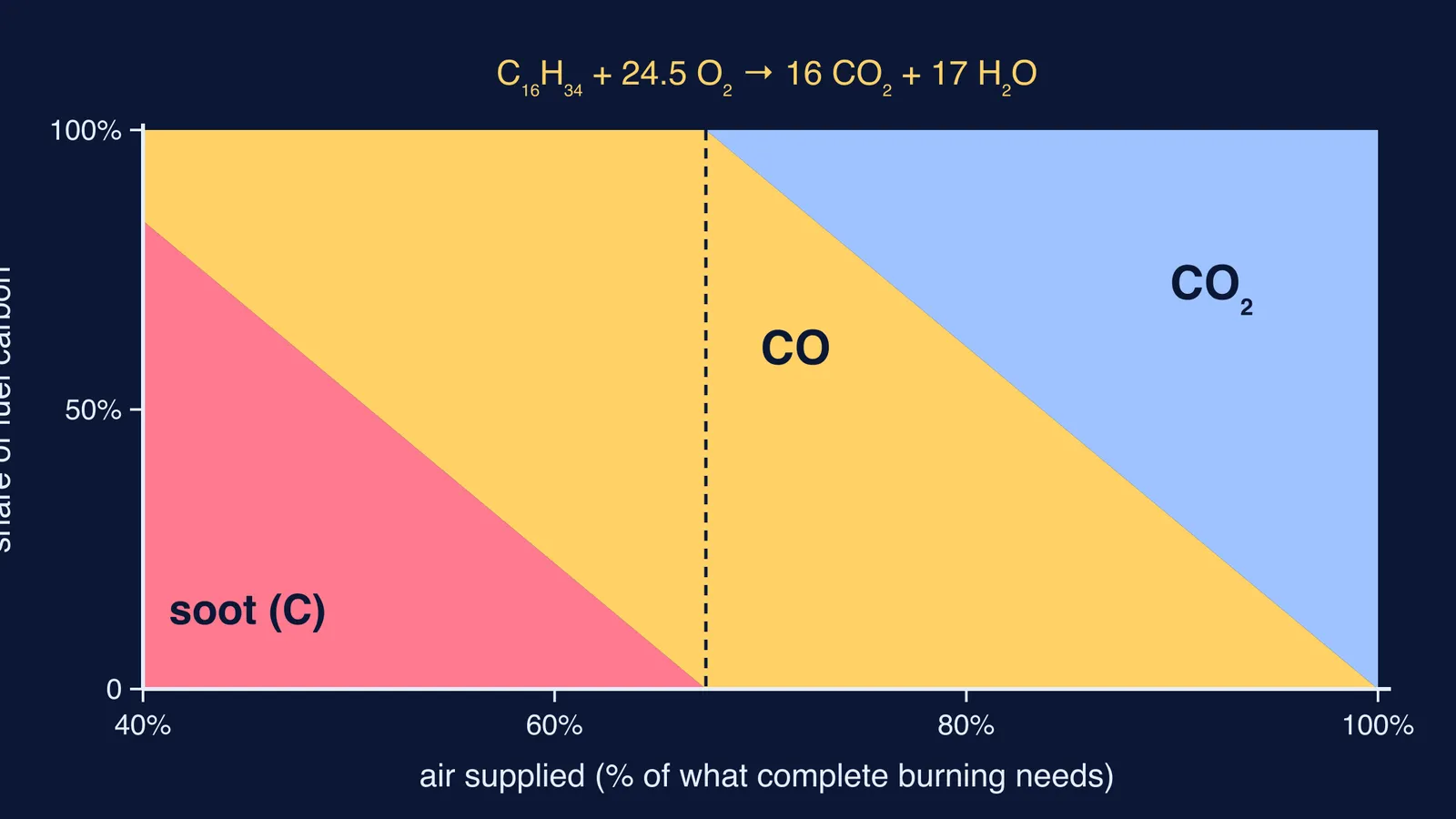
Now starve it of air. Use a simple bookkeeping rule: the hydrogen takes its oxygen first (17 H2O needs 8.5 O2), then the carbon becomes CO, and only leftover oxygen turns CO into CO2.
100% of the air: 24.5 O2. All 16 carbons leave as CO2.
75% of the air: 18.4 O2. After water, 9.9 O2 remain. Turning all 16 carbons into CO uses 8, and the last 1.9 O2 makes about 3.8 CO2. Roughly 12 of the 16 carbons leave as carbon monoxide, which you cannot see.
60% of the air: 14.7 O2. After water, only 6.2 O2 remain, enough to turn 12.4 carbons into CO. The other 3.6 carbons, between a fifth and a quarter, have no oxygen at all and leave as soot.
As air runs short, CO2 first gives way to invisible CO, and only then does carbon come out as soot. Real engines are messier, but the direction is right.
If the shift from blue flame to sooty flame is easier to see than to read, the Fermi Simulation Lab has interactive simulations for ideas like this one.
What makes an engine run short of air?
The Queensland guide lists faults that can cause smoky exhaust (Queensland Government). Several match the chemistry directly:
A blocked air cleaner lets in less air, so the mixture turns rich.
Incorrectly set or damaged fuel injectors or pumps can push in more fuel than the air can burn.
Damaged turbochargers, which push in extra air, are listed too, as are worn piston rings and cylinder bores.
Even well-maintained vehicles may smoke under maximum power or heavy loads, and NPTEL adds that poor injection control during acceleration raises smoke (NPTEL, Diesel Smoke).
For why diesel engines light their fuel by squeezing air rather than with a spark, see why diesel engines do not need spark plugs.
Is black smoke harmful, and what can a family do?
In 2012 the International Agency for Research on Cancer, part of WHO, classified diesel engine exhaust as carcinogenic to humans (Group 1), finding it a cause of lung cancer (IARC press release).
A simple plan if your family's vehicle smokes:
Time it. Queensland's guide says smoke that lasts continuously for 10 seconds or more means something is wrong and needs fixing as soon as possible.
Ask a mechanic about the air filter and injectors, the two causes that match the chemistry most directly.
Avoid overloading and flooring the accelerator from a standstill.
If balancing combustion equations still feels shaky, the Fermi Concept Library has a lesson for every concept in chemistry.


