

On this page
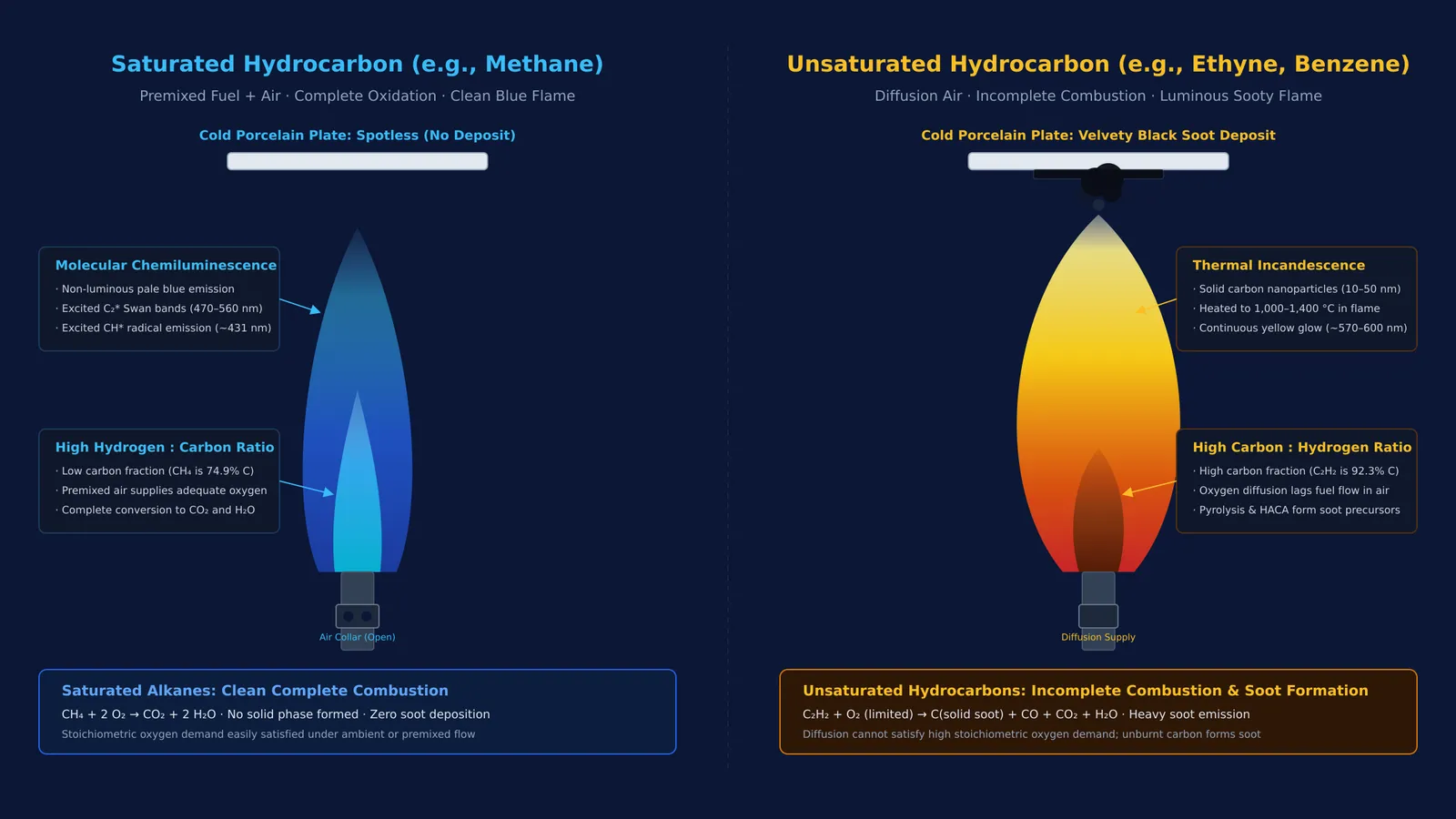
If you hold a cold porcelain plate over a burning candle or a dish of benzene, a velvety coat of black soot forms within seconds. Above a well-ventilated gas stove or an open-valved Bunsen burner, the identical plate remains spotless above a blue flame. This classic demonstration illustrates the chemical divide between saturated and unsaturated combustion.
Why does carbon content change how a hydrocarbon burns?
The difference begins with carbon density. Saturated hydrocarbons contain only single carbon-carbon bonds. In methane (CH4), carbon accounts for 74.87% of molecular mass, with a relative molecular weight of 16.0425 amu recorded in the NIST Chemistry WebBook. In ethane (C2H6) and propane (C3H8), carbon represents 79.89% and 81.71% of total mass.
Unsaturated hydrocarbons contain double or triple bonds. In ethene (C2H4), carbon comprises 85.63% of mass, while in ethyne (acetylene, C2H2), it reaches 92.26% with a molecular weight of 26.0373 amu in the NIST Chemistry WebBook. Benzene (C6H6) likewise contains 92.26% carbon.
Complete combustion converts all carbon to carbon dioxide (CO2) and hydrogen to water:
CxHy + (x + y/4) O2 → x CO2 + (y/2) H2O
Because ambient air contains roughly 21% oxygen, natural diffusion cannot deliver oxygen fast enough to satisfy the heavy stoichiometric demand of carbon-dense unsaturated fuels. For homologous series formulas, see our carbon compounds guide for Class 10.
How does incomplete combustion create soot particles?
When oxygen diffusion lags behind fuel flow, hydrocarbon molecules inside the flame core undergo rapid pyrolysis—heat-induced bond cleavage in an oxygen-starved zone.
In Physical Chemistry Chemical Physics (2002), Michael Frenklach showed that pyrolysed unsaturated fragments assemble into soot via the HACA mechanism (Hydrogen-Abstraction-C2H2-Addition). Fuel radicals lose hydrogen and repeatedly add acetylene units, forming polycyclic aromatic hydrocarbons (PAHs) that coagulate into solid carbon nanoparticles measuring 10 to 50 nanometers.
In laminar diffusion flames, A. Gomez and Irvin Glassman demonstrated in the Symposium (International) on Combustion (1988)80339-4) that unsaturated and aromatic fuels form soot far faster than saturated alkanes. Heated to 1,000 °C to 1,400 °C, these solid carbon particles glow intensely via thermal incandescence, emitting yellow light (570 to 600 nm) before escaping as soot. Read our guide to reactions of alkanes, alkenes, alkynes, and benzene to see how saturation alters chemical pathways.
Why is complete combustion flame blue instead of yellow?
Saturated alkanes oxidize fully without forming polycyclic aromatic rings or solid carbon nanoparticles. Without solid soot particles to glow, there is no yellow thermal incandescence; the pale blue emission comes from molecular chemiluminescence.
In *The Spectroscopy of Flames*, Alfred Gordon Gaydon showed in Springer (1974) that blue emission arises from excited radicals formed during oxidation. Excited dicarbon (C2*) emits green-blue light across the Swan bands (470 to 560 nm), discovered by William Swan in the Transactions of the Royal Society of Edinburgh (1857), while excited methylidyne (CH*) emits near 431 nm. To practice balancing combustion equations, work through exercises in the Fermi Problem Library, where a step-by-step solver explains the underlying chemical reasoning.
Can saturated hydrocarbons ever burn with a yellow flame?
Flame color depends on oxygen access, not fuel structure alone. In Annalen der Physik und Chemie (1857), Robert Bunsen and Henry Enfield Roscoe showed that opening the air collar of a burner premixes gas with air before ignition, ensuring complete oxidation with a sootless blue flame. Closing the collar starves the flame of premixed oxygen, forcing methane to pyrolyse and burn with a luminous, sooty yellow flame.
Conversely, unsaturated fuels burn blue when supplied with pure oxygen. In ambient air, ethyne produces thick black soot. When mixed with pure compressed oxygen in a welding torch, ethyne achieves complete combustion with a clean blue flame exceeding 3,100 °C, as documented by Alfred Gordon Gaydon in *The Spectroscopy of Flames* (1974). Explore burner physics in our guide to flame zones and fuel combustion fundamentals.
How can you diagnose and predict flame behaviour?
Use this four-step diagnostic framework to evaluate flame behavior in laboratory practicals and exams:
Compare the carbon-to-hydrogen ratio. Unsaturated fuels like alkenes, alkynes, and aromatics carry a higher proportion of carbon by mass than saturated alkanes, creating an intrinsic tendency to form soot in open air.
Check oxygen premixing. Diffusion flames in open air face oxygen diffusion limits, whereas premixed burners draw adequate oxygen before ignition.
Identify the emission mechanism. Pale blue flames signify molecular chemiluminescence from excited C2* and CH* radicals; bright yellow flames indicate thermal incandescence from solid soot.
Test for particulate carbon. Holding a cool metal spatula over the flame tip collects black soot if combustion remains incomplete.
When preparing for Class 10 board exams or competitive tests like JEE, students can review reaction mechanisms in the Fermi Concept Library. If you are analyzing why a reaction produces unexpected soot, Fermi's AI tutor can work out what you already know and build a plan for the session, helping you reason through the underlying chemistry.


